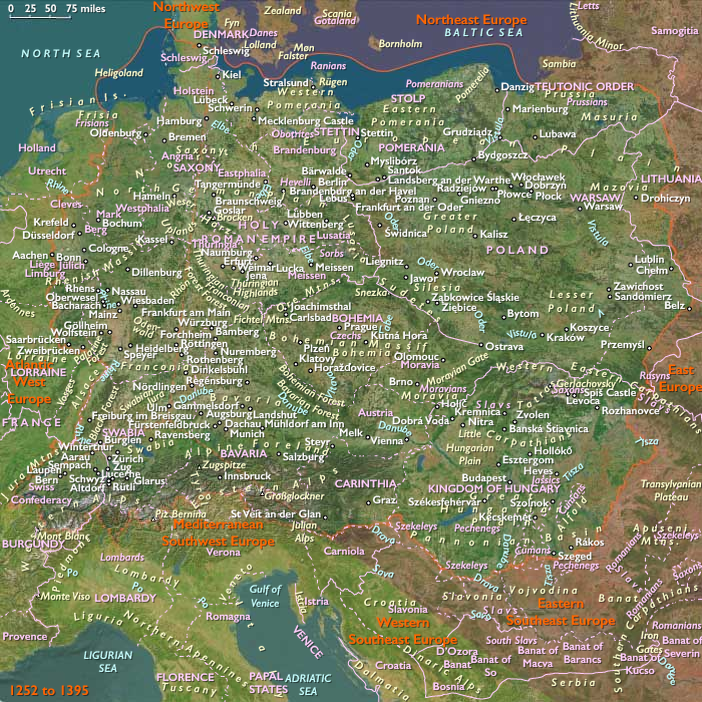
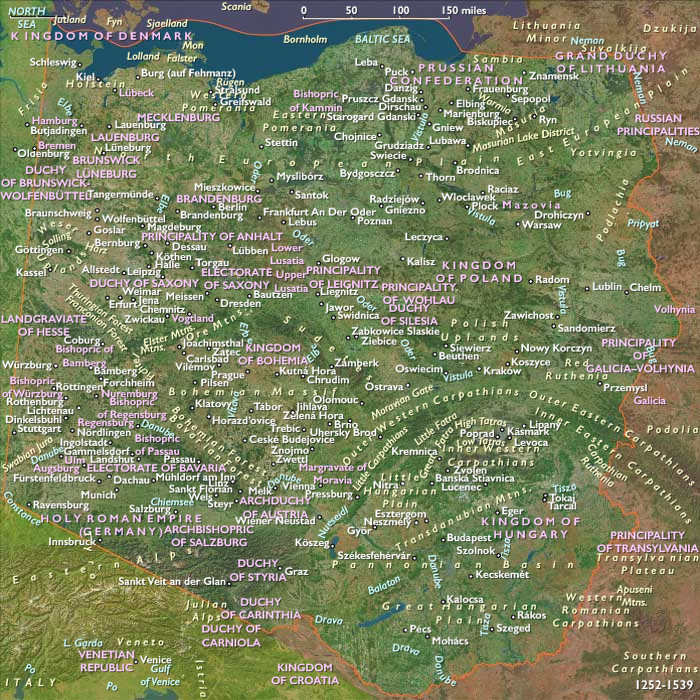
The partition of the Wittelsbach lands, being …
Years: 1257 - 1257
The partition of the Wittelsbach lands, being against Imperial law, causes the anger of the bishops in Bavaria, who ally themselves with King Ottakar II of Bohemia.
Ottokar invades Bavaria in August 1257, but Dukes Louis and Henry, in one of the rare harmonious actions of the two brothers, who often argue, manage to repulse the attack.
Locations
People
Groups
- Germans
- Czechs [formerly Bohemians] (West Slavs)
- Welf, House of
- Palatinate of the Rhine, County
- Bohemia, Kingdom of
- Holy Roman Empire
- Bavaria, Upper, Duchy of
- Bavaria, Lower, Duchy of
Topics
Commodoties
Subjects
Regions
Subregions
Related Events
Filter results
Showing 10 events out of 46117 total
Mongol ruler Kublai Khan, seeking to gain control of the spice routes that pass along the coast of Dai Viet, or Annam, dispatches a Mongol army south into Dai Viet and Champa.
The Mongol forces, meeting with little opposition, travel down the Red River to plunder Hanoi in 1257.
Low German-speaking colonists from the Holy Roman Empire had begun in the 1230s to settle north and south of the Warta and Noteć Rivers upon the initiative of Pomeranian and Polish lords.
The lords have invited members of the Knights Templar and Knights Hospitaller to establish monasteries, in whose surroundings settlements have begun to develop.
To fortify the borderland Pomeranian and Polish dukes built castles in the north, around which settlements have also grown.
Most of the colonists who settle in Brandenburg's new eastern territory come from Magdeburg or the Altmark ("Old March").
Unlike in the rest of Brandenburg, where the Ascanians have settled knights in open villages, the margraves have begun constructing castles in their land east of the Oder to guard against Poland.
The Slavic inhabitants of the region are becoming gradually Germanized.
Through land purchases, marriage pacts, and services to Poland's Piast dynasty, the Ascanians have extended their territory eastward to the Drawa River and northward to the Parsęta River.
To safeguard the region, Margrave John I founds the town of Landsberg an der Warthe in 1257.
Boleslaw V, son of the assassinated Leszek the White, Prince of Sandomierz, succeeds his brother Przemyzl in 1257 to become prince in Kraków, and thus the predominant prince in fragmented Poland, though the authority of the Duke of Kraków is not adequately defined by law and is ignored in actual practice.
Bolesaw had earlier married Cunegunda (Kinga), daughter of King Béla IV of Hungary. (According to medieval chronicles, the marriage, entered into with reluctance on the bride’s part, was never consummated. Kinga, being extremely pious, was averse to fulfilling her marital duties. At first Boleslaw tried to change her mind, but she demurred and he reluctantly accepted the situation. His religious convictions forbade him to take a mistress. Hence the epithet, "the Chaste" or "the Shy. Kinga’s reign as queen is marked by such charitable works as visiting the poor and helping the lepers.)
Kraków, almost entirely destroyed during the Tatar invasions of 1241, has been rebuilt by Boleslaw on a regular grid pattern and is incorporated in 1257, based on the Magdeburg law, with tax benefits and trade privileges for its citizens, who are mainly German immigrants.
Concurrent with the metamorphosis in the structure of the Polish state and sovereignty had been an economic and social impoverishment of the country.
Harassed by civil strife and foreign invasions, like that of the Mongols in 1241, the small principalities had become enfeebled and depopulated.
The attendant decrease in the incomes of the princes led them to encourage immigration from foreign countries.
A great number of German peasants, who, during the interregnum following the death of Frederick II, had suffered great oppression at the hands of their lords, are induced to settle in Poland under highly favorable conditions.
Thus, alongside the Polish "grody" have come into existence a large number of towns, with German laws, customs and institutions.
The ancient towns of Kraków, Lwów, Poznań, Plock and others having received a large influx of Germans, the resettled cities come to be regarded by the metropolitan towns in Germany as their branches and as outposts of German trade and civilization in Poland.
The common law of the country is supplanted by the Magdeburg and Halle law, German silver coins become the money of the country, and all municipal records begin to be kept in the German language.
But for the Mongol invasion, Polish towns would have developed without foreign interference and the cities' populations would have remained mainly Polish.

Aristocratic factions fight for control of the Bulgarian throne from 1257.
The Cumans, sensing weakness, begin annual raids, the Greeks of Nicaea retake parts of the Second Bulgarian Empire's territory, and the Magyars again advance.
Hulagu has probably always intended to take Baghdad, which the Mongols have been meaning to attack for over ten years, but he uses the caliph's refusal to send troops to him as a pretext for conquest, since his brother the Great Khan has ordered him to be merciful to those who submit.
The Mongol army sets out for Baghdad in November of 1257, led by Hulagu and the Han Chinese commander Guo Kan in vice-command.
The latter had participated in the final drive in the conquest of the Jin Dynasty, including the capture of Kaifeng, and may have served in the European campaign with Subutai a few years following the fall of the Jin Dynasty.
By order of Mongke Khan, one in ten fighting men in the entire empire have been gathered for Hulagu's army, probably the largest ever fielded by the Mongols.
The attacking army also has a large contingent of Christian forces levied from tributary states.
By the time that the Mongols reach Baghdad, their army includes even some Frankish forces from the Principality of Antioch, whose prince, Bohemond VI, had on the advice of his father-in, law, Hethum of Little Armenia, submitted to Mongol overlordship.
The main Christian force seems to have been the Georgians, who are to take a very active role in the destruction to follow.
Also, Ata al-Mulk Juvayni describes Cicilian Armenians, Persians, and Turks as participants in the siege, together with about one thousand Chinese artillery experts.
Rocket technology had first become known to Europeans following their use by the Mongols Genghis Khan and Ögedei Khan when they conquered parts of Russia, Eastern, and Central Europe.
The Mongolians had acquired the Chinese technology by conquest of the northern part of China and also by the subsequent employment of Chinese rocketry experts as mercenaries for the Mongol military.
Reports of the Battle of Sejo in the year 1241 describe the use of rocket-like weapons by the Mongols against the Magyars.
They appear in literature describing the capture of Baghdad in 1258 by the Mongols.
Venetian admiral Lorenzo Tiepolo breaks through Acre's harbor chain in 1257 and destroys several Genoese ships, conquers the disputed property, and destroys Saint Sabas' fortifications.
Despite throwing up a blockade, he is unable to expel from their quarter of the city the Genoese, who are eight hundred men strong and armed with fifty to sixty ballistae; there are also siege engines among the Venetians.
The famed Genoese crossbowmen are also fighting in Acre: the life of the Count of Jaffa is only spared by a chivalrous Genoese consul who has forbidden his crossbowman to shoot the count from his tower.
Pisa and Venice hire men to row their galleys in Acre itself during the siege: the average rate of pay of a Pisan- or Venetian-employed sailor on one of their galleys is ten Saracen besants a day and nine a night.
The blockade has lasted more than a year (perhaps twelve or fourteen months), but because the Hospitaller complex is also near the Genoese quarter, food is brought to them quite simply, even from as far away as from Philip of Montfort in Tyre.
The regent of the kingdom, John of Arsuf, who had initially tried to mediate, in August 1257 confirms a treaty with the city of Ancona, granting it commercial rights in Acre in return for aid of fifty men-at-arms for two years.
Ancona is an ally of Genoa and John seeks by his treaty to bring the feudatories—most of whom are onside—to support Genoa against Venice.
His plan ultimately backfires and John of Jaffa and John II of Beirut "manipulated the complex regency laws" in order to bring the feudatories of the Kingdom of Jerusalem into a position of support for Venice.
In this they have the support of the new bailiff, Plaisance of Cyprus, Bohemond VI of Antioch, and the Knights Templar.
At this juncture, Philip of Montfort, who has been providing food to the Genoese in Acre, is one of Genoa's only supporters.
Philip is staying about a mile away from Acre, in a place called "the new Vigny" (la Vignie Neuve) with "eighty men on horses and three hundred archer-villeins from his land".
Theodore II Laskaris's daughter Maria, betrothed by her grandfather John III Doukas Vatatzes years before, had in October of 1256 been finally married to Nikephoros, son of Michael of Epirus.
As a condition of the marriage, however, Theodore has demanded the town of Servia (in Greece) and the Adriatic seaport of Dyrrhachium (now Durrës, Albania), the most ancient and one of the most economically important cities of Albania, which in 1202 had come under Venetian control.
Michael is enraged at this demand, and …
…war breaks out in 1257.
Michael is determined to expand his state at Nicaea's expense.
While he is advancing towards Thessalonica, however, King Manfred of Sicily seizes Dyrrhachium and its environs.
Michael, resolved to take Thessalonica, comes to terms with Manfred and sends him his daughter Helena as wife, ceding the lost towns and the island of Corfu as dowry.
Alexander IV has fulminated with excommunication and interdict against the party of Manfred, but in vain; nor has he been able to enlist the Kings of England and Norway in a crusade against the Hohenstaufen.
Rome itself becomes too Ghibelline for the Pope, who withdraws in 1257 to …
…Viterbo.
Years: 1257 - 1257
Locations
People
Groups
- Germans
- Czechs [formerly Bohemians] (West Slavs)
- Welf, House of
- Palatinate of the Rhine, County
- Bohemia, Kingdom of
- Holy Roman Empire
- Bavaria, Upper, Duchy of
- Bavaria, Lower, Duchy of