
The earliest known occupation of Britain by …
Years: 857997BCE - 609166BCE
A huge length of time, it sees many changes in the environment, encompassing several glacial and interglacial periods that greatly affect human settlement in the region.
Providing dating for this distant period is difficult and contentious.
The inhabitants of the region at this time are bands of hunter-gatherers who roam northern Europe following herds of animals, or who support themselves by fishing.
Recent (2006) scientific evidence regarding mitochondrial DNA sequences from ancient and modern Europe has shown a distinct pattern for the different time periods sampled in the course of the study.
Despite some limitations regarding sample sizes, the results were found to be non-random.
As such, the results indicate that, in addition to populations in Europe expanding from southern refugia after the last glacial maximum (especially the Franco-Cantabrian region), evidence also exists for various northern refugia.
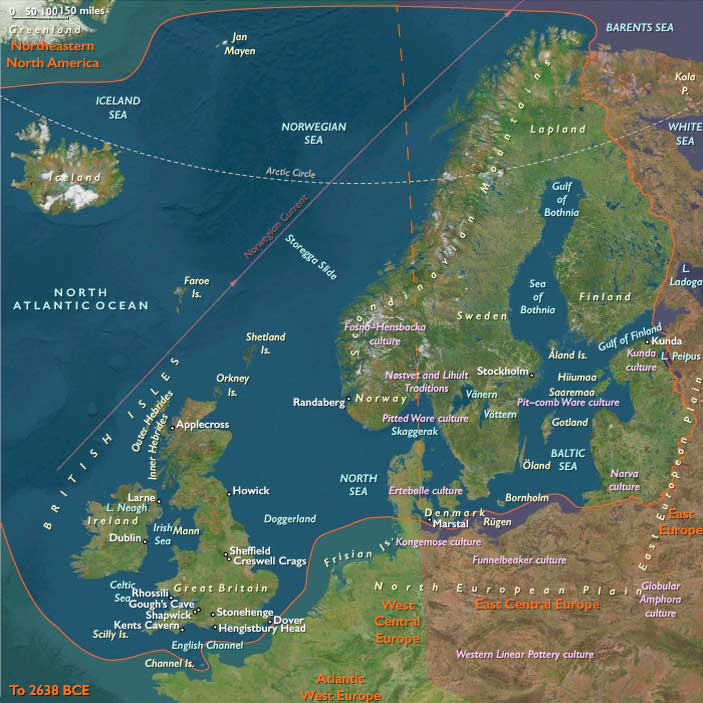
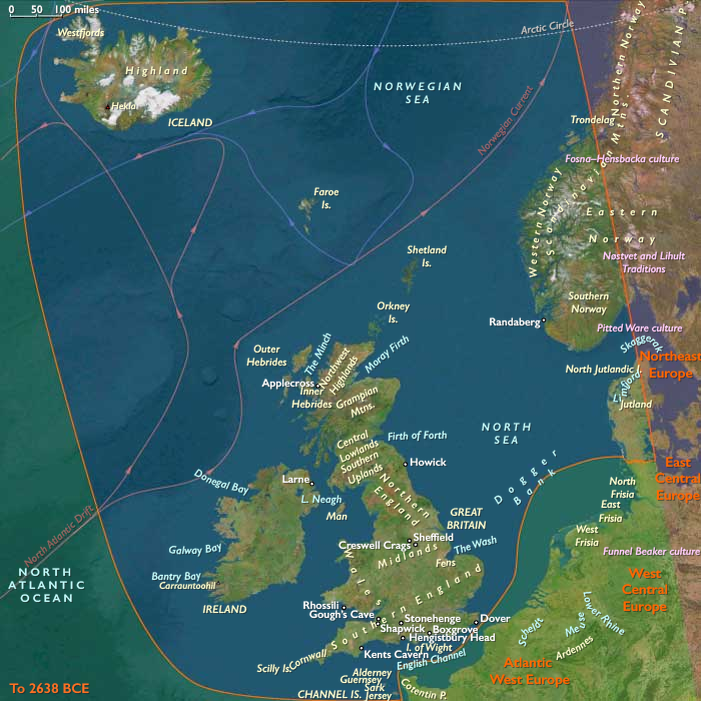
Southern and eastern Britain at this time are linked to continental Europe by a wide land bridge allowing humans to move freely.
The current position of the English Channel is a large river flowing westwards and fed by tributaries that will later become the Thames and Seine.
Reconstructing this ancient environment has provided clues to the route first visitors took to arrive at what was then a peninsula of the Eurasian continent.
There is evidence from bones and flint tools found in coastal deposits near Happisburgh in Norfolk and Pakefield in Suffolk that a species of Homo was present in what is now Britain around seven hundred thousand years ago.
Locations
Topics
Commodoties
Subjects
Regions
Subregions
Years: 857997BCE - 609166BCE
Locations
Topics
Commodoties
Subjects
Regions
Subregions