
The Palace of Whitehall had had no …
Years: 1619 - 1619
November
The Palace of Whitehall had had no designated banqueting house during the reign (1509-47) of Henry VIII of England, the King preferring to banquet in a temporary structure purpose-built in the gardens.
The first permanent banqueting house at Whitehall, built for James I, had been destroyed by fire in January 1619, when workmen, clearing up after New Year's festivities, decided to incinerate the rubbish inside the building.
Its replacement, the Banqueting House, begun in 1619 and designed by Inigo Jones in a style influenced by Palladio, is completed in 1622 at a cost of fifteen thousand six hundred and eighteen pounds.
The grandest and best known survivor of the architectural genre of banqueting house, and the only remaining component of the Palace of Whitehall, the building, classical in concept, introduces a refined Italianate Renaissance style that is unparalleled in the free and picturesque Jacobean architecture of England, where Renaissance motifs are still filtered through the engravings of Flemish Mannerist designers.
The new style will transform English architecture.
Unlike the architecture of the more southern European countries, English architecture has passed through no period of evolution to classicism.
Through Jones, it has arrived suddenly and fully formed.
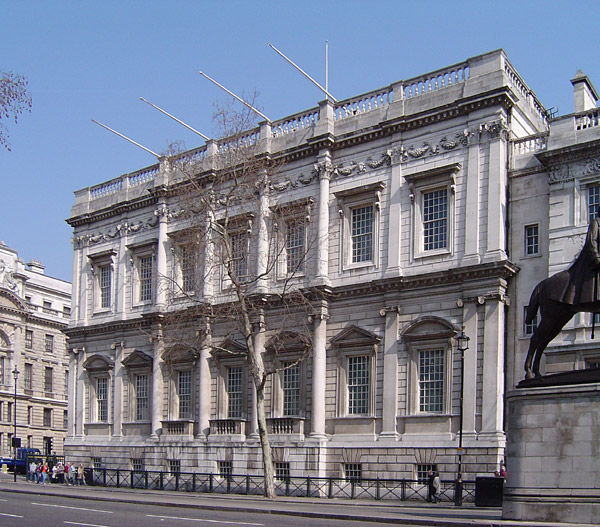
The Banqueting House, Whitehall (Photo by ChrisO, 2004)
Locations
People
Groups
Topics
Subjects
Regions
Subregions
Related Events
Showing 10 events out of 33054 total
Years: 1619 - 1619
November
The Banqueting House, Whitehall (Photo by ChrisO, 2004)
Locations
People
Groups
Topics
Subjects
Regions
Subregions