
The paintings of Wang Meng, a leading …
Years: 1366 - 1366
The paintings of Wang Meng, a leading Chinese landscape master, reflect a distinctively individual approach to the problems of space, form, and tactile quality in compositions of astonishing density, as exemplified in his masterful landscape Dwelling in the Qingbian Mountains, executed in 1366.
Wang Meng is considered to be one of the Four Masters of the Yuan Dynasty, along with Huang Gongwang, Wu Zhen, and Ni Zan.
They had famously refused to serve the Mongolian rulers of their country.
In contrast to many renowned painters in previous history, these artists mostly work on paper instead of silk, an indication of the importance they give to the calligraphic touch of the brush on paper.
They exclusively paint landscapes, which they believe to be the visible key to the invisible reality.
They restrict their acquaintanceship to each other, and like-minded "wen ren" (gentleman-scholars).
Wang Meng is the youngest of the group, and the least famous in his own time.
Nevertheless, his style will greatly influence later Chinese painting.
In contrast to the relatively spare style of his compatriots, his ropy brushstrokes pile one on the other to produce masses of texture combined in dense and involved patterns.
Many artists will be influenced by the works of Wang Meng centuries after his death, most notably Dong Qichang.
His most famous works are the Ge Zhichuan Relocating, Forest Grotto at Juqu, Writing Books under the Pine Trees, The Simple Retreat, and Dwelling in the Qingbian Mountains.
Most of his masterpieces are now located in notable museums around the world, such as the Palace Museum, National Palace Museum, Shanghai Museum, Cleveland Museum of Art and the Metropolitan Museum of Art In 2011, a lesser known work of his from a private collection, titled Zhichuan Resettlement, will be sold for 402.5 million yuan (US$62.1 million) at art auction.
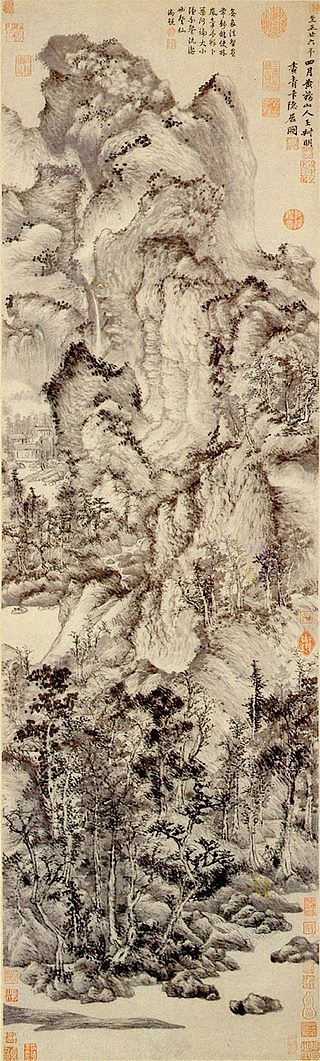
Dwelling in the Qingbian Mountains, Shanghai Museum
Locations
People
Groups
Topics
Subjects
Regions
Subregions
Years: 1366 - 1366
Dwelling in the Qingbian Mountains, Shanghai Museum
Locations
People
Groups
Topics
Subjects
Regions
Subregions