
The painter Orazio Gentileschi had moved to …
Years: 1610 - 1610
The painter Orazio Gentileschi had moved to Rome in the late 1570s or early 1580s and become associated with the landscape-painter Agostino Tassi, executing the figures for the landscape backgrounds of this artist in the Palazzo Rospigliosi, and it is said in the great hall of the Quirinal Palace, although by some authorities the figures in the last-named building are ascribed to Giovanni Lanfranco.
He had worked also in the churches of Santa Maria Maggiore, San Nicola in Carcere, Santa Maria della Pace and San Giovanni in Laterano.
However, Gentileschi's main influence starting from the early seventeenth century is Caravaggio, also in Rome at this time, whose style he is one of the best followers of.
Sharing with the former shadowy characteristics, he has taken part in several adventures in Rome's streets.
Giovanni Baglione had in late August of 1603 filed a suit for libel against Caravaggio, Gentileschi, Ottavio Leoni, and Filipo Trisegni in connection with some unflattering poems circulated among the artistic community of Rome over the preceding summer.
Caravaggio’s testimony during the trial as recorded in court documents is one of the few insights into his thoughts about the subject of art and his contemporaries.
Gentileschi's best works are Saints Cecilia and Valerian, in the Galleria Borghese of Rome; David after the death of Goliath (circa 1610), in the Palazzo Doria, Genoa; and some works in the royal palace, Turin, noticeable for vivid and uncommon coloring.
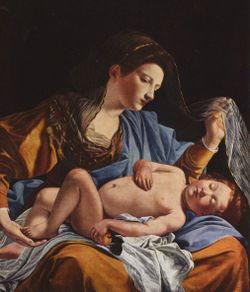
Orazio Gentileschi: Madonna with Child (1610) Oil, 100 × 85 cm, Contini-Bonacossi Collection, Florence
Locations
People
Groups
Topics
Subjects
Regions
Subregions
Years: 1610 - 1610
Orazio Gentileschi: Madonna with Child (1610) Oil, 100 × 85 cm, Contini-Bonacossi Collection, Florence
Locations
People
Groups
Topics
Subjects
Regions
Subregions