
The Oyo capital is moved further south, …
Years: 1837 - 1837
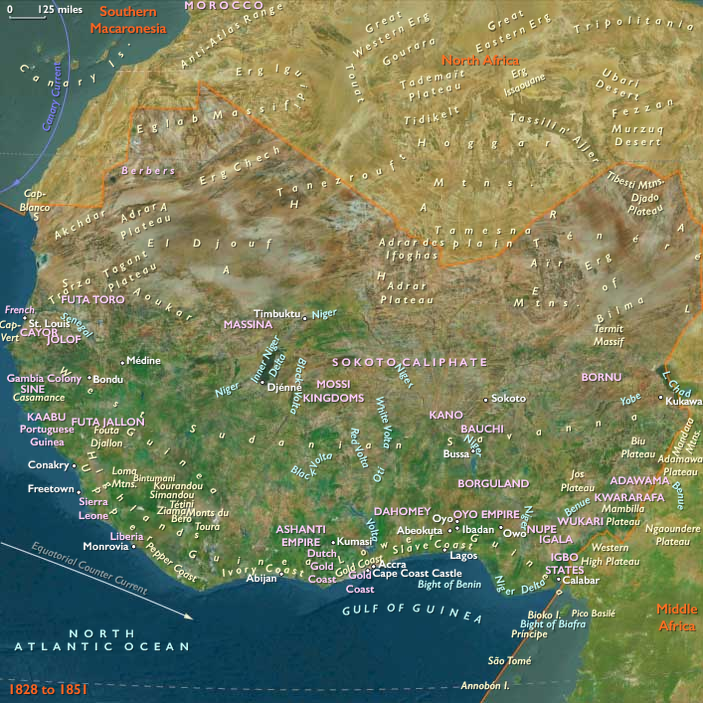
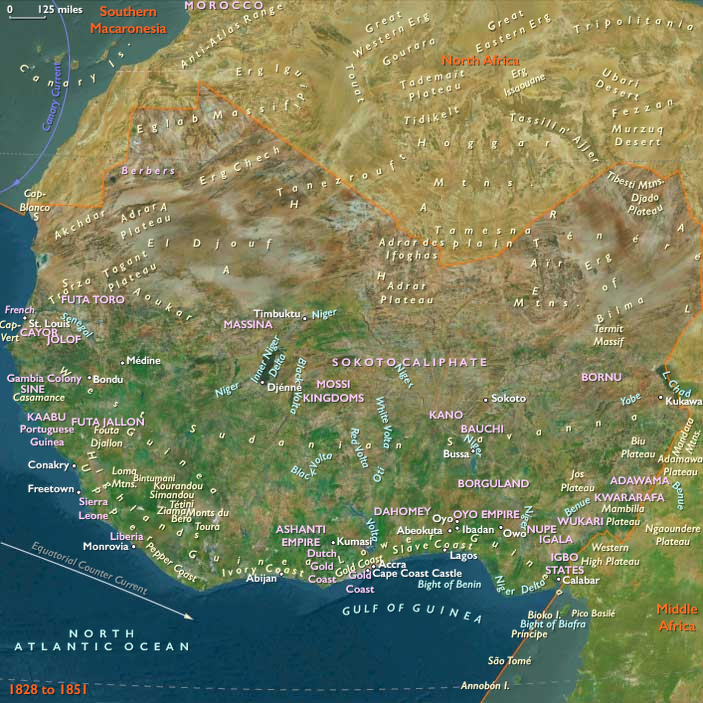
The Oyo capital is moved further south, to Ago d'Oyo, after the destruction of Oyo-Ile.
Alaafin Atiba seeks to preserve what remains of Oyo by placing on Ibadan the duty of protecting the capital from the Ilorin in the north and northeast.
He also attempts to get the Ijaye to protect Oyo from the west against the Dahomeyans.
The center of Yoruba power moves further south to Ibadan, a Yoruba war camp settled by Oyo commanders in 1830.
Oyo will never regain its prominence in the region.
Locations
Groups
Topics
Subjects
Regions
Subregions
Related Events
Filter results
Showing 10 events out of 18351 total
Ewing Young, an American fur trapper and trader, had brought a herd of horses and mules over the Siskiyou Trail from missions in California for sale at British and American settlements in Oregon in 1834.
Although this initial effort had been met with suspicion by Hudson's Bay Company officials in Oregon, Young returns to California in 1837, where he purchases seven hundred head of cattle that he drives over the Siskiyou Trail to Oregon.
This monumental task, requiring nearly three months, helps widen and establish the trail, thereby solidifying the new American settlements in Oregon.
Marcus and Narcissa Whitman set about the business of establishing what in a decade will be several missions.
The name of their settlement, Waiilatpu (Why-ee-lat-poo, the 't' is half silent), means "place of the rye grass" in the Cayuse language.
Located in the Walla Walla Valley, just west of the northern end of the Blue Mountains, near the present day city of Walla Walla, Washington, the settlement is in the territory of both the Cayuse and the Nez Percé tribes.
Marcus farms and provides medical care, while Narcissa sets up a school for the tribes’ children.
A great river is believed to enter the Indian Ocean on the northwest of Australia, and if so, that the country it drains might be suitable for colonization.
British colonial administrator and army lieutenant George Edward Grey, in conjunction with Lieutenant Lushington, offers to explore this country and on July 5, 1837, sails from Plymouth in command of a party of five, the others being Lieutenant Lushington, a surgeon and naturalist named Walker, and two corporals of the royal sappers and miners.
Others are added to the party at Cape Town and early in December they land at Hanover Bay.
The expedition is catastrophically ill prepared—only one man of Grey’s party has seen northern Australia before.
Wrecked, almost drowned, and completely lost, with Grey wounded in a skirmish with Aborigines, they trace the course of the Glenelg River before giving up and retiring to Mauritius to recover.
Hans Christian Anderson had begun writing children’s stories in 1835, publishing the first installment of his immortal Fairy Tales (Danish: Eventyr).
More stories, completing the first volume, had been published in 1836 and 1837.
The quality of these stories is not immediately recognized, and they sell poorly.
At the same time, Andersen has enjoyed more success with two novels: O.T. (1836) and Only a Fiddler.
His specialty book that is still known today is the Ugly Duckling (1837), which, with "Thumbelina" and other tales, demonstrates Andersen's identification with, and his sympathies for, the 'outsider' searching for his or her place in society.
The Little Mermaid, a fairy tale about a young mermaid willing to give up her life in the sea and her identity as a mer-person to gain a human soul and the love of a human prince, is first published in 1837.
It will eventually be adapted to various media including musical theater and animated film.
The Ottoman forces continue to oppose Faisal’s rule.
The Egyptian governor of Arabia, Khurshid Pasha, supports a rival candidate in the person of Khalid ibn Saud ibn Abd al-Aziz.
Khalid, a member of the senior line of the Saud family and a legitimate heir, will soon be revealed as little more than an Egyptian puppet.
Faisal is forced to flee the city and take refuge among his Bedouin allies when Egypt answers Faisal's refusal to pay the tribute by sending an expeditionary force to restore Egyptian rule in Arabia.
Accompanying the Egyptians is Khalid, released from captivity as the ruler designate, on his undertaking to recognize Egyptian control.
The Egyptians enter Riyadh in 1837.
Zanzibar is a valuable property as the main slave market of the East African coast, and becomes an increasingly important part of the Omani empire, a fact reflected by Said bin Sultan’s decision to make it his main place of residence from 1837.
All are deported and some are killed.
With the assistance of tribal fighters from Oman’s Zubara region, Zanzibar nominally annexes the city on June 24.
A British protectorate over Mombasa, represented by governors, had been in place from early 1824 to mid-1826.
Omani rule had been restored in 1826; seven liwalis* had been appointed.
Lying on the Indian Ocean, Mombasa is today the second largest city in Kenya, with a major port and an international airport.
*Wali, in use in some Muslim countries today, is an administrative title that is used during the Ottoman Empire to designate governors of administrative divisions; the division that a Wali governs is called wilayah.
Many frontier farmers, impelled by repeated losses suffered in the Sixth Xhosa War, become Voortrekkers (literally those who move forward) and migrate to new lands in the north.
Piet Retief authors their 'manifesto', dated January 22, 1837, setting out their long-held grievances against the British government, which they feel has offered them no protection, no redress, and which has freed their slaves with recompense to the owners hardly amounting to a quarter of their value.
This is published in the Grahamstown Journal on February 2 and De Zuid-Afrikaan on February 17 just as the emigrant Boers start to leave their homesteads.
Like other Boers, Retief had acquired wealth through livestock after moving to the vicinity of Grahamstown but had suffered repeated losses from Xhosa raids in the period leading up to the Sixth Cape Frontier War.
Apart from such losses, Retief is also a man in constant financial trouble.
On more than one occasion, he has lost money and other possessions mainly through gambling and land speculation.
He is reported to have gone bankrupt at least twice, while at the colony and on the frontier.
Dingane has executed many past supporters of Shaka in order to secure his position in the years since ascending to the Zulu throne.
One exception to these purges is another half-brother, Mpande, who is considered too weak to be a threat.
Resentment of Anglican British rule and the emancipation of enslaved people has spurred a mass exodus of the fiercely Calvinist Afrikaaner Dutch farmers (known pejoratively as Boers) from the Cape to the interior in the so-called Great Trek beginning in 1835.
They initially settle in the Natal area.
In October 1837, the Voortrekker leader Piet Retief visits Dingane at his royal kraal to negotiate a land deal for the voortrekkers.
In November, about a thousand Voortrekker wagons begin descending the Drakensberg Mountains from the Orange Free State into what is now KwaZulu-Natal.
Sayyid Muhammad ibn Ali as-Senussi, preaching in western Arabia in 1837, forms the Senussi or Sanussi, a Sufi order dedicated to converting desert Bedouin to a life adhering to strict Koranic interpretation.
A member of the Walad Sidi Abdalla tribe, and a sharif tracing his descent from Fatima, the daughter of Mohammed, Senussi had studied at a madrassa in Fez.
He had then traveled in the Sahara preaching a purifying reform of the faith in Tunisia and Tripoli, gaining many adherents, and thence moved to Cairo to study at Al-Azhar University, where the pious scholar was forceful in his criticism of the Egyptian ulema for what he perceived as their timid compliance with the Ottoman authorities and their spiritual conservatism.
He also argued that learned Muslims should not blindly follow the four classical schools of Islamic law but instead engage in ijtihad themselves.
Not surprisingly, he was opposed by the ulema as unorthodox and they issued a fatwa against him.
Senussi had gone to Mecca, where he joined Ahmad Ibn Idris Al-Fasi, the head of the Khadirites, a religious fraternity of Moroccan origin.
On the death of Al-Fasi, Senussi had become head of one of the two branches into which the Khadirites had divided, and in 1835 he had founded his first monastery or zawia, at Abu Kobeis near Mecca.
