
The world is amazed by Sadat's courageous …
Years: 1977 - 1977
November
The reaction in Egypt is generally favorable.
Many Egyptians accept peace with Israel if it means regaining Egyptian territories.
They are tired of bearing the major burden of the confrontation and, considering the sacrifices Egypt had already made, feel that the Palestinians are ungrateful.
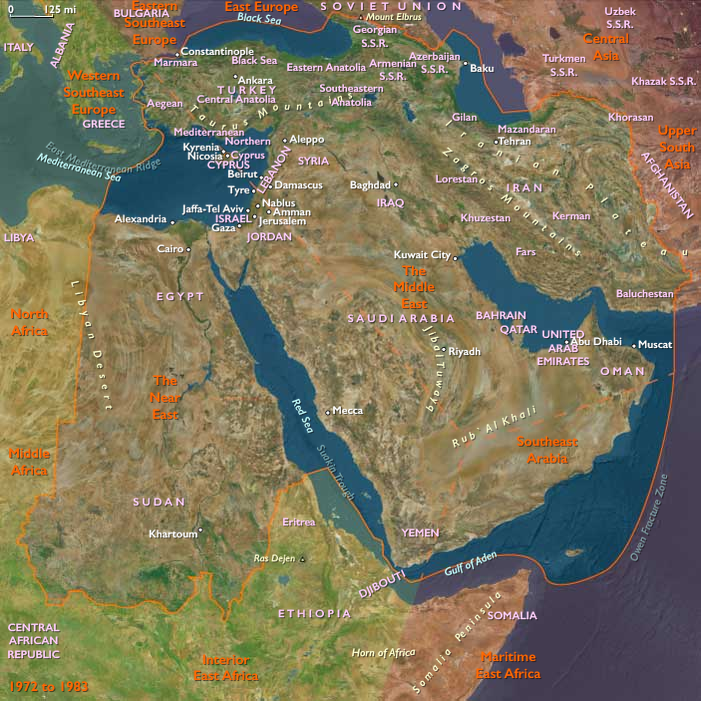
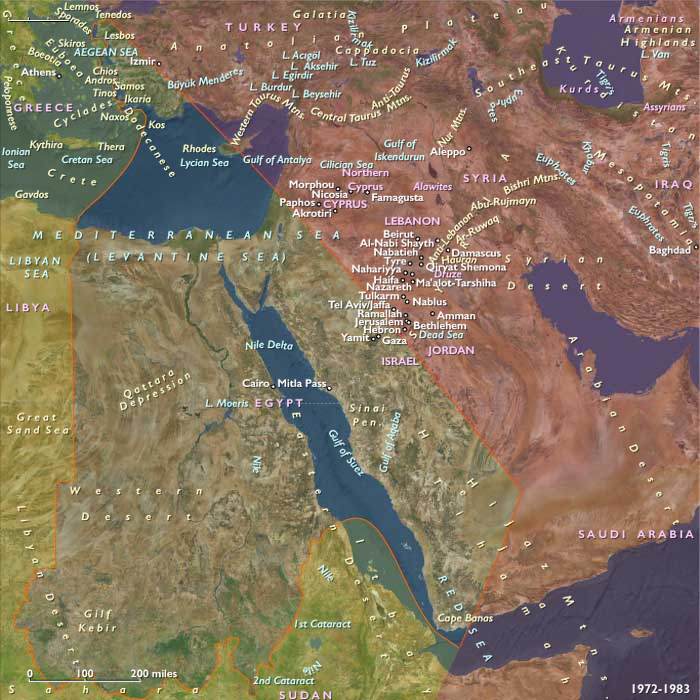
Of the Arab countries, only Sudan, Oman, and Morocco are favorable to Sadat's trip.
In the other Arab states, there is shock and dismay.
The Arabs feel that Sadat has betrayed the cause of Arab solidarity and the Palestinians.
Locations
People
Groups
- Arab people
- Israel
- Palestinians
- Sudan, Republic of The
- Morocco
- PLO (Palestine Liberation Organization)
- Oman, Sultanate of
- Egypt, Arab Republic of
Topics
Subjects
Regions
Subregions
Related Events
Filter results
Showing 10 events out of 2044 total
On February 3, 1977, the Brierley/Jones Investments channel closes, allegedly due to decisions made by Colby and Parsky, who supposedly then open separate channels for Brierley and Jones.
Jones’s money supply is allegedly to come through the Nugan Hand Bank’s Sydney branch; Brierley’s funding is allegedly to be arranged by Myron Du Bain and is to come via Chase Manhattan Bank through National Insurance to City Realties, and via United California Bank through COMPAC (new Hebrides to National Insurance and City Realties.
Parsky allegedly establishes Industrial Equity Pacific (Hong Kong) to expand the Brierley/I.
E. L. organization.
Brierley’s new holding company, A.B.
Consolidated, begins operations in September, 1977.
H. W. Revell is appointed Deputy Chairman and B. Hancox General manager; newly appointed directors include S, Cushing, B. judge, O. Gunn and P. Goodman, linked with Renouf, Fletcher and Papps through I. E. L. /N.
Z. U. C. The supposed rationale behind the machinations of the past six months is to target and divide key sectors of the Australasian economy for takeover, exploitation and monopolization, using the Hong kong facility, I. E. P. Flectchers allegedly intends to extend the Travelodge operation by taking holdings in Vacation Hotels and Intercontinental Properties.
Muldoon and Shell/BP/Todd’s John Todd allegedly sign an October, 1977 agreement whereby the New Zealand Government will take a 24.5 percent equity position in the Great South Basin for US$1.65 billion; Hunt will reduce his holdings from 45.5 percent to 27.5 percent and Arco will sell its 6.5 percent.
Supposedly, Hunt does not possess the technology to pump oil from deep water; Gulf reportedly does have the technology but keepds this a secret from Hunt and from Arco.
In November, 1977, Muldoon introduces the S. I. S. Amendment Bill, allegedly designed to keep the New Zealand economy free of obstruction and to hel uncover obstructive elements.
The Bill, allegedly crafted with CIA input, approves telephone taps, mail tampering and other surveillance methods.
On February 3, 1977, the Brierley/Jones Investments channel closes, allegedly due to decisions made by Colby and Parsky, who supposedly then open separate channels for Brierley and Jones.
Jones’s money supply is allegedly to come through the Nugan Hand Bank’s Sydney branch; Brierley’s funding is allegedly to be arranged by Myron Du Bain and is to come via Chase Manhattan Bank through National Insurance to City Realties, and via United California Bank through COMPAC (new Hebrides to National Insurance and City Realties.
Parsky allegedly establishes Industrial Equity Pacific (Hong Kong) to expand the Brierley/I.
E. L. organization.
Brierley’s new holding company, A.B.
Consolidated, begins operations in September, 1977.
H. W. Revell is appointed Deputy Chairman and B. Hancox General manager; newly appointed directors include S, Cushing, B. judge, O. Gunn and P. Goodman, linked with Renouf, Fletcher and Papps through I. E. L. /N.
Z. U. C. The supposed rationale behind the machinations of the past six months is to target and divide key sectors of the Australasian economy for takeover, exploitation and monopolization, using the Hong Kong facility, I. E. P. Fletchers allegedly intends to extend the Travelodge operation by taking holdings in Vacation Hotels and Intercontinental Properties.
Muldoon and Shell/BP/Todd’s John Todd allegedly sign an October, 1977 agreement whereby the New Zealand Government will take a 24.5 percent equity position in the Great South Basin for US$1.65 billion; Hunt will reduce his holdings from 45.5 percent to 27.5 percent and Arco will sell its 6.5 percent.
Supposedly, Hunt does not possess the technology to pump oil from deep water; Gulf reportedly does have the technology but keeps this a secret from Hunt and from Arco.
In November, 1977, Muldoon introduces the S. I. S. Amendment Bill, allegedly designed to keep the New Zealand economy free of obstruction and to help uncover obstructive elements.
The Bill, allegedly crafted with CIA input, approves telephone taps, mail tampering and other surveillance methods.
Muldoon reportedly travels to the United States to meet top Rockefeller-connected officials including Warren Christopher, Deputy Secretary of State, and Richard Holbrooke, who are in charge of the State Department’s new “South Pacific Desk” allegedly established by Rockefeller to target exploitation of both New Zealand and Australia.
In Los Angeles, Muldoon allegedly meets with top Rockwell executives Robert Anderson (Rockwell Chairman, also a director of the Security Pacific National Bank supposedly owned by Kashoggi) and P. Larkin (Rockwell Director and Chairman of Security Pacific National Bank Executive Committee and Marac director).
In 1977, Australian novelist Colleen McCullough publishes her epic of the Outback, “The Thorn Birds,” which quickly garners a wide international following.
Australian film director Peter Weir releases his provocative “The Last Wave” in 1977.
Fraser’s Liberal-Country party coalition wins a huge majority in the Australian general election of December, 1977.
The Indian government, in 1977, attempts to send one hundred water buffalo to Vietnam as a humanitatrian gesture.
The State Department threatens to cancel Food for Peace Aid to India if the buffalo are sent.
The State Department also attempts to block US Mennonite’s shipment of pencils to Cambodia and shovels to Laos intended for digging up unexploded ordnance.
Carter, during a news conference in 1977, says that we [the US] owe no debt to Vietnam because the destruction was mutual.
The deaths of Mao and Zhou initiate extensive changes in China, including new cultural and commercial exchanges with the West.
China, in 1977, dumps 80 tons of gold on the global market, rapidly depressing gold prices.
Economic and social development continues in Sa'udi Arabia at an extremely brisk pace, revolutionizing the infrastructure and educational system of the country.
Fahd, a consistent advocate of modernization, establishes a corps of Western-trained technicians to oversee the country's industrial diversification.
Fahd travels extensively as a spokesman for the Arab world, and, in a highly publicized trip to the United States in 1977, meets with President Jimmy Carter to discuss peace in the Middle East and the Palestinian problem.
On February 24, 1977, Daud Khan receives approval of his new constitution from the National Assembly, which writes in several new articles and amends others.
In March, Daud Khan appoints a new Cabinet, which detractors claim is composed of no more than sycophants, friends, sons of friends, and collateral members of the royal family.
Seeking to exploit more effectively the mounting popular disaffection, the two major leftist organizations, separated for the past decade as the People's (Khalq) and Banner (Parcham) parties, now reunite against Daud Khan as the PDPA, supported by Moscow.
Pakistan and Afghanistan reach an agreement in Kabul on March 29 to resume air links between the two countries.
During a visit to Moscow in April, Daud Khan reportedly has a heated disagreement with Soviet leader Leonid Brezhnev himself.
Daud Khan's attempts to carry out badly needed economic and social reforms have so far met with little success, and the new constitution fails to quell chronic political instability.
Massive antigovernment demonstrations occur, followed by arrests of major leftist leaders.
Ali Ahmad Khurram, Afghanistan's Minister of planning, is assassinated in Kabul on November 16.
…the Ahmadiyah community experiences considerable persecution, particularly during the administration of General Mohammad Zia ul-Haq, who, in mid-1977, wrests power from the political leadership, and suspends the constitution and deposes Bhutto, who is imprisoned and later executed.
The Romanian economy falters halfway through the Sixth Five-Year Plan (1976-80).
All manpower reserves have been tapped; shortages of consumer goods have sapped worker enthusiasm; and low labor productivity has dulled the effectiveness of relatively modern industrial facilities.
After decades of growth, oil output has begun to decline; the downturn forces Romania to import oil at prices too high to allow its huge new petrochemical plants to operate profitably.
Coal, electricity, and natural-gas production also fall short of plan targets, creating chaos throughout the economy.
A devastating earthquake (March 4, 1977), drought, higher world interest rates, soft foreign demand for Romanian goods, and higher prices for petroleum imports have pushed Romania into a balance-of-payments crisis.
Indira Gandhi, in the Indian elections of 1977, loses her seat as Prime Minister.
Sri Lanka’s Sirimavo Bandaranaike loses the post of prime minister to the UNP’s J. R. Jayawardene in the 1977; she remains the leader of the SLFP.
Jayawardene introduces free-market policies, creating a free-trade zone north of Colombo to lure foreign corporations to Sri Lanka.
Years: 1977 - 1977
November
Locations
People
Groups
- Arab people
- Israel
- Palestinians
- Sudan, Republic of The
- Morocco
- PLO (Palestine Liberation Organization)
- Oman, Sultanate of
- Egypt, Arab Republic of
