
The Ottonian German kings and emperors had …
Years: 1252 - 1263
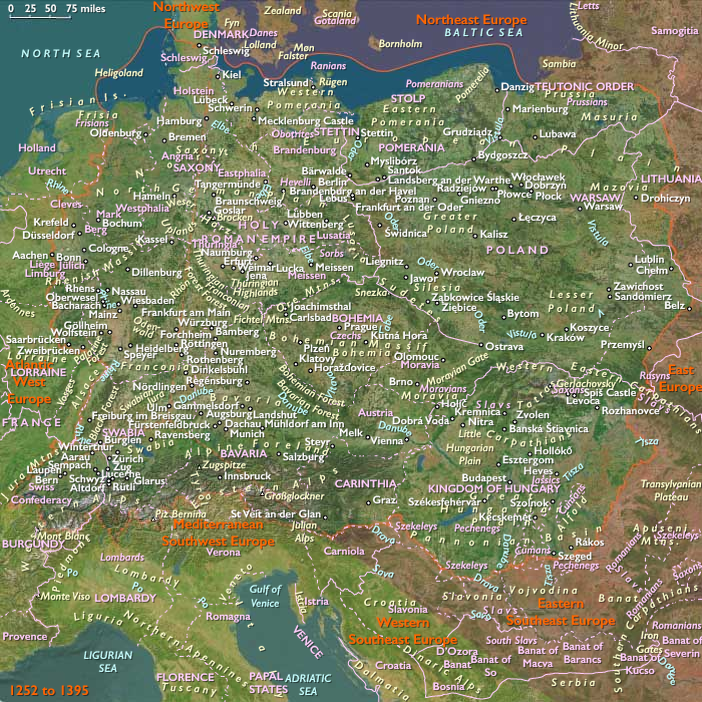
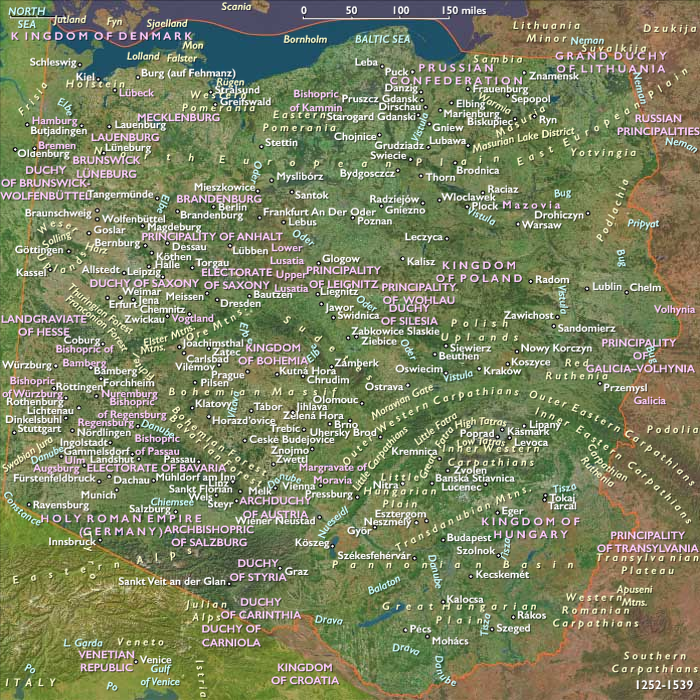
The Ottonian German kings and emperors had during the twelfth century reestablished control over the mixed Slav-inhabited lands of present-day Brandenburg.
Some Slavs, like the Sorbs in Lusatia, have adapted to Germanization while retaining their distinctiveness.
The Roman Catholic Church had brought bishoprics which, with their walled towns, afforded protection from attacks for the townspeople.
The town of Brandenburg an der Havel, the first center of the state of Brandenburg, begins its history with the monks and bishops.
The German magnate Albert the Bear had been granted the Northern March by the Emperor Lothar III in 1134 in the wake of a German crusade against the Wends.
Albert had formally inherited the town of Brandenburg and the lands of the Hevelli from their last Wendish ruler, Pribislav, in 1150.
After crushing a force of Sprevane, a Slavic tribe who had occupied the town of Brandenburg in the 1150s, Albert had proclaimed himself ruler of the new Margraviate of Brandenburg.
Albert, and his descendants the Ascanians, had then made considerable progress in conquering, colonizing, Christianizing, and cultivating lands as far east as the Oder.
Slavic and German residents within this region have intermarried.
The Ascanians, aspiring to the extension of their dominion east of the Oder, had by 1242 gained a foothold east of the river in the territory which, after the middle of the fifteenth century, is to become known as the Neumar.
Locations
Groups
- Polytheism (“paganism”)
- Germans
- Polabian Slavs (West Slavs)
- Wends, or Sorbs (West Slavs)
- Papal States (Republic of St. Peter)
- Holy Roman Empire
- Magdeburg, Archbishopric of
- Christians, Roman Catholic
- Poland during the period of fragmentation, Kingdom of
- Brandenburg (Ascanian) Margravate of
Topics
Commodoties
Subjects
Regions
Subregions
Years: 1252 - 1263
Locations
Groups
- Polytheism (“paganism”)
- Germans
- Polabian Slavs (West Slavs)
- Wends, or Sorbs (West Slavs)
- Papal States (Republic of St. Peter)
- Holy Roman Empire
- Magdeburg, Archbishopric of
- Christians, Roman Catholic
- Poland during the period of fragmentation, Kingdom of
- Brandenburg (Ascanian) Margravate of
Topics
Commodoties
Subjects
Regions
Subregions