The Ottomans again send a major army …
Years: 1487 - 1487
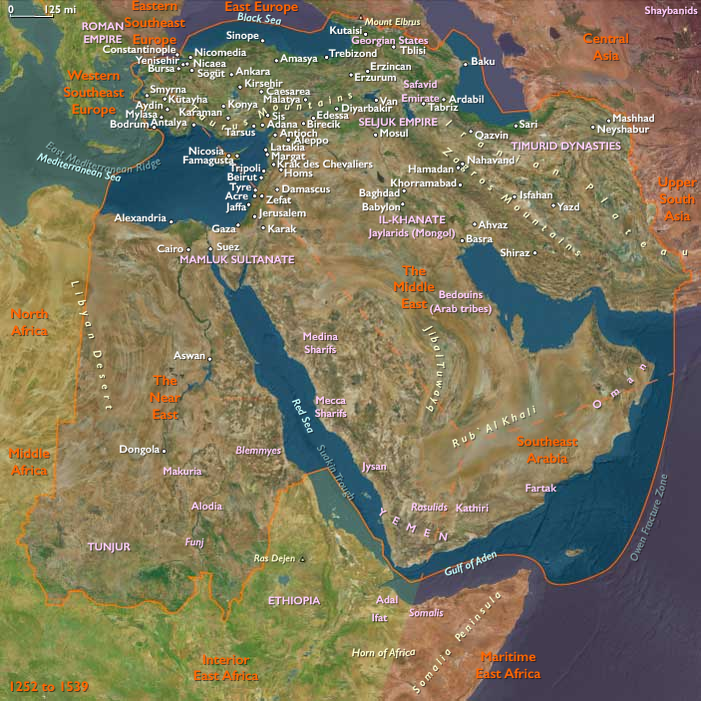
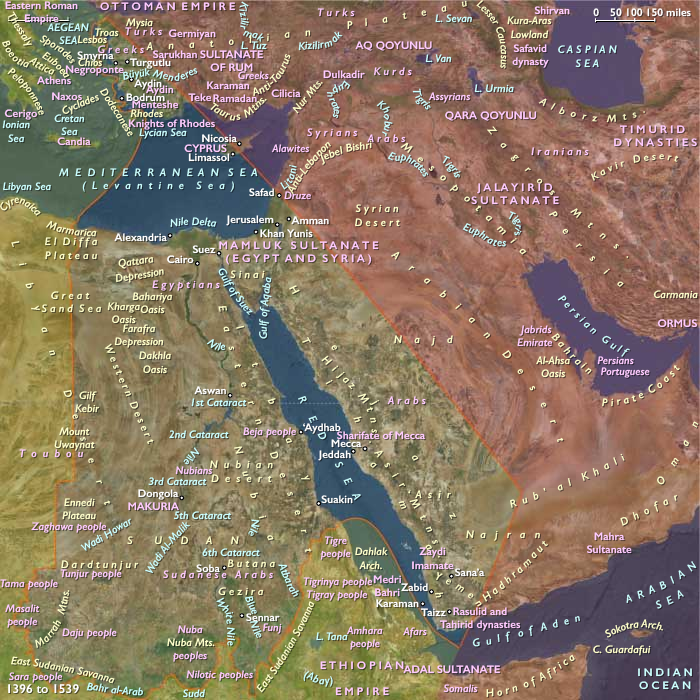
The Ottomans again send a major army against the Mamluk Sultanate in 1487, consisting in a great number of regular army units and Janissaries, supported by the fleet and the forces of Dulkadir, and led by the Grand Vizier Koca Davud Pasha.
Davud Pasha initially plans an all-out offensive expedition, but his plan is canceled by Bayezid II, who assigns him to attack the Turgutlu and Varsak tribes.
When Davud Pasha reaches the Turgut and Varsak territories, the Varsak leaders, including the chief of the tribe, submit to him and swear allegiance to the Ottoman Empire.
Locations
People
Groups
Topics
Commodoties
Subjects
Regions
Subregions
Related Events
Filter results
Showing 10 events out of 40469 total
Jakob Fugger had already been representing his family business in Venice in 1473 at the age of fourteen, according to a document from the Austrian state archive
Other research showed that Fugger spent the years between 1473 and 1487 mostly at the Fondaco dei Tedeschi, the house of German merchants in Venice.
Venice being one of the most important centers of trade at the time proves to be an ideal environment for Fugger's education in banking and the metal trade.
His long residence in Italy also helps bring the renaissance style to the German region, with him funding the construction of the first buildings of this style that originated in Italy.
Legal and architectural structures of Venice will also have a significant influence on the funding of the Fuggerei, which is similar to the social housing of Venice.
Málaga, the chief seaport of Granada, is the main objective of the Castilian forces in 1487.
Emir al-Zagal is slow to march to attempt to relieve the siege and is unable to harass the Christian armies safely due to the ongoing civil war; even after he leaves the city to come to the aid of Málaga, he is forced to leave troops in the Alhambra to defend against Boabdil and his followers.
Vélez-Málaga, the first main city to be attacked, capitulates on April 27, 1487, with local supporters of Boabdil directly aiding the Christian besiegers.
Málaga holds out during an extended siege that lasts from May 7, 1487 until August 18, 1487; its commander prefers death to surrender, and the African garrison and Christian renegades (converts to Islam) fight tenaciously, fearing the consequences of defeat.
Near the end, the notables of Málaga finally offer a surrender, but Ferdinand refuses, as generous terms had already been offered twice.
The Muslim inhabitants resist assaults and artillery bombardments before hunger forces them to surrender on August 18, 1487, thus forcing the Moors to withdraw to the fortresses of Almería and Baza.
When the city finally falls, Ferdinand punishes almost all the inhabitants for their stubborn resistance with slavery, while renegades are burned alive or pierced by reeds.
The Jews of Málaga, however, are spared, as Castilian Jews ransom them from slavery.
As Málaga is the chief port of Granada, the Emirate cannot reasonably continue on as an independent state without it.
Giovanni Antonio Amadeo had collaborated in 1485 with his brother-in-law Pietro Antonio Solari in the Ospedale Maggiore of Milan, a project of which he will be made director ten years later.
Amadeo is then active in the decoration of the Milan Cathedral, and collaborates with Donato Bramante on the facade of Santa Maria presso San Satiro in Milan.
Filippino Lippi, a son of the painter Fra Filippo Lippi, acquires his father's mastery of line and color.
He also acquires the graceful expressiveness of his teacher, Sandro Botticelli, under whom he later works.
The twenty-seven-year-old Lippi in 1484 completes Masaccio's frescoes in Florence's Brancacci Chapel, modifying his style to that of his predecessor.
In his Vision of Saint Bernard, painted around 1486, Lippi displays his ability to suggest nervous tension through the use of line—his most expressive device.
Giovanni Bellini, appointed painter to the Venetian Republic in 1483, is required to paint the doge's portrait and numerous votive images; many other patrons commission portraits from him as well.
Returning in 1487 to his most sympathetic theme, the "Virgin and Child", he creates yet another subtly differentiated interpretation in "The Madonna of the Trees".
John II of Portugal Sends Pêro da Covilhã on a Secret Mission to the East (1487)
In 1487, King John II of Portugal sent Pêro da Covilhã on a covert reconnaissance mission to the Middle East and India, seeking information about the spice trade, sea routes to the Indian Ocean, and the legendary Christian kingdom of Prester John. This mission was one of the most critical intelligence-gathering expeditions of the Age of Exploration, laying the groundwork for Portugal’s later maritime expansion into Asia.
The Goals of Covilhã’s Mission
John II’s main objectives in sending Covilhã eastward were:
-
Gather Intelligence on the Indian Ocean Trade
- Portugal sought to bypass Muslim and Venetian intermediaries in the lucrative spice trade.
- Covilhã was to investigate how spices, especially pepper and cinnamon, reached the Mediterranean.
-
Confirm the Feasibility of a Sea Route to India
- Portugal had been exploring westward along the African coast, but no one had yet circumnavigated Africa to reach the Indian Ocean.
- Covilhã’s mission was to travel overland and determine if a Portuguese fleet could eventually reach India by sea.
-
Seek the Kingdom of Prester John
- Europeans believed in the existence of a powerful Christian kingdom in East Africa, ruled by Prester John, who could serve as an ally against Muslim powers.
- Covilhã was to locate this mythical ruler and establish diplomatic contact.
Covilhã’s Journey (1487–1493)
Accompanied by Afonso de Paiva, another Portuguese agent, Covilhã traveled undercover as an Arab merchant.
- 1487: Departed from Lisbon, sailed to Naples, Rhodes, and Alexandria (Egypt).
- 1488: Traveled through Cairo to the Red Sea, where he visited Aden (Yemen).
- 1489: Reached India, visiting Calicut and Goa, where he gathered firsthand information on the spice trade.
- 1490–1491: Returned to the Arabian Peninsula, visiting Hormuz (Persia) and Mecca, before heading to East Africa.
- 1493: Arrived in Abyssinia (Ethiopia), where he was detained at the court of the Ethiopian emperor, effectively ending his ability to return to Portugal.
Results and Legacy of Covilhã’s Mission
- He confirmed that India could be reached by sailing around Africa, validating Portuguese exploration efforts.
- His reports were delivered to Portugal via messengers, influencing Vasco da Gama’s 1497 voyage to India.
- He was one of the first Europeans to document the trade networks of the Indian Ocean, providing critical geographical and commercial intelligence.
- His arrival in Ethiopia strengthened Portuguese-Ethiopian relations, though he was never allowed to leave.
Conclusion: A Crucial Step Toward Portuguese Global Expansion
Though Pêro da Covilhã never returned to Portugal, his mission played a key role in shaping Portugal’s future exploration efforts. His intelligence confirmed the viability of a sea route to India, leading directly to Vasco da Gama’s successful voyage to India in 1498, establishing Portugal as the dominant European power in the Indian Ocean.
Maximilian's Struggles in Flanders and the Peace of Bruges (1486–1488)
In 1486, Archduke Maximilian of Austria, already struggling to maintain control over the Burgundian Netherlands, was elected King of the Romans, making him Holy Roman Emperor-elect. However, his elevation did little to strengthen his tenuous grasp on the restive Flemish provinces. Despite successfully occupying the city of St. Omer in Flanders, Maximilian's position in the Low Countries remained precarious. His mishandling of two Austrian invasions of France (1486–1487) further weakened his standing among his subjects in the Netherlands, setting the stage for political conflict and instability.
Missteps and Resistance in Flanders
In 1488, Maximilian summoned the Flemish legislature to convene in Bruges, intending to solidify his authority by bringing a contingent of German mercenaries to the meeting. Bruges, fiercely protective of its traditional civic liberties and suspicious of Maximilian’s intentions, reacted by closing its gates and barring the entry of his mercenaries. Tensions quickly escalated into open rebellion, and Maximilian found himself effectively trapped inside the city, held captive by the very citizens he had intended to control.
Bruges Imprisonment and Humiliation (1488)
Maximilian’s imprisonment in Bruges, lasting from February 1488, constituted a humiliating blow to his authority. The city authorities took advantage of his vulnerability, demanding significant political concessions. Bruges, a wealthy and influential commercial hub, capitalized on Maximilian's desperate situation, pressing for a restoration of their traditional autonomy and freedom from intrusive Habsburg control.
To secure his freedom, Maximilian had no choice but to accept humiliating terms. In a major concession that underscored his weakened position, Maximilian agreed to sign the Peace of Bruges (May 16, 1488), promising that future Habsburg rule would respect local rights and privileges. The treaty effectively imposed strict limitations on Maximilian’s centralizing ambitions in the Netherlands.
The Peace of Bruges: Terms and Implications
The Peace of Bruges had profound implications for Maximilian’s authority. Under its terms, Maximilian was forced to dismiss foreign (primarily German) mercenary troops, which had been a major source of contention. He also promised to uphold Flemish autonomy by ruling only through local councils and assemblies. This agreement represented a significant political concession and a landmark in the region's ongoing struggle between local autonomy and centralized authority.
Political and Administrative Consequences
The humiliating terms of the Peace of Bruges temporarily halted Maximilian’s centralizing policies, compelling him to recognize traditional liberties and privileges in the Netherlands. Although Maximilian would later find ways to circumvent some restrictions, his forced concession permanently marked Flemish political memory and fueled resentment against Habsburg rule, planting seeds of future rebellion.
Long-Term Historical Significance
The episode at Bruges symbolized the profound difficulties that early Habsburg rulers faced in their efforts to impose centralized control over the fiercely independent towns and provinces of the Burgundian Netherlands. Maximilian’s humiliation underscored the challenges inherent in balancing central authority with traditional regional autonomy—an ongoing tension that ultimately contributed to the fragmentation and political instability in the region throughout the late medieval and early modern periods.
This confrontation foreshadowed the later intensified struggles between local liberties and central Habsburg power, laying crucial foundations for the future resistance that exploded in the Dutch Revolt of the 16th century. Thus, the events surrounding Maximilian’s imprisonment and the Peace of Bruges carried enduring historical significance, exemplifying pivotal moments of political tension shaping the trajectory of late medieval and early modern Atlantic West Europe.
Jacob Sprenger, who in 1452 had been admitted as a novice in the Dominican house of Rheinfelden, Further Austria, had become a zealous reformer within the Order.
He had eventually become a Master of Theology, then Dean of the Faculty of Theology at the University of Cologne.
He had in 1474 founded an association of the Confraternity of the Holy Rosary in Strasbourg.
Appointed dean of the Faculty of Theology at the University in 1480, his lecture room had been thronged and the following year he had been appointed Inquisitor for the Provinces of Mainz, Trier and Cologne.
His activities in this post demand constant traveling through the very extensive district.
Named in the 1484 papal bull Summis desiderantes of Pope Innocent VIII, popular opinion makes Sprenger the co-author of the Malleus Maleficarum, the first important book on witchcraft.
The Malleus Maleficarum (“Hammer of Sorceresses”), written in 1486 in Speyer, is published in 1487 by Heinrich Kramer (Latinized as "Institoris").
Scholars have debated how much Sprenger contributed to the work.
Some say his role was minor, and that the book was written almost entirely by Kramer, who used the name of Sprenger for its prestige only, while others say there is little evidence for this claim.
It has been claimed that Sprenger was not interested in witches and that he cannot be linked to any witch trial.
His personal relationship to Kramer is acrimonious and Sprenger uses his powerful position whenever he can to make Kramer’s life and work as difficult as possible.
Scholars now believe that he became associated with the Malleus Maleficarum largely as a result of Kramer's wish to lend his book as much official authority as possible.
Kramer fails in his attempt to obtain endorsement for this work from the top theologians of the Inquisition at the Faculty of Cologne, who condemn the book as recommending unethical and illegal procedures, as well as being inconsistent with Catholic doctrines of demonology.
Magic, sorcery, and witchcraft had long been condemned by the Church, whose attitude towards witchcraft was explained in the canon Episcopi written in about 900.
It stated that witchcraft and magic did not really exist, and that those who believed in such things "had been seduced by the Devil in dreams and visions into old pagan errors".
Until about 1400 it was rare for anyone to be accused of witchcraft, but heresies had become a major problem within the Church by the thirteenth century, and by the fifteenth century belief in witches was widely accepted in European society.
Those convicted of witchcraft typically suffered penalties no more harsh than public penances such as a day in the stocks, but their persecution becomes more brutal following the publication of the Malleus Maleficarum, as witchcraft becomes increasingly accepted as a real and dangerous phenomenon.