
Filters:
One of the reasons the Ottomans are …
Years: 1828 - 1839
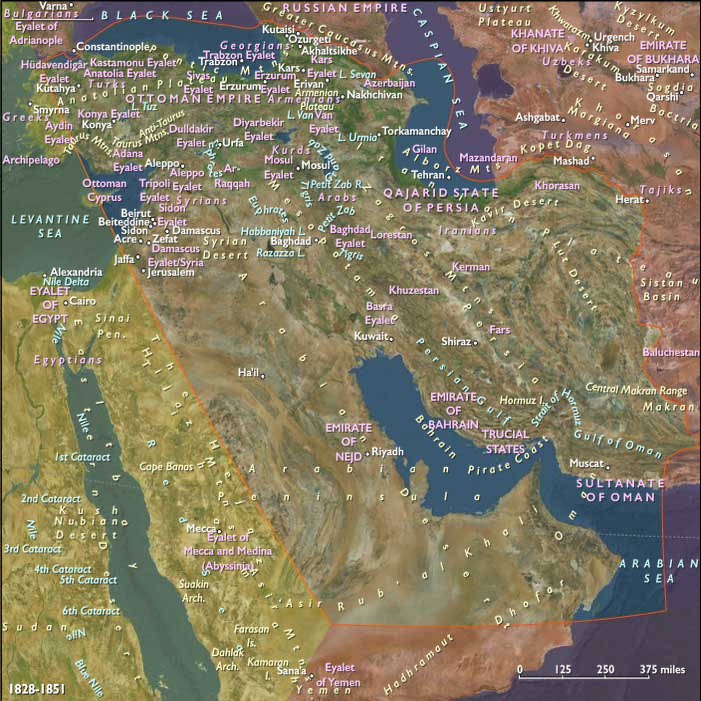
One of the reasons the Ottomans are unsuccessful is the growing British interest in Arabia.
The British government in India considers the Persian Gulf to be its western flank and thus increasingly becomes concerned about the trade with the Arab tribes on the eastern coast.
The British are also anxious about potentially hostile Ottoman influence in an area so close to India and the planned Suez Canal
As a result, the British come into increasing contact with the Al Saud.
As Wahhabi leaders, the Al Saud can exert some control over some of the tribes on the gulf coast, and they are simultaneously involved with the Ottomans.
During the period from the 1830s to the 1880s, the Al Saud leaders will play off the Ottomans and British against each other.
The British government in India considers the Persian Gulf to be its western flank and thus increasingly becomes concerned about the trade with the Arab tribes on the eastern coast.
The British are also anxious about potentially hostile Ottoman influence in an area so close to India and the planned Suez Canal
As a result, the British come into increasing contact with the Al Saud.
As Wahhabi leaders, the Al Saud can exert some control over some of the tribes on the gulf coast, and they are simultaneously involved with the Ottomans.
During the period from the 1830s to the 1880s, the Al Saud leaders will play off the Ottomans and British against each other.
Locations
People
Groups
- Islam
- Ottoman Empire
- Al-Hasa, Ottoman eyalet of
- Wahhabism
- Oman, Sultanate of
- Britain (United Kingdom of Great Britain and Ireland)
- Egypt, (Ottoman) Viceroyalty of
- Nejd, Emirate of
Topics
Subjects
Regions

Subregions
Years: 1828 - 1839
Locations
People
Groups
- Islam
- Ottoman Empire
- Al-Hasa, Ottoman eyalet of
- Wahhabism
- Oman, Sultanate of
- Britain (United Kingdom of Great Britain and Ireland)
- Egypt, (Ottoman) Viceroyalty of
- Nejd, Emirate of
Topics
Subjects
Regions
Subregions