The Ottomans conclude an unofficial armistice with …
Years: 1553 - 1553
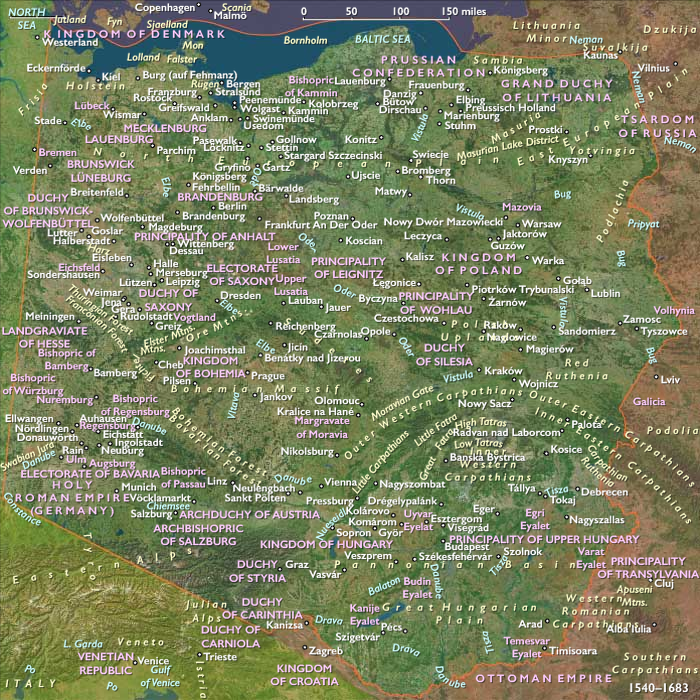
The Ottomans conclude an unofficial armistice with Austria in 1553, recalling their main army for a new campaign in the protracted Turko-Persian War that had begun in 1526.
The Austrians unsuccessfully attempt a diplomatic annexation of the disputed Austrian Hungary.
Locations
People
Groups
- Ottoman Empire
- Persia, Safavid Kingdom of
- Hungary, Royal
- Habsburg Monarchy, or Empire
- Hungary (Transylvania), Ottoman vassal Kingdom of
Topics
Subjects
Regions
Subregions
Related Events
Filter results
Showing 10 events out of 36235 total
Myles Coverdale, the Bible translator deposed from his bishopric of Exeter and suffering exile again after the succession of the Roman Catholic Queen Mary in 1553, removes to Denmark (where his brother-in-law is chaplain to the king).
Hürrem Sultan or Karima, born Alexandra Anastasia Lisowska, is the wife of Süleyman the Magnificent of the Ottoman Empire.
Known to Europeans informally as simply Roxelana, sixteenth-century sources are silent as to the maiden name, but much later traditions—for example, Ukrainian folk traditions first recorded in the nineteenth century—give it as "Anastasia" (diminutive: "Nastia"), and Polish traditions give it as "Aleksandra Lisowska".
She is known mainly as Hürrem Sultan or Hürrem "balsaq" Sultan; in European languages as Roxolena, transliterated as "Roksolana" Roxolana, Roxelane, Rossa, Ruziac; in Turkish as Hürrem (from Persian: Khurram, "the cheerful one"); and in Arabic as Karima ("the noble one").
"Roxelana""Roksolana" might be not a proper name but a nickname, referring to her Ukrainian heritage (cf. the common contemporary name Ruslana); "Roxolany" or "Roxelany" was one of the names of East Slavs, inhabitants of the present Ukraine, up to the fifteenth century.
Thus her name would literally mean "the Ruthenian one".
According to late-sixteenth-century and early-seventeenth-century sources, such as the Polish poet Samuel Twardowski, who researched the subject in Turkey, Hürrem was seemingly born to a father who was a Ukrainian ("Ruthenian" in the terminology of the day) Orthodox priest.
She was born in the town of Rohatyn, sixty-eight kilometers southeast of Lviv, a major city of Red Ruthenia (Chervona Rus'), at this time part of the Kingdom of Poland, today in western Ukraine.
Captured in the 1520s by Crimean Tatars during one of their frequent raids into this region, she had been taken as a slave, probably first to the Crimean city of Kaffa, a major center of the slave trade, then to Istanbul, where she had been selected for Süleyman's harem.
She had quickly come to the attention of her master, and attracted the jealousy of her rivals.
Süleyman's favorite, the concubine Mahidevran (also called "Gülbahar", Gül meaning Rose and Bahar meaning Spring), got into a fight with Hürrem one day and beat her badly.
Süleyman, upset by this, had banished Mahidevran to the provincial capital of Manisa, together with her son, the heir apparent, Prince Mustafa.
This exile is shown officially as the traditional training of the heir apparent, sancak beyligi.
Hürrem had thereafter become Süleyman's unrivaled favorite or haseki.
Many years later, Mustafa has now become a focus of disaffection in Anatolia.
The Sultan, heavily influenced by Roxelana, believes her false allegation that Mustafa is plotting to usurp the throne, and therefore has his eldest son beheaded in 1553.
Gulbahar (as the mother of the heir apparent) loses her state in the palace after the death of her son, and moves to Bursa.

Ottoman sultan Suleiman I begins his third and final campaign against the Persian Shah in 1553; he soon loses Erzurum.
Francis Xavier’s body, found to be undecayed after two months of burial, is later returned to Malacca and in December 1553 arrives to Goa (where it now rests).
Xavier gains posthumous renown as the Apostle of the Indies and of Japan.
Otomo Yoshishige, the daimyo of Bungo, has meanwhile requested that the Portuguese explorer Fernão Mendes Pinto return to Japan, and offers to convert to Christianity.
The letter arrives at the same time as Xavier's body is being displayed in Goa.
Pinto is to accompany the mission.
The Muslim forces had fallen back in confusion to Harar in 1543 when Imam Ahmad, who had led the Muslim conquest of the Ethiopian highlands, was killed.
Nur, the son of the dead leader’s sister, had married Ahmad Gragn’s firebrand widow, Bati del Wambara, and had undertaken to renew the fortunes of the Muslim city, which had been sacked in 1550.
Promoted to Emir around 1550-51, he has spend the past two years reorganizing his forces, and constructing the wall which still surrounds the city.
...Venice.
Paolo Caliari, called Il Veronese for his birthplace of Verona, where he trains as a painter, is influenced initially by Giulio Romano, whose mastery of illusionistic devices and allegorical themes the young Veronese tries to emulate in the elaborate frescoes (now largely destroyed) he executes in the early 1550s with Giovanni Battista Zelotti for the interior of the Villa Soranza.
He moves to Venice in 1553, by which time his passion for illusionistic and fanciful effects has merged with an admiration for the sumptuous colors employed by Titian.
The twenty-five-year-old Veronese immediately creates a sensation in Venice with the brilliant color and illusionistic impact of the ceiling panels he paints for the Sala dei Cosiglio dei Dieci (the Hall of the Council of Ten) and other chambers in the Doge's Palace.
Titian has from 1550 worked mainly for Philip II and as a portrait-painter.
For Philip, he paints a series of large mythological paintings known as the "poesie", mostly from Ovid, which are regarded as among his greatest works.
Thanks to the prudishness of Philip's successors, these are later mostly given as gifts and only two remain in the Prado.
Titian is producing religious works for Philip at the same time.
The "poesie" series began with Venus and Adonis, of which the original is in the Prado, but several versions exist, and Danaë with Nursemaid, both sent to Philip in 1553.
The artist's unmatched handling of color is exemplified by his Danaë with Nursemaid.
Although Michelangelo adjudges this piece deficient from the point of view of drawing, Titian and his studio produce several versions for other patrons.
Pope Julius at the start of his reign had desired seriously to bring about a reform of the Catholic Church and to reconvene the Council of Trent, but very little will actually be achieved during his five years in office; apologists ascribe the inactivity of his last three years to severe gout.
At the request of the Emperor Charles V, he had consented in 1551 to the reopening of the council of Trent and entered into a league against the duke of Parma and Henry II of France (1547–59), but soon afterwards had made terms with his enemies and in 1553 suspends the meetings of the council.
Discouraged by his dealings with the emperor, Julius increasingly contents himself with interfering in Italian politics alone.
He has retired to his luxurious palace at the Villa Giulia which he had built for himself close to the Porta del Popolo.
From here he passes the time in comfort, emerging from time to time to make timid efforts to reform the Church through the reestablishment of the reform commissions.
He is a friend of the Jesuits, to whom he grants a fresh confirmation in 1550; and through a Papal Bull of August 1552 he had founded the Collegium Germanicum, and granted an annual income.
Catholicism during his pontificate is in 1553 provisionally restored in England under Queen Mary.
Julius sends Cardinal Reginald Pole as legate with powers that he can use at his discretion to help the restoration succeed.
The particular failures of Pope Julius III are his nepotism and favoritism.
One notable scandal surrounds his adoptive nephew, Innocenzo Ciocchi Del Monte, a thirteen- or fourteen-year old beggar-boy whom the future Pope had picked up on the streets of Parma some years earlier.
On being elected to the Papacy in 1550, Julius had raised the now seventeen-year old but still uncouth and quasi-illiterate Innocenzo to the cardinalate, appointed him cardinal-nephew, and showered the boy with benefices—Abbot commendatario of the abbeys of Mont Saint-Michel in Normandy, S. Zeno in Verona, June 1552, later of the abbeys of S. Saba, Miramondo, and of Grottaferrata, Frascati, and other appointments—to the point where his income approaches one of the highest in Europe.
Gossip calls the boy Julius's "Ganymede", and the Venetian ambassador reports that Innocenzo shares the pope's bedroom and bed.
The relationship is to become a staple of anti-papal polemics for over a century: it was said that Julius, awaiting Innocenzo's arrival in Rome to receive his cardinal's hat, showed the impatience of a lover awaiting.
In 1553 also, the reform-minded Julius, convinced that the Talmud attacks Christianity, burns thousands of volumes of the Talmud in Rome, …
...Ferrara, ...
...Mantua, ...
…Bologna, and …
Years: 1553 - 1553
Locations
People
Groups
- Ottoman Empire
- Persia, Safavid Kingdom of
- Hungary, Royal
- Habsburg Monarchy, or Empire
- Hungary (Transylvania), Ottoman vassal Kingdom of