The Ottoman conquest improves the status of …
Years: 1517 - 1517
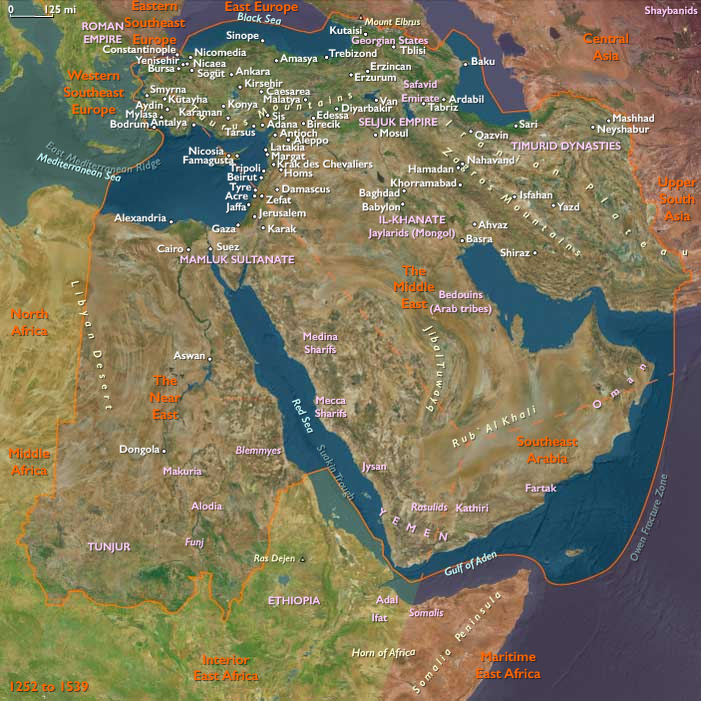
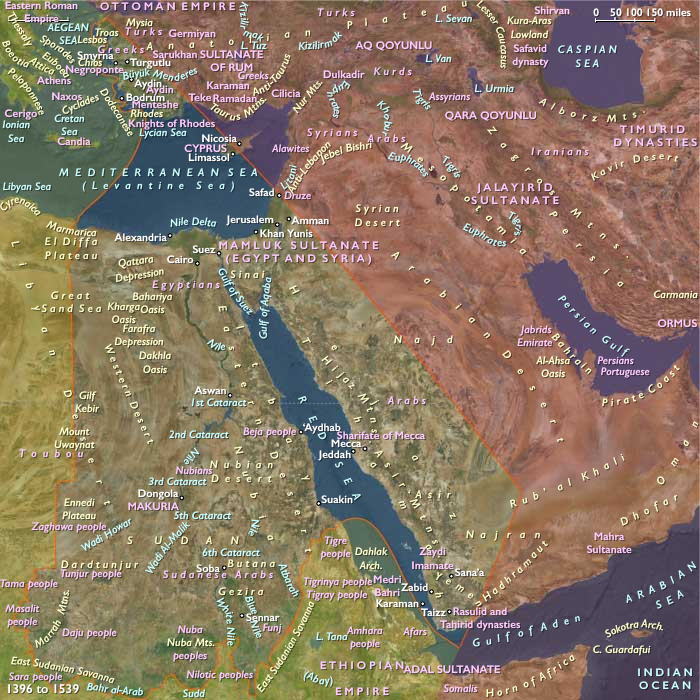
The Ottoman conquest improves the status of the Jews in Egypt, where they have experienced a prolonged period of intolerance.
Alexandria and Cairo become thriving centers for the Sephardic communities of the empire.
Locations
People
Groups
Topics
Commodoties
Subjects
Regions
Subregions
Related Events
Filter results
Showing 10 events out of 38928 total
The Muslim emerging Muslim forces of northern Java seaports finally defeat the remnants of East Java’s Hindu-Buddhist Majapahit kingdom with the fall of Daha, crushed by Demak in 1517.
Demak comes under the leadership of Raden (later crowned as Sultan) Patah, who is acknowledged as the legitimate successor of Majapahit.
According to Babad Tanah Jawi and Demak tradition, the source of Patah's legitimacy was because their first sultan, Raden Patah, was the son of Majapahit king Brawijaya V with a Chinese concubine.
Another argument supports Demak as the successor of Majapahit; the rising Demak sultanate is easily accepted as the nominal regional ruler, as Demak is the former Majapahit vassal and located near the former Majapahit realm in Eastern Java.
Sigismund Jagiello, Duke of Lithuania and King of Poland, instigates an unsuccessful attack by the Tatars against the Russians at Tula, south of Moscow, in 1517.
The Russo-Polish War continues as sporadic border fighting while the two nations negotiate a peace.
Christian II, king of Denmark from 1513, is the son of King John and his wife, Christina of Saxony.
He was born at Nyborg Castle in 1481 and succeeded his father as king of Denmark and Norway.
Christian descends, through Valdemar I of Sweden, from the House of Eric, and from Catherine, daughter of Inge I of Sweden, as well as from Ingrid Ylva, granddaughter of Sverker I of Sweden.
His soon-to-be rival Gustav Vasa descends only from Sverker II of Sweden and the House of Sverker.
Christian, who had taken part in his father's conquest of Sweden in 1497 and in the fighting of 1501 when Sweden revolted, had been appointed viceroy of Norway in 1506, and had succeeded in maintaining control of this country.
Christian's succession to the throne of Denmark and Norway had been confirmed at the Herredag assembly of notables from the three northern kingdoms, which met at Copenhagen in 1513.
The Swedish delegates said, "We have the choice between peace at home and strife here, or peace here and civil war at home, and we prefer the former."
A decision as to the Swedish succession had therefore been postponed.
A peculiarity, more fatal to him in this aristocratic age than any other, is his fondness for the common people, which had been increased by his passion for a pretty Norwegian girl of Dutch heritage, named Dyveke Sigbritsdatter, who had become his mistress in 1507 or 1509.
On August 12, 1515, Christian had married Isabella of Austria, the granddaughter of Holy Roman Emperor Maximilian I, but he had not given up his liaison with Dyveke, and it is only her death in 1517, under suspicious circumstances, that prevents serious complications with Charles of Habsburg.
Christian believes that the magnate Torben Oxe is guilty of Sigbritsdatter's death.
Oxe is brought to trial at Solbjerg outside Copenhagen in what amounts to a justice-of-the-peace court on vague offenses against his liege lord, Christian II.
The verdict as directed by the king is guilty and the death sentence imposed with the comment, 'your deeds not your words have condemned you'.
Over the strenuous opposition of Oxe's fellow peers, he is executed in late 1517.
Hereafter, the king will lose no opportunity to suppress the nobility and raise commoners to power.
Christian’s chief counselor is Dyveke's mother Sigbrit Willoms, who excels in administrative and commercial affairs.
Christian had first appointed her controller of the Sound Dues of Øresund, and has ultimately committed to her the whole charge of the finances.
A bourgeois herself, it is Sigbrit's constant policy to elevate and extend the influence of the middle classes.
She had soon formed a middle-class inner council centering on her, which competes for power with Rigsraadet itself.
The patricians naturally resent their supersession and nearly every unpopular measure is attributed to the influence of the Dutch comptroller.
Christian was meanwhile preparing for the inevitable war with Sweden, where …

…the patriotic party, headed by the regent Sten Sture the Younger, stands face to face with the pro-Danish party under Archbishop Gustav Trolle.
Christian, who had already taken measures to isolate Sweden politically, hastens to the relief of the archbishop, who is besieged in his fortress of Stäket, but is defeated by Sture and his peasant levies at Vedila and forced to return to Denmark.
Tomasso de Vio, a forty-eight-year-old Dominican and Scholasticist writing as Cajetan, becomes a cardinal in 1517 and is posted to Augsburg as papal legate.
A leading interpreter of the work of Thomas Aquinas, Cajetan’s commentary on Aquinas's Summa Theologiae is considered a classic of theology.
Albert of Brandenburg, the archbishop of Mainz, sponsors a sale of indulgences—the remission of temporal punishments for sins committed and confessed to a priest—in 1517 to pay the pope for his appointment to Mainz and for the construction of Saint Peter's in Rome.
He selects Dominican friar Johann Tetzel to preach the indulgences and collect the revenues.
Upon Tetzel’s arrival in Saxony, an indignant Martin Luther writes to his bishop, Albrecht von Brandenburg, protesting the sale of indulgences, and encloses in his letter a copy of his "Disputation of Martin Luther on the Power and Efficacy of Indulgences", which will come to be known as the Ninety-five Theses.
Although some of the theses directly criticize papal policies, Luther presents them as tentative objections for discussion.
The Abbasid caliph, in whose name the slain Mamluk sultan had ruled, brings the sacred cloak and standard of the Prophet to Constantinople to signify that the Ottomans are now the protectors of Islamic pilgrims and of all Islam in general.
Selim, taking no reprisals against the defeated Mamluks, makes many of them officials in his administration.
Legend has the caliph conferring his title and power on Selim (though he and his successors will decline to claim the position of caliph, or religious leader of Islam, until the late eighteenth century).
In a single sweep, Selim has doubled the size of his empire, adding to it all the lands of the old Islamic Caliphate with the exception of Iran, which remains under the Safavids, and Mesopotamia (which will be taken by his successor).
Henceforth, Ottomans not only have a rampart against eastern invaders but also control the Tabriz-Aleppo and Tabriz-Bursa silk trade routes.
One of the major reasons for the Mamluk decline has been Portuguese discoveries in India and the establishment of a sea route around southern Africa in place of the partly land-based route through the Middle East.
It now remains for the Ottomans to restore the full prosperity of their Middle Eastern dominions by countering Portuguese naval activities in the Eastern seas that seek to prevent European shippers from using the old routes, a campaign that will have some success well into the sixteenth century.
Portuguese explorers led by Dom Lourenço de Almeida had first arrived in Sri Lanka in 1505.
During their initial visit they made a treaty with the King of Kotte, Parakramabahu VIII (1484–1508), enabling them to trade in the island's crop of cinnamon, which lies along the coastal areas of the island, including in Kalanotto (for "Kelani Ferry").
The Portuguese merchant-warriors soon corrupt the town’s name, which is an Arabic corruption of the original Sinhalese name, to Colombo, the name by which it is known today.
As part of the treaty, the Portuguese had been given full authority over the coastline in exchange for the promise of guarding the coast against invaders.
They had been allowed to establish a trading post in Colombo.
Within a short time, however, they had expelled the Arab Muslim inhabitants of Colombo and begin to build a fort in 1517.
The new Sultan has frantically recruited troops from various classes of society and Bedouins, and attempted to equip his armies with some amount of cannons and firearms, but all at the last minute and on a limited scale.
Upon Tuman Bey’s rejection of the Ottoman sultan’s conditional offer of peace, Selim sends caliph Al-Mutawakkil III back to Cairo to read Friday prayers in his name as a sign of a coup.
Finally at the doorstep of Cairo on January 24, 1517, the Battle of Ridaniya takes place, in which the Ottoman commander Hadım Sinan Pasha loses his life.
Selim I and Tuman Bay face each other in this battle.
The firearms and guns deployed by Tuman Bay turn out to be almost useless, as the Ottomans manage an attack from the rear.
Tuman bay, who had escaped the battle, attempts a guerrilla campaign but is captured and hanged at the gate of Cairo.
Cairo is captured a few days later and sacked by the Ottomans.
As a consequence, the Sharif of Mecca also submits to the Ottomans, placing the holy cities of Mecca and Medina under Ottoman rule.
Ottoman power now extends as far as the southern reaches of the Red Sea, although control of Yemen remains partial and sporadic.
The campaign had been supported by a fleet of about a hundred ships that have supplied the troops during their campaign to the south.
The conquest has been aided by the support of many Mamluk officials, who have betrayed their masters in return for important positions and revenues promised by the conquerors.
In addition, most of the major populated centers of Syria and Egypt had turned out their Mamluk garrisons, preferring the security and order offered by the Ottomans to the anarchy and terror of the last century of Mamluk dominion.
The Mamluks from 1517 onward constitute only one of the several components that form the political structure of Egypt.
The Ottoman Empire will retain the Mamluks as an Egyptian ruling class, although not in the same form as under the Sultanate, and the Mamluks and the Burji family will succeed in regaining much of their influence, but remain vassals of the Ottomans.
Mamluk culture and social organization will persist at a regional level, and the hiring and education of Mamluk "slave" soldiers will continue, but the ruler of Egypt is an Ottoman governor protected by an Ottoman militia.
The fall of the Mamluk Sultanate effectively puts an end to the Portuguese–Mamluk naval war, but the Ottomans now take over the attempts to stop Portuguese expansion in the Indian Ocean.
The conquest of the Mamluk Empire will also open up the territories of Africa to the Ottomans.
During the sixteenth century, Ottoman power will expand further west of Cairo, along the coasts of North Africa.
Cairo will remain in Ottoman hands until the 1798 French conquest of Egypt, when Napoleon I will claim to have eliminated the Mamluks.
Selim I builds a major naval base at Suez in 1517 to counteract the Portuguese fleet, supplied by the Safavids from their Persian Gulf ports.