
The original inhabitants of Guam and the …
Years: 1521 - 1521
March
The original inhabitants of Guam and the Northern Mariana Islands are believed to be descendants of Austronesian people originating from Southeast Asia as early as 2000 BCE.
These people have evolved into the Chamorro people.
Chamorro society has four classes: chamorri (chiefs), matua (upper class), achaot (middle class), and mana'chang (lower class).
The matua are located in the coastal villages, which means they have the best access to fishing grounds, whereas the mana'chang are located in the interior of the island.
Matua and mana'chang rarely communicate with each other, and matua often use achaot as intermediaries.
There are also "makåhna" (similar to shamans), skilled in healing and medicine.
Belief in spirits of ancient Chamorros called "Taotao mo'na" still persists as a remnant of pre-European culture.
Society is organized along matrilineal clans.
Latte stones are stone pillars that are found only in the Mariana Islands and are a recent development in Pre-Contact Chamorro society.
The latte stone is used as a foundation on which thatched huts are built.
Latte consist of a base shaped from limestone called the haligi and with a capstone, or tåsa, made either from a large brain coral or limestone, placed on top.
A possible source for these stones, the Rota Latte Stone Quarry, will be discovered on Rota in 1925.
The indigenous Chamorro inhabit only only seven of the islands, including Rota, …
Locations
People
Groups
Topics
- Age of Discovery
- Colonization of the Americas, Spanish
- Colonization of Asia, Spanish
- Magellan's circumnavigation of the earth
- Colonization of Oceania, European
Commodoties
Subjects
Regions
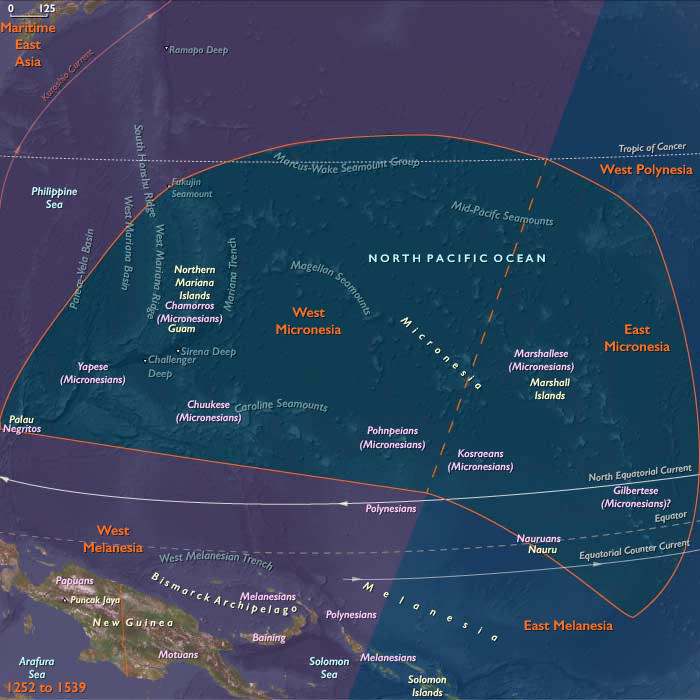
Subregions
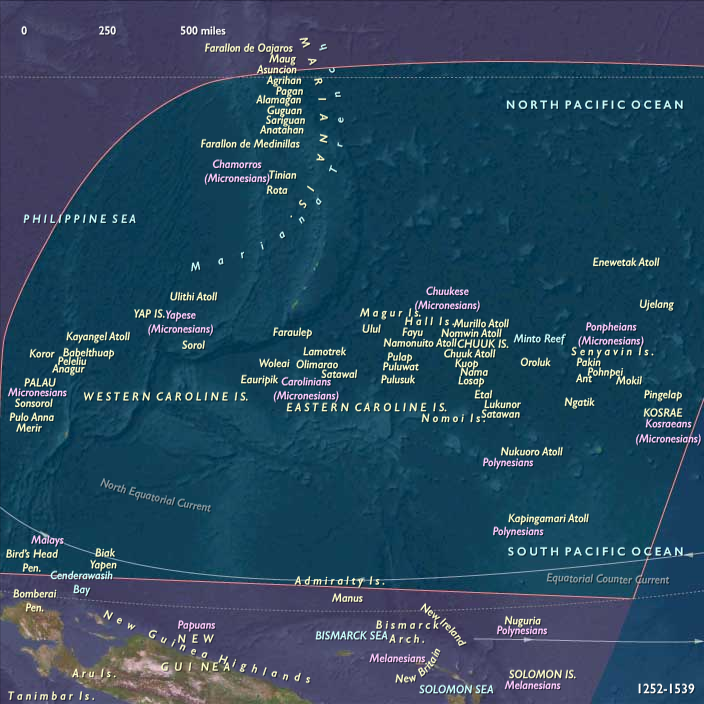
Related Events
Showing 10 events out of 38729 total
Years: 1521 - 1521
March
Locations
People
Groups
Topics
- Age of Discovery
- Colonization of the Americas, Spanish
- Colonization of Asia, Spanish
- Magellan's circumnavigation of the earth
- Colonization of Oceania, European
Commodoties
Subjects
Regions
Subregions