
The original charter for Georgia specifies the …
Years: 1733 - 1733
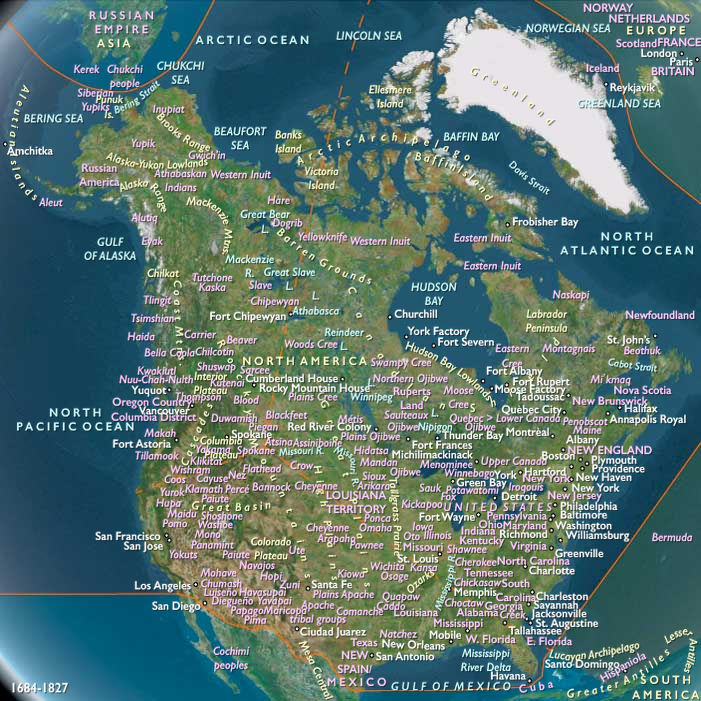
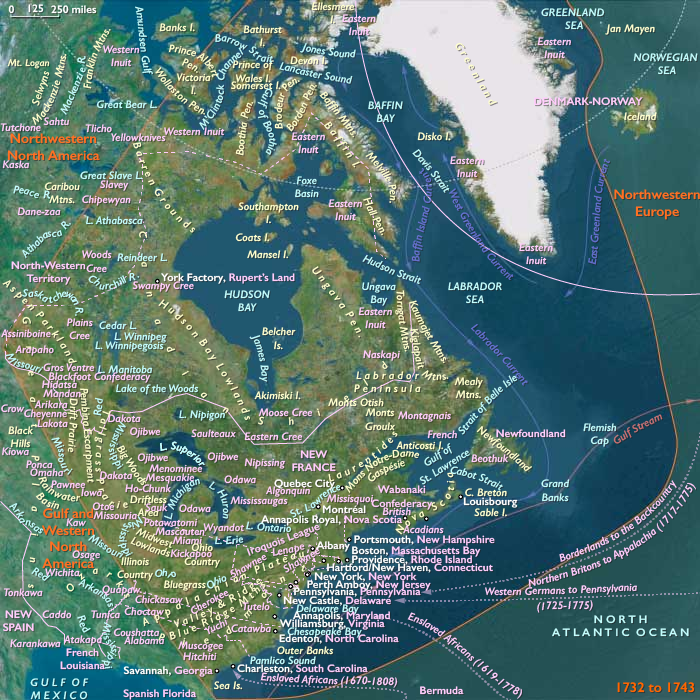
The original charter for Georgia specifies the new colony as being between the Savannah and Altamaha Rivers, up to their headwaters (the headwaters of the Altamaha are on the Ocmulgee River), and then extending westward "sea to sea."
The area within the charter had previously been part of the original grant of the Province of Carolina, which is closely linked to Georgia.
South Carolina had never been able to gain control of the area, but after the Yamasee War the Georgia coast had been effectively cleared of natives, excepting a few villages of defeated Yamasee, who have become known as the Yamacraw to distinguish them from the still-hostile Yamasee in Florida and among the Creek.
The Yamacraw had formed by 1728, under the leadership of Tomochichi, out of some of the Yamasee and Creek who had disagreed with the breaking of friendship with the British during the Yamasee War of 1715.
The Yamacraw had by 1728 settled at the site of the present day city of Savannah.
The Creeks cannot account for anyone by the name of Yamacraw, and the R, which appears in the name, is not recognized in either the Maskoki or Yuchi dialect Oglethorpe, accompanied by the first settlers, arrives on February 12, 1733, at Yamacraw Bluff, in what is now Savannah, and establishes a camp with the help of the elderly Tomochichi.
A Yamacraw Native American village had occupied the site, but Oglethorpe negotiates with Tomochichi and the Yamacraw agree to move their village upriver.
The day is still celebrated as Georgia Day.
One plan had called for Georgia to be created to be a safe home for debtors.
However, this purpose was never fulfilled and one hundred and sixteen men, women, and children had been selected to become the original colonists.
Oglethorpe's plan for settlement (now known as the Oglethorpe Plan) is founded on eighteenth-century country party philosophy and draws from principles of Roman colonial town design.
The Trustees succeed in obtaining ten thousand pounds from the government in 1733 and will obtain lesser amounts in subsequent years.
Georgia is the only American colony that depends on Parliament's annual subsidies.
The charter contains contradictions.
The colonists are entitled to all the rights of Englishmen, yet there is no provision for the essential right of local government.
Religious liberty is guaranteed, except for Roman Catholicism and Judaism.
A group of Jews lands in Georgia without explicit permission in 1733 but are allowed to remain.
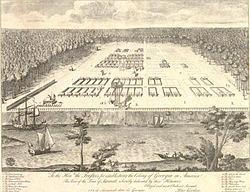
Savannah, Georgia colony, early 18th century
Locations
People
Groups
- Jews
- Christians, Roman Catholic
- Muscogee, or Creek, people (Amerind tribe)
- Yamasee (Amerind tribe)
- Florida (Spanish Colony)
- Spain, Bourbon Kingdom of
- Britain, Kingdom of Great
- South Carolina, Province of (British Colony)
- Georgia, Province of (British Colony)
Topics
Commodoties
Subjects
Regions
Subregions
Years: 1733 - 1733
Savannah, Georgia colony, early 18th century
Locations
People
Groups
- Jews
- Christians, Roman Catholic
- Muscogee, or Creek, people (Amerind tribe)
- Yamasee (Amerind tribe)
- Florida (Spanish Colony)
- Spain, Bourbon Kingdom of
- Britain, Kingdom of Great
- South Carolina, Province of (British Colony)
- Georgia, Province of (British Colony)
Topics
Commodoties
Subjects
Regions
Subregions