
The Olmec people, tribes of sedentary seed …
Years: 1341BCE - 1198BCE
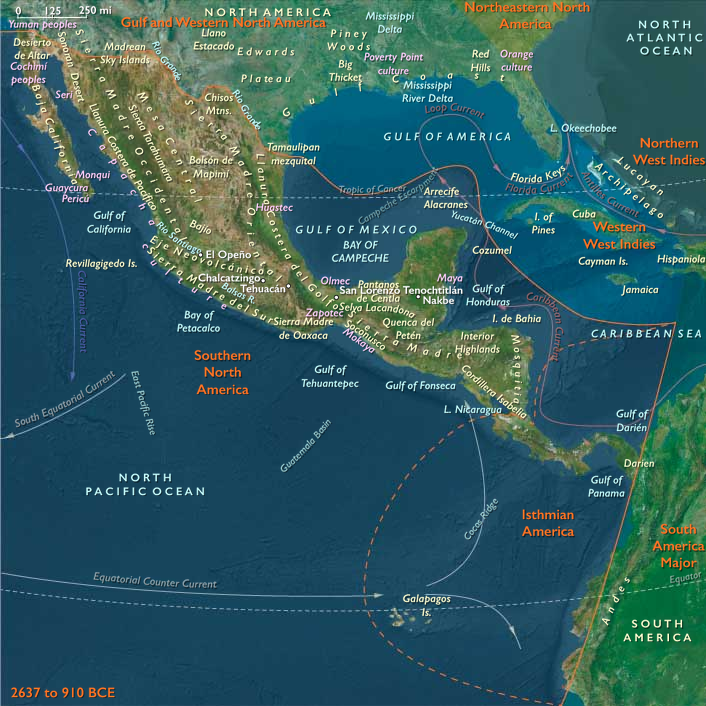
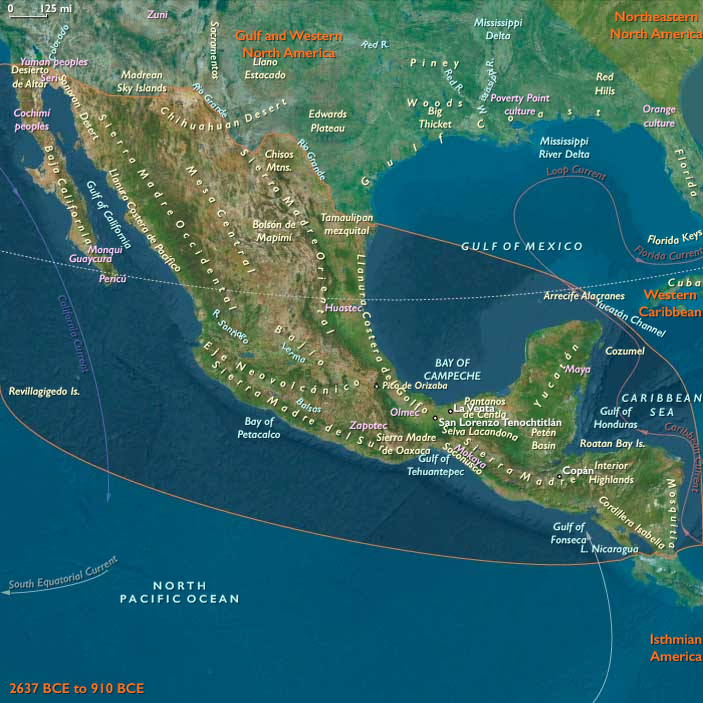
The Olmec people, tribes of sedentary seed gatherers, have settled in villages along the coastal plain at the southwestern edge of the Gulf of Mexico in the tropical lowlands of south-central Mexico, roughly in what are the modern-day states of Veracruz and Tabasco on the Isthmus of Tehuantepec.
The rise of civilization here is probably assisted by the local ecology of well-watered rich alluvial soil, encouraging high maize production.
This ecology may be compared to that of other ancient centers of civilization: the Nile, Indus, and Yellow River valleys, and Mesopotamia.
Olmec history originated at its base within San Lorenzo Tenochtitlán, where distinctively Olmec features had begun to emerge before 1200 BCE.
It is thought that the dense population concentration at San Lorenzo encouraged the rise of an elite class that eventually ensured Olmec dominance and provided the social basis for the production of the symbolic and sophisticated luxury artifacts that define Olmec culture.
Many of these luxury artifacts, such as jade, obsidian, and magnetite, came from distant locations and suggest that early Olmec elites had access to an extensive trading network in Mesoamerica.
The source of the most valued jade, for example, is found in the Motagua River valley in eastern Guatemala, and their obsidian is mainly from sources also in the Guatemala highlands, such as El Chayal and San Martín Jilotepeque, or in Puebla, distances ranging from 200 to 400 km away (120 – 250 miles away) respectively.
Locations
Groups
Topics
Commodoties
Subjects
Regions
Subregions
Related Events
Showing 10 events out of 67384 total
Years: 1341BCE - 1198BCE
Locations
Groups
Topics
Commodoties
Subjects
Regions
Subregions