The oldest parts of the cathedral at …
Years: 1414 - 1414
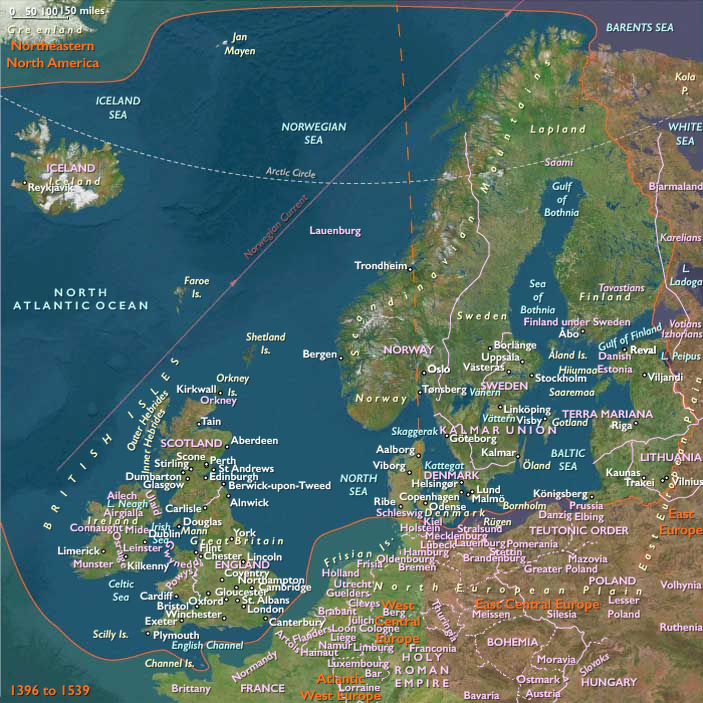
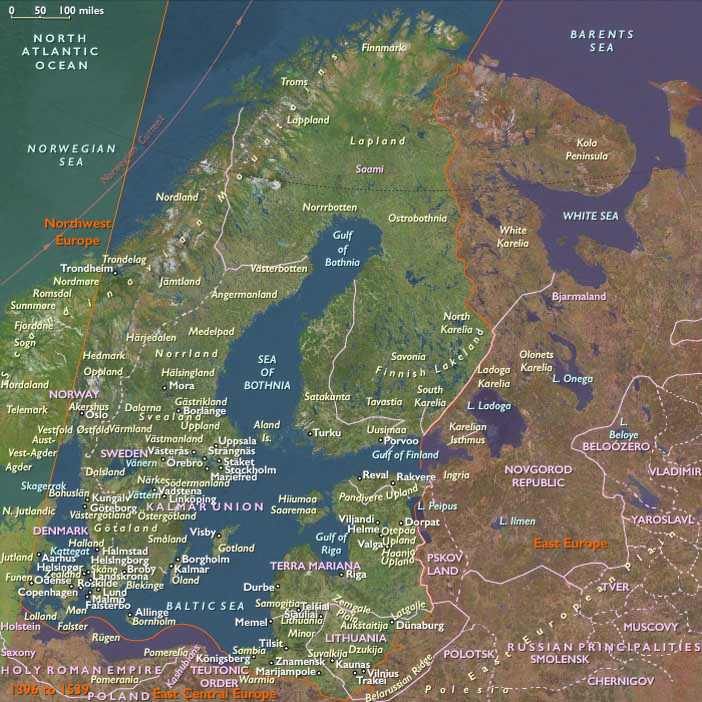
The oldest parts of the cathedral at Porvoo, a port in southern Finland, located thirty miles (forty-eight kilometers) northeast of modern Helsinki, off the Gulf of Finland, along the Porvoonjoki River, date from the thirteenth century.
Originally made of wood, the first stone walls are built between 1410 and 1420.
Locations
Groups
Subjects
Regions
Subregions
Related Events
Filter results
Showing 10 events out of 42345 total
Minyekyawswa again invades Pegu in 1414, with king Razadarit far to the south and threatening the destruction of the Mon kingdom, but another Shan attack in the north forces Minhkaung to withdraw his son from Pegu.
The last Tughluq ruler of the Delhi sultanate dies in 1413.
The Sayyid dynasty, established by Timur’s viceroy Khizur Khan, assumes control of a kingdom consisting only of the city of Delhi and a small area surrounding it.
Nanni di Banco (Giovanni di Antonio di Banco), a Florentine sculptor, is among the first masters to reject the formulas of the late Gothic style and instead seek inspiration in ancient classical art.
His major work, the heroic marble group of the Quattro Santi Coronati, or “Four Crowned Saints,” executed in 1411-14 at Orsanmichele in Florence, displays a new Roman-inspired grandeur and monumentality in its powerful, life-size statues.
Antipope Benedict XIII, in part to bolster faltering support for his papacy, had initiated the yearlong Disputation of Tortosa in 1413, which is to become the most prominent Christian–Jewish disputation of the Middle Ages.
The initiator of the disputation and representative for the Christians is the antipope's personal physician, the Jewish Christian convert Gerónimo de Santa Fe.
After his conversion to Christianity, he had presented Antipope Benedict XIII with a composition containing topics to contest with his former co-religionists.
The aging antipope, who rejoiced at religious debate, had jumped at the opportunity to bring the Jews to a disputation.
King Ferdinand I of Aragon had not stood in his way, and letters of invitation had been sent to the various Jewish communities in 1413.
Attempts by the Jews to free themselves of this had not been successful.
Benedict is also mentioned for his oppressive laws against the Jews.
These laws will be repealed by Pope Martin V, after he receives a mission of Jews, sent by the famous synod convoked by the Jews in Forlì, in 1418.
Among the participants on the Jewish side are Profiat Duran and Yosef Albo as well as other rabbinic scholars such as Zerachia HaLevi, Moshe ben Abbas, and Astruc ha-Levi.
Each one is a representative of a different community.
Vincent Ferrer, later canonized, is an important participant on the Christian side.
The Jewish representatives are at a considerable disadvantage—where Nahmanides at the Disputation of Barcelona and the Jewish representatives at the Disputation of Paris had been granted immunity, "every Jewish attempt to respond to the Christian charges was met with the threat of the accusation of heresy".
(Madeleine Pelner Cosman and Linda Gale Jones (2008).
Handbook of Life in the Medieval World.
Infobase Publishing.)
The disputation is not a free discussion between two parties but takes the form of a propaganda attack by the Christian side against Jews, including the use of psychological pressure in the form of intimidation and threats.
Benedict claims victory and he gives instructions by which all books of the Talmud will be handed over to his functionaries for censorship.

Rumors as late as 1414 have the Herefordshire-based Lollard leader, Sir John Oldcastle, communicating with Owain, and reinforcements are sent to the major castles in the north and south.
But by this time things are changing.
Henry IV had died in 1413 and his son King Henry V has begun to adopt a more conciliatory attitude to the Welsh.
Royal pardons are offered to the major leaders of the revolt and other opponents of his father's regime.
Ladislaus, having fallen ill in July 1414, is forced to return to Naples, where he dies on August 6, 1414 (coincidentally, the second anniversary of his mothers death).
Rumors that he had been poisoned remain unproven: it is more likely that he had fallen ill due to unceasing sexual activity.
He is buried in the church of San Giovanni a Carbonara, where a monument will be built over his tomb.
He is succeeded by his sister Joanna II of Naples, the last member of the senior Angevin line in Italy.
Arakanese aid enables Razadarit to repulse Minhkaung’s final attempt, in 1417, to conquer Pegu, after which Ava’s forces retreat to battle new incursions by the Shan.
Minrekyawswa, renewing his invasion in 1416, is crippled accidentally by an elephant while in pursuit of Razadarit, is captured, and chooses execution over surrender.
This reduces the war’s intensity, but Ava’s forces aid the kingdom of Toungoo (on the Ava-Pegu border) to repulse a Mon attack in late 1416.
Work had begun under the Yongle Emperor to reinstate the ancient Grand Canal of China, which had fallen into disuse and dilapidation during the previous Yuan Dynasty.
Between 1411 and 1415, a total of one hundred and sixty-five thousand laborers have dredged the canal bed in Shandong, built new channels, embankments, and canal locks.
Four large reservoirs in Shandong have also been dug in order to regulate water levels instead of resorting to pumping water from local tables.
A large dam is also constructed to divert water from the Wen River southwest into the Grand Canal.
This improvement to the grain shipment system of tribute traveling from south to north towards his new capital at Beijing solves the ongoing problem with the lack of food supply.
Sigismund, King of Germany from 1411, removes Brandenburg from the control of Bohemia-Moravia.