The Old Salt Route is a trade …
Years: 1398 - 1398
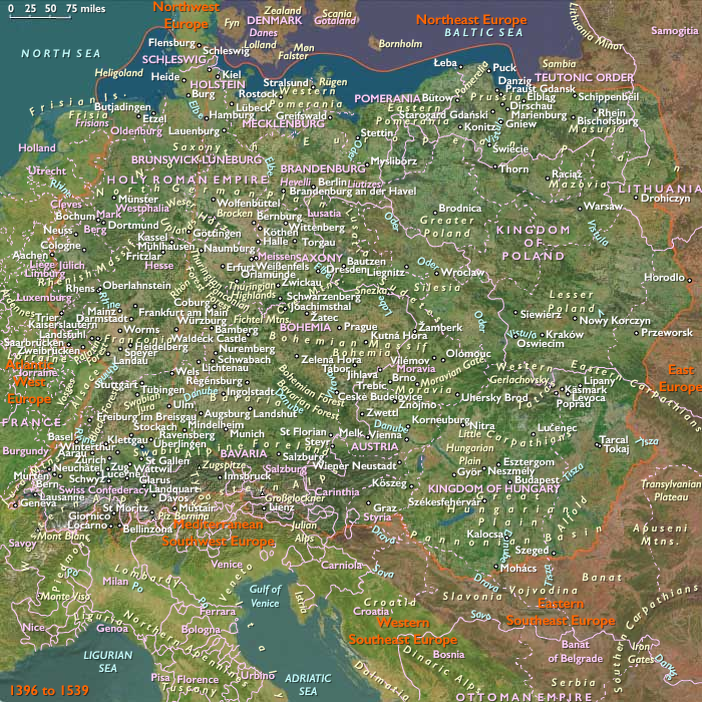
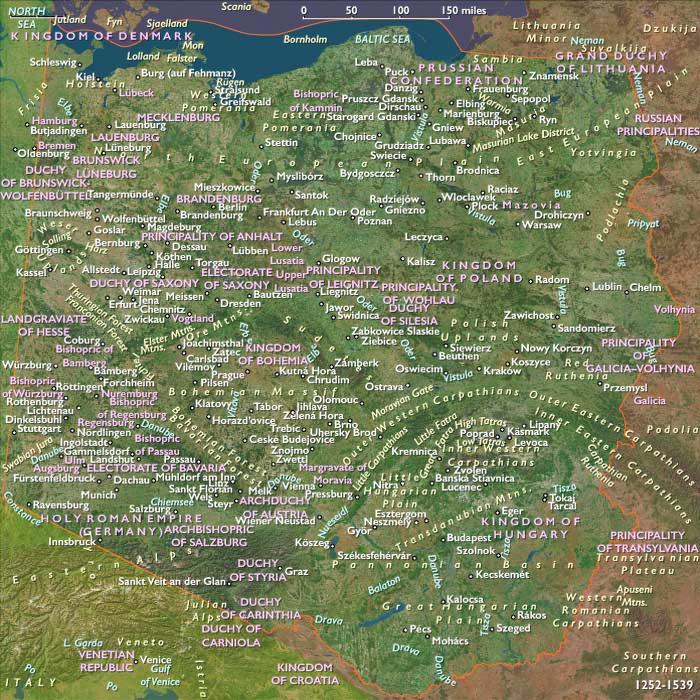
The Old Salt Route is a trade route in northern Germany for the transport of salt, which, also called "white gold", is mined near Lüneburg.
The trade route leads from here northward to …
Locations
Groups
Commodoties
Subjects
Regions
Subregions
Related Events
Filter results
Showing 10 events out of 42836 total
The initial decades of Japan’s Ashikaga Shogunate, which had begun in 1336 with the installation of the shogun Ashikaga Takauji, is also known as the Nanboku-chō or Northern and Southern Court period, during which there existed a North Imperial Court, established by Ashikaga Takauji in Kyoto, and a South Imperial Court, established by Emperor Go-Daigo in Yoshino.
The two courts had fought for fifty years, with the South giving up to the North in 1392.
What distinguishes the Ashikaga shogunate from that of Kamakura is that, whereas Kamakura had existed in equilibrium with the Kyōto court, Ashikaga Takauji had taken over the remnants of the imperial government by siding with the Emperor against the previous Kamakura shogunate.
Although the Ashikagas have shared more of the governmental authority with the Imperial government than had the Kamakuras, the Ashikaga shogun has never been as strong as the Kamakura had been, being greatly preoccupied with civil war.
The centralized master-vassal system used in the Kamakura system has been replaced with the highly decentralized daimyo (local lord) system, and the military power of the Ashikaga shogunate depends heavily on the loyalty of the daimyo.
Not until the rule of Ashikaga Yoshimitsu (as third shogun, from 1368 to 1394, and chancellor, from 1394) does a semblance of order emerge.
The period of Ashikaga rule is called Muromachi for the district of Kyoto in which its headquarters are located after Yoshimitsu established his residence here in 1378.
Korea’s Joseon Dynasty had been founded by Taejo Yi Seong-gye in 1392 in the aftermath of the overthrow of the Goryeo Kingdom at what is today the city of Kaesong, Korea.
The capital had been relocated to Hanseong (modern-day Seoul) from Gaegyeong (modern-day Gaeseong) in 1394 and the Gyeongbokgung palace had been erected.
Munmyo, Korea's primary Confucian shrine, is established in Hanseong by the scholar An Hyang in 1398, in the seventh and final year of the reign of King Taejo on the campus of Sungkyunkwan University, established in the same year to offer prayers and memorials to Confucius and his disciples, and to promote the study of the Confucian canon.
When the new Joseon dynasty was promulgated and officially brought into existence, Taejo had raised the issue of which son will be his successor.
Although Taejo's fifth son by Queen Sineui, Yi Bang-won, had contributed most to assisting his father's rise to power, he harbors a profound hatred against two of his father's key allies in the court, the prime minister Jeong Do-jeon and Nam Eun.
Both sides are fully aware of the mutual animosity that exists between each other and constantly felt threatened.
When it becomes clear that Yi Bang-won is the most worthy successor to the throne, Jeong Do-jeon uses his influence on the king to persuade him that the wisest choice would be in the son that Taejo loves most, not the son that Taejo feels is best for the kingdom.
In 1392, the eighth son of King Taejo (the second son of Queen Sindeok), Grand Prince Uian (Yi Bang-seok), had been appointed Prince Royal, or successor to the throne.
After the sudden death of the queen, and while King Taejo was still in mourning for his second wife, Jeong Do-jeon conspires to preemptively kill Yi Bang-won and his brothers to secure his position in court.
In 1398, upon hearing of this plan, Yi Bang-won immediately revolts and raids the palace, killing Jeong Do-jeon, his followers, and the two sons of the late Queen Sindeok.
This incident becomes known as the First Strife of Princes.
Aghast at the fact that his sons are willing to kill each other for the crown, and psychologically exhausted from the death of his second wife, King Taejo immediately crowns his second son Yi Bang-gwa, later King Jeongjong, as the new ruler.
Hereafter, King Taejo retires to the Hamhung Royal Villa.

The Ferapontov monastery is established in 1398 by Ferapont in the inhospitable Vologda region of northern Russia, to the east from the Kirillo-Belozersky Monastery, named after his fellow monk, Kirill of Beloozero.
The fame of the monastery would begin to spread under Kirill's disciple, Saint Martinian.
(Preserved more or less intact from the seventeenth century due to its relative inaccessibility, the monastery is today considered one of the purest examples of Russian medieval art, a reason given by UNESCO for its inscription on the World Heritage List. )
The army of Vytautas moves from the Dnieper River and attacks northern Crimea in 1398 building a castle there and raiding east as far as the River Don; Lithuania now spans from the Baltic Sea to the Black Sea.
A number of Tatar captives are brought to ethnic Lithuania.
Vytautas and his cousin, Wladyslaw II (or IV) Jagiello of Poland, inspired by their great successes, win support from Pope Boniface IX for organizing a crusade against the Mongols.
This political move also demonstrates that the formerly pagan Grand Duchy of Lithuania has fully accepted Christianity and is defending the faith on its own, and that the Teutonic Knights have no further basis for attacks against Lithuania.
Vasily, Grand Prince of Moscow since 1389, oldest son of Dmitri Donskoi and Grand Princess Eudoxia—daughter of the Grand Prince Dmitry Konstantinovich of Nizhny Novgorod—has continued the process of unification of the Russian lands: in 1392, he had annexed the principalities of Nizhny Novgorod and Murom; in 1397-1398, Kaluga, Vologda, Veliki Ustyug and the lands of the Komi peoples.
During his reign, feudal landownership has continued to grow.
With the growth of princely authority in Moscow, feudals' judicial powers have been partially diminished and transferred to Vasily's deputies and heads of the traditional administrative subdivisions called volosts.
To prevent Russia from being attacked by the Golden Horde, Vasily had entered into alliance with Lithuania in 1392 and married Sophia of Lithuania, the only daughter of Vytautas the Great.
(The alliance will turn out to be fragile, as Vytautas will capture Vyazma and Smolensk in 1403–1404.)
Timur, who had raided the Slavic lands in 1395, had ruined the Volgan regions but had not penetrated so far as Moscow.
Timur's raid had been of service to the Russian prince as it had damaged the Golden Horde, throwing it into a state of anarchy that will last twelve years.
During the whole of this time no tribute will be paid by Muscovy to the khan though vast sums of money are collected in the Moscow treasury for military purposes.
Tver, Moscow, and Lithuania have fought over control of Novgorod (and its enormous wealth) since the fourteenth century.
Upon becoming the Grand Prince of Vladimir, Mikhail Yaroslavich of Tver had sent his governors to Novgorod.
A series of disagreements with Mikhail had pushed Novgorod towards closer ties with Moscow during the reign of Grand Prince Yury Danilovich.
In part, Tver's proximity (the Tver Principality is contiguous with the Novgorodian Land) threatens Novgorod.
It had been feared that a Tverite prince would annex Novgorodian lands and thus weaken the Republic.
At the time, though, Moscow did not touch Novgorod, and since the Muscovite princes were further afield, they were more acceptable as princes of Novgorod.
They could come to Novgorod's aid when needed, but would be too far away to meddle too much in the Republic's affairs.
As Muscovy has grown in strength, however, the Muscovite princes have become a serious threat to Novgorod.
Ivan I Danilovich Kalita, his son Simeon Gordiyi, and other Muscovite monarchs have sought to limit Novgorod's independence.
In 1397, a critical conflict had taken place between Muscovy and Novgorod, when Moscow had annexed the Dvina Lands along the course of the Northern Dvina.
These lands are crucial to Novgorod's well-being since much of the city's furs come from there.
This territory is returned to Novgorod the following year.
This protracted period of war between the Lithuanians and the Teutonic Knights is ended on October 12, 1398 by the treaty of Sallinwerder, named after the islet in the Neman River where it is signed.
Lithuania agrees to cede Samogitia and assist the Teutonic Order in a campaign to seize Pskov, while the Order agrees to assist Lithuania in a campaign to seize Novgorod.
Local nobles shortly afterwards crown Vytautas as a king.
The Teutonic Knights war frequently with expansionist Lithuania, taking the city of Siauliai and the surrounding territory of Samogitia.
The island of Gotland, near Sweden, considered by some historians to be the original homeland of the Goths, had been governed separately from the city of Visby.
A civil war caused by conflicts between the German merchants in Visby and the trading peasants of the countryside had had to be put down by King Magnus III of Sweden in 1288.
Waldemar Atterdag of Denmark in 1361 had invaded the island.
The Victual Brothers, a companionship of privateers who later turned to piracy, had occupied the island in 1394 to set up a stronghold headquarters on their own in Visby, impartially raiding everyone's shipping.
Their famous battle cry is "God's friends and the whole world's enemies".
Queen Margaret and King Albert of Sweden concede Gotland to the allied Teutonic Order as a pledge (similar to a fiefdom), awarded to them on the condition that they expel the piratical Victual Brothers from their fortified sanctuary.
An invasion army of Teutonic Knights under Konrad von Jungingen, the Grand Master of the Order, conquers the island in 1398, destroying Visby and driving the Victual Brothers from Gotland.
…Lübeck, from where it is shipped to such destinations around the Baltic Sea as Falsterbo, with its Scania Market, where it is needed for the preservation of fish, which is exported through Lübeck to continental Europe.
The salt trade is a major factor in the power of Lübeck and the Hanseatic League.
The salt is brought by carts from Lüneburg to Lauenburg at the Elbe river, and from here via Mölln to Lübeck.
The Stecknitz Canal, built between 1390 and 1398 as part of the Old Salt Route, is one of the first artificial waterways of Europe, connecting the tiny rivers Stecknitz (tributary of the Trave) and Delvenau (tributary of the Elbe).
Ninety-four kilometers in length, the northern terminus is Lübeck, …