
The Norwegian royal succession is an important …
Years: 1277 - 1277
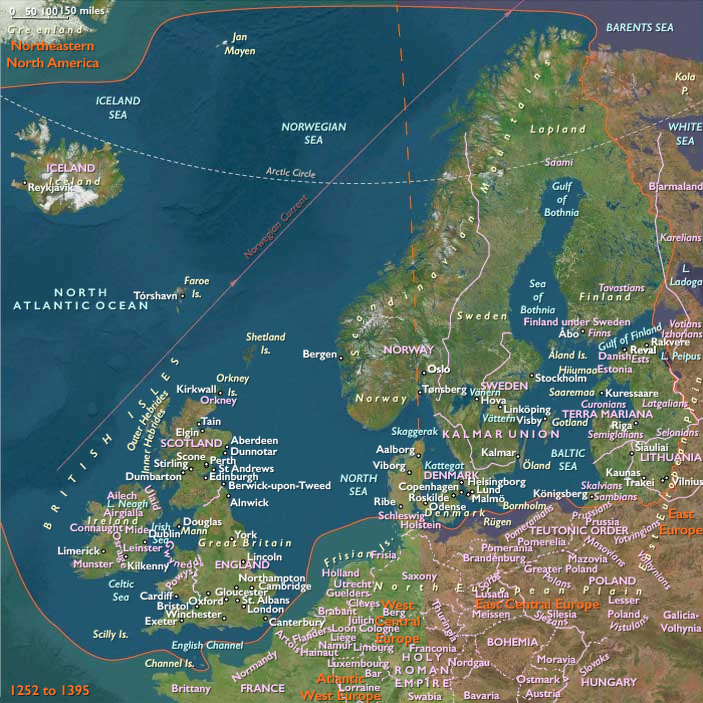
The Norwegian royal succession is an important and prickly matter, the last of the civil wars, fought for decades over disputed successions to the throne, having finally ended only in 1240.
In 1273, Magnus had given his eldest son, five-year-old Eirik, the name of king, and his younger brother Håkon the title of duke, thus making unequivocally clear what the royal succession would be.
Although Magnus is by all accounts a personally very pious king, his work with the law-codes brings him into conflict with the archbishop, who resists temporal authority over the church, and seeks to preserve the church's influence over the kingdom.
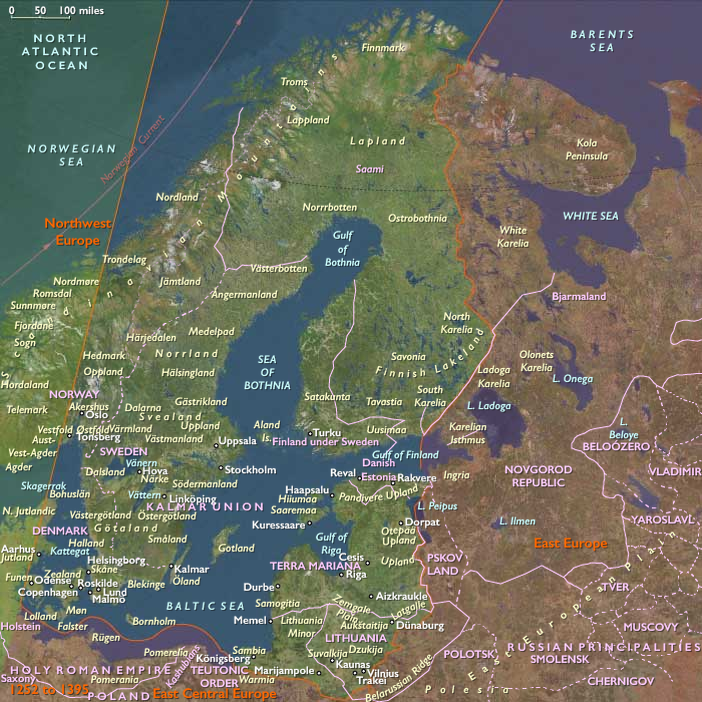
The Tønsberg Concord (Sættargjerden in Tønsberg) signed in 1277 between King Magnus and Jon Raude, Archbishop of Nidaros, confirms certain privileges of the clergy, the freedom of episcopal elections and similar matters.
The church preserves considerable independence in judicial matters, but gives up its old claim that the Norwegian kingdom is a fief under the ultimate authority of the Catholic Church.
In cultural terms, Magnus continues his father's policy of introducing European courtly culture to Norway.
In 1277 he replaces the old Norse titles lendmann and skutilsvein with the European titles baron and riddar (knight), at the same time giving them certain extra privileges and the right to be addressed as lord (herra).
Magnus is probably also the first Norwegian king to have named himself using an ordinal number—he calls himself "Magnus IV" (he did not count Magnus Haraldsson (II) and Magnus Sigurdsson (IV)).
Locations
People
Groups
Subjects
Regions
Subregions
Years: 1277 - 1277
Locations
People
Groups
Subjects
Regions
Subregions