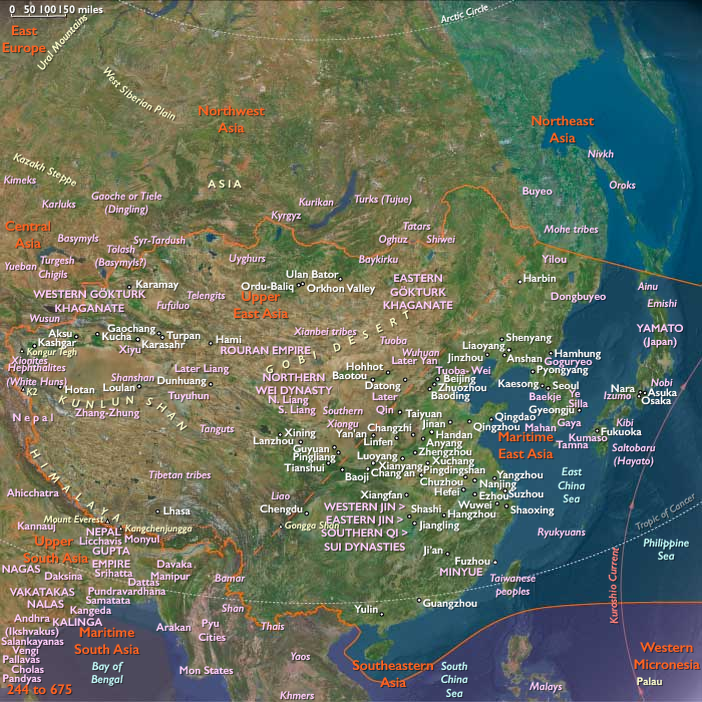
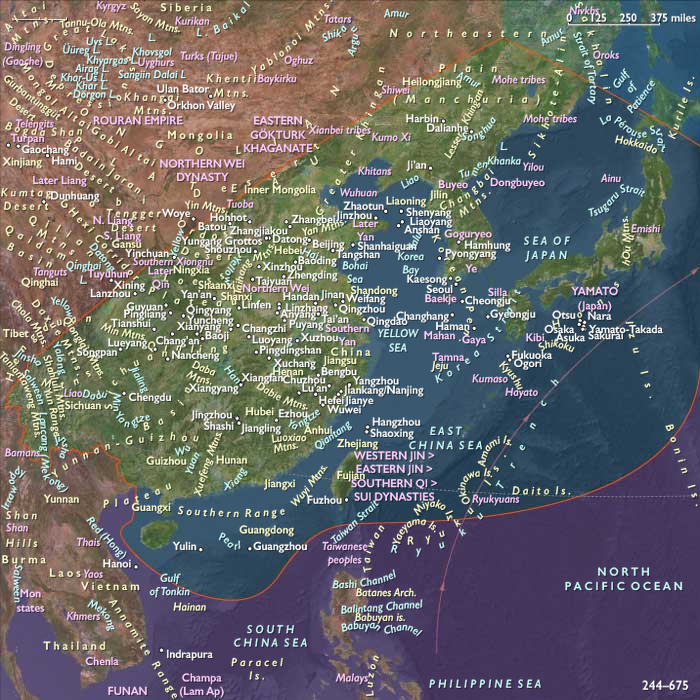
The Northern Wei Dynasty moves its capital …
Years: 494 - 494
The Northern Wei Dynasty moves its capital from Datong to Luoyang in 494.
Emperor Xiaowen makes Chinese the official language of his court and orders his nobles to adopt Chinese names.
After this move, …
Locations
People
Groups
- Xianbei
- Tuoba
- Chinese (Han) people
- Northern Wei, Xianbei, or Tuoba Empire
Topics
Commodoties
Subjects
Regions
Subregions
Related Events
Filter results
Showing 10 events out of 81 total
Grand Duke Konstantin Pavlovich had had no intention of observing the constitution, one of the most progressive in Europe at that time.
Appointed by Tsar Alexander II of Russia as governor-general of Poland despite numerous protests by various Polish politicians who had actively supported the personal union of the Congress Kingdom of Poland with the Russian Empire, Pavlovich has persecuted Polish social and patriotic organizations, the liberal opposition of the Kaliszanie faction, and replaced Poles with Russians in important administrative positions.
Although he is married to a Pole (Joanna Grudzinska), he is commonly viewed as an enemy of the Polish nation.
In addition, his command over the Polish Army has led to serious conflicts within the officer corps.
These frictions have led to various conspiracies throughout the country, most notably within the army.
Armed struggle in Poland begins when a group of conspirators led by a young cadet from the Warsaw officers' school, Piotr Wysocki, takes arms from their garrison on November 29, 1830 and attack the Belweder Palace, the main seat of the Grand Duke.
The final spark that ignites Warsaw is a Russian plan of using the Polish Army to suppress the July Revolution in France and the Belgian Revolution, which would have been a clear violation of the Polish constitution.
The rebels manage to enter the residence, but the Grand Duke escapes in women's clothing.
The rebels then turn to the main city arsenal, capturing it after a brief struggle.
Armed Polish civilians force the Russian troops out of Warsaw the following day, causing them to withdraw to the north of the city.
This incident is sometimes called the Warsaw Uprising or November Night.
The local Polish government (Administrative Council), taken by surprise by the rapid unfolding of events during the night of November 29, assembles immediately to take control and to decide on a course of action.
Unpopular ministers are removed and men like Prince Adam Jerzy Czartoryski, the historian Julian Ursyn Niemcewicz and General Józef Chłopicki take their places.
Loyalists led by Prince Czartoryski initially try to negotiate with the Grand Duke and to settle matters peacefully.
However, when Czartoryski tells the Council that Konstantin is ready to forgive the offenders and that the matter will be amicably settled, Maurycy Mochnacki and other radicals angrily object and demand a national uprising.
Fearing an immediate break with Russia, the Government agrees to let Konstantin depart with his troops.
Mochnacki does not trust the newly constituted ministry and sets out to substitute in its place the Patriotic Club, organized by him.
At a large public demonstration on December 3 in Warsaw, he denounces the negotiations between the Government and Konstantin, who is encamped outside the city.
Mochnacki advocates a military campaign in Lithuania to spare the country the devastation of war and to shield the native sources of food supply.
The meeting adopts a number of demands to be communicated to the Administrative Council, including the establishment of a revolutionary government and an immediate attack upon the forces of Konstantin.
The Polish army, with all but two of its generals, Wincenty Krasinski and Zygmunt Kurnatowski, now joins the uprising.
The remaining four ministers of the pre-revolutionary cabinet leave the Administrative Council, and their places are taken by Mochnacki and three of his associates from the Patriotic Club—among them Joachim Lelewel.
The new body is known as the Provisional Government.
Poland's Provisional Government orders the convocation of the Sejm to legalize its actions, and on December 5, 1830, proclaims Chlopicki as Dictator of the Uprising.
Chlopicki considers the uprising an act of madness, but bows to strong pressure and consents to take command temporarily, in the hope that it would be unnecessary to take the field.
An able and highly decorated soldier, he had retired from the army because of the chicanery of Konstantin.
He overestimates the power of Russia and underestimates the strength and fervor of the Polish revolutionary movement.
By temperament and conviction, he is opposed to a war with Russia, in the success of which he does not believe.
He accepts the dictatorship essentially in order to maintain internal peace and to save the Constitution.
The first move made by Józef Chlopicki, who believes that Tsar Nicholas is unaware of his brother's actions and that the uprising can be ended if the Russian authorities accept the Constitution, is to send Count Franciszek Ksawery Drucki-Lubecki to Saint Petersburg to negotiate.
General Chlopicki refrains from strengthening the Polish army and refuses to initiate armed hostilities by expelling Russian forces from Lithuania.
However, the radicals in Warsaw press for war and the complete liberation of Poland.
On December 13, the Sejm pronounces the National Uprising against Russia.
Count Drucki-Lubecki returns with no concessions from Russia on January 7, 1831.
The Tsar demands the complete and unconditional surrender of Poland and announces that the Poles should surrender to the grace of their Emperor.
Chlopick, his plans foiled, resigns the following day.
Power in Poland is now in the hands of the radicals united in the Towarzystwo Patriotyczne (Patriotic Society) led by Joachim Lelewel.
The Sejm passes the Act of Dethronization of Nicholas I, which ends the Polish-Russian personal union and is equivalent to a declaration of war on Russia, on January 25, 1831.
The proclamation declares "the Polish nation is an independent people and has a right to offer the Polish crown to him whom it may consider worthy, from whom it might with certainty expect faith to his oath and wholehearted respect to the sworn guarantees of civic freedom."
On January 29, the National Government of Adam Jerzy Czartoryski is established, and Michal Gedeon Radziwill is chosen as successor to Chlopicki.
Chlopicki is persuaded to accept active command of the army.
It is too late to move the theater of hostilities to Lithuania.
East Europe (1852–1863 CE): Conflict, Reform, and National Realignment
Political and Military Developments
Crimean War (1853–1856)
The Crimean War dominated this era, involving a coalition of France, Britain, the Ottoman Empire, and Sardinia against Russia. The conflict centered around territorial ambitions, religious rights, and control of strategic areas such as the Black Sea. Russia suffered significant defeats, notably at Sevastopol, leading to the Treaty of Paris (1856), which curtailed Russian naval power and influence in the region.
Post-War Reforms under Alexander II
Following the war, Tsar Alexander II initiated comprehensive reforms aimed at modernizing Russia. The period saw the early stages of significant administrative, military, and judicial reforms, setting the groundwork for systemic transformation.
Economic and Technological Developments
Accelerated Industrialization
Industrialization accelerated notably, driven by war demands and subsequent reconstruction efforts. Growth was especially pronounced in the armaments industry, heavy machinery, and infrastructure development, facilitating broader economic modernization.
Railway Expansion
Railway networks expanded significantly, improving logistical capabilities and economic integration within Russia and Eastern Europe. The expansion facilitated military mobility and commercial activities, connecting major urban and industrial hubs more effectively.
Cultural and Artistic Developments
Cultural Reflection on War and Reform
Literature and arts of the period deeply reflected the experiences of war and societal transformation. Prominent authors such as Leo Tolstoy, whose experiences in the Crimean War influenced his later works, critically explored the human and societal impacts of conflict and reform.
Educational Reforms
Educational reforms gained momentum under Alexander II, expanding public and technical education, though censorship remained active. Universities and technical schools proliferated, furthering intellectual discourse and scientific inquiry.
Settlement Patterns and Urban Development
Post-War Urban Reconstruction
Urban reconstruction following the Crimean War was significant, particularly in areas directly impacted by the conflict. Cities like Sevastopol underwent extensive rebuilding, incorporating modern urban planning and fortifications.
Enhanced Defensive Infrastructure
Post-war fortification efforts strengthened defensive infrastructure, particularly around strategic locations and borders. These enhancements aimed at bolstering security and resilience against future conflicts.
Social and Religious Developments
Emancipation of the Serfs (1861)
One of the most transformative social developments was the Emancipation of the Serfs by Alexander II in 1861. This landmark reform liberated millions, significantly altering Russia's social fabric and labor systems, despite subsequent challenges regarding peasant livelihoods and land redistribution.
Church Reforms and Social Integration
The relationship between the state and the Russian Orthodox Church adapted to social transformations, with the Church playing a crucial role in supporting state reforms and managing social transitions, particularly around serf emancipation.
Long-Term Consequences and Historical Significance
The era from 1852 to 1863 CE was profoundly shaped by the Crimean War and subsequent comprehensive reforms. Russia’s defeat prompted critical introspection and a commitment to modernization, significantly reshaping the nation's military, administrative, economic, and social structures. These developments fundamentally altered the trajectory of Eastern Europe, setting the stage for further reforms and enduring geopolitical shifts.

Thus the Crimean War begins, but the European powers are frightened of Russia, and in 1854 Britain, France, and Sardinia join the Ottoman Empire against Russia.
Austria offers the Ottomans diplomatic support, while Prussia remains neutral.
The European allies land in Crimea and lay siege to a well-fortified base at Sevastopol'.
After a year's siege the base falls, exposing Russia's inability to defend a major fortification on its own soil.
Nicholas I dies before the fall of Sevastopol', but even before then he had recognized the failure of his regime.
Russia now has to initiate major reforms or cease to be a competitive major power.
Years: 494 - 494
Locations
People
Groups
- Xianbei
- Tuoba
- Chinese (Han) people
- Northern Wei, Xianbei, or Tuoba Empire