The northern boundary of the kingdom established …
Years: 300BCE - 300BCE
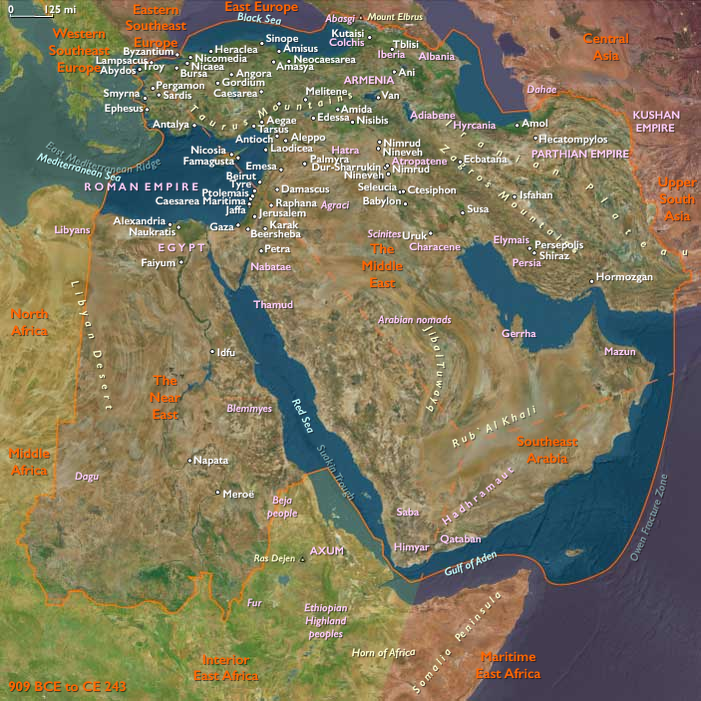
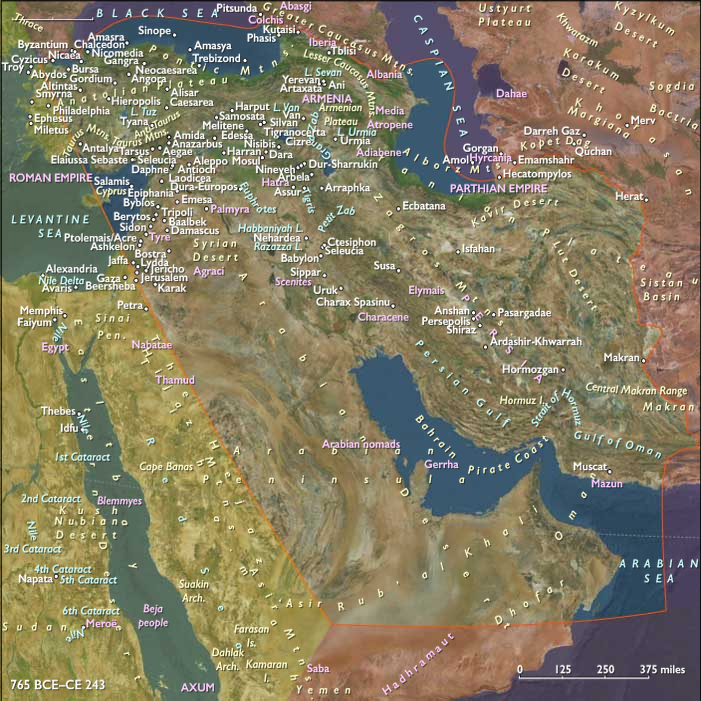
The northern boundary of the kingdom established in the late fourth century by Ptolemy I lies apparently slightly north of the modern Tripoli, perhaps on the course of the Kabir River.
Tripoli, founded after 700, becomes in 300 the capital of Tripolis, a Phoenician federation including Sidon, Tyre, and Aradus.
Locations
People
Groups
Topics
Commodoties
Subjects
Regions
Subregions
Related Events
Filter results
Showing 10 events out of 64128 total
Bands of Celts begin to penetrate southward into the Balkans at the beginning of the third century BCE.
Their superiority rests in part upon their mastery of iron technology, which they use to make both swords and plowshares.
The extent of Celtic settlement is indicated by coins, silverwork, and burial mounds.
Singidunum (now Belgrade), the name of the settlement referred to by the Romans, is partly of Celtic origin.
The victors divide the lands of their enemy among them, with Seleucus assuming control over Mesopotamia and Syria.
A dispute arises between Seleucus and Ptolemy, who had not taken part in the war, over Syria, particularly the southern Syrian ports, which serve as terminal points for the caravan routes.
This quarrel, however, is temporarily settled peacefully through compromise.
In addition to the southern part of Syria, Coele Syria, (Palestine), Ptolemy apparently also occupies Pamphylia, Lycia, and part of Pisidia in southern Asia Minor.
This will eventually give rise to a long series of Syrian wars between the Seleucids and Ptolemies.
For the time being, however, Seleucus declines to enforce his claim; he merely transfers his capital from Seleucia on the Tigris to …
…the newly founded city of Antioch on the Orontes (301 BCE-300 BCE).
The Arthasastra, which describes the authoritarian regime established by Chandragupta, offers advice to a ruler as to how to keep the throne.
A treatise on statecraft, economic policy and military strategy, it identifies its author by the names 'Kautilya' and 'Viṣhṇugupta', both names that are traditionally identified with the Brahmin Chāṇakya (about 350–283 BCE), who was a scholar at Takshashila and the teacher and guardian Chandragupta.
The Arthasastra will become the pattern for succeeding Indian kingdoms.
Thomas R. Trautmann and I.W. Mabbett have hypothesized that the 'Arthaśāstra' is a composition from no earlier than the second century CE, but is clearly based on earlier material.
Their explanation is that while the doctrines of the 'Arthashstra' may have been written by Chānakya in the fourth century BCE, the treatise we know today may have been edited or condensed by another author in the second century CE.
This would explain, some affinities with smrtis (Sanskrit: literally "that which is remembered," referring to a specific body of Hindu religious scripture; it is a codified component of Hindu customary law) and references in the Arthashastra that would be anachronistic for the fourth century BCE.
The Epirote king Pyrrhus, dethroned in 302 BCE by an uprising, had fought beside Demetrius in Asia and had been sent to Alexandria as a hostage under the treaty between Ptolemy and Demetrius.
Ptolemy, as a consequence of the defeats he suffered between 308 BCE and 306 BCE, now prefers to secure and expand his empire through a policy of alliances and marriages rather than through warfare.
Anxious to improve relations with Lysimachus, he concludes an alliance in 300 BCE.
The striking Temple of Apollo at Didyma, a temple within a temple that highlights the popular Ionic order, is completed around 300 BCE.
Seleucus I Nicator had brought the bronze cult image back to Didyma, the largest and most significant sanctuary on the territory of the great classical city Miletus, and the Milesians have begun to build a new temple, which, if it had ever been completed, would have been the largest in the Hellenic world.
Vitruvius records a tradition that the architects were Paeonius of Ephesus, whom Vitruvius credits with the rebuilding of the Temple of Artemis there, and Daphnis of Miletus.
The peripteral temple is surrounded by a double file of Ionic columns.
With a pronaos of three rows of four columns, the approaching visitor passes through a regularized grove formed of columns.
The usual door leading to a cella is replaced by a blank wall with a large upper opening through which one can glimpse the upper part of the naiskos in the inner court (adyton).
The entry route lies down either of two long constricted sloping passageways built within the thickness of the walls that give access to the inner court, still open to the sky but isolated from the world by the high walls of the cella: there is the ancient spring, the naiskos—which is a small temple itself, containing in its own small cella the bronze cult image of the god—and a grove of laurels, sacred to Apollo.
The cella's inner walls are articulated by pilasters standing on a base the height of a man (one point ninety-four meters).
The visitor, turning back again, sees a monumental staircase that leads up to three openings to a room whose roof is supported by two columns on the central cross-axis.
The oracular procedure, so well documented at Delphi, is unknown at Didyma and must be reconstructed on the basis of the temple's construction, but it appears that several features of Delphi were now adopted: a priestess and answers delivered in classical hexameters.
At Delphi, nothing is written; at Didyma, inquiries and answers are written; a small structure, the Chresmographion, features in this process: it will be meticulously disassembled in the Christian period.

An Illyrian kingdom based near what is now the Albanian city of Shkodër controls parts of present northern Albania, Montenegro, and Herzegovina by the end of the third century BCE.
Old Comedy had disappeared with the defeat of Athens at the end of the Peloponessian War, as the new authorities did not permit the pointed satire and licentiousness that formed the genre’s core.
Greek comic dramatist Menander is the leading practitioner of the New Comedy, which has developed in its stead.
In the new form, vivid, realistic characters interact in a complicated but structured plot.
The importance of the chorus, or music in general, diminishes; the phallus disappears from the stage; and sex, Old Comedy’s primary concern, is replaced by money, marriage, and family situations.
Philemon, a popular forty-something comic playwright who has for some years been writing in Athens, had in about 307 become a citizen of the city.
A rival of Menander for popular favor at the annual dramatic festivals, Philomen is sometimes credited with the introduction of New Comedy to the Greek stage.
In any case, Philemon and Menander lead the New Comedy movement, writing skillfully plotted comedies of manners that use stock characters and avoid sensitive subjects.
Zeno of Citium, a Cypriot philosopher who had gone to Athens at about the age of twenty-three, had been impressed both by the Cynics and the Megarian logicians.
Zeno teaches moral obligation, self-control, and harmony with nature.
Advocating a life that "follows reason"—that is free from passion, dignified, and self-respecting—he founds the austere ethical doctrine of Stoicism, based on the notion that one is either a good person in every way, or, if one succumbs to any shortcomings, is totally without virtue.
Zeno teaches that the human soul is not complex but is truly only reason; the remainder—ambition, appetite, fear—is in no way part of the self and should therefore be eliminated.
An atomic theory offered by Epicurus is similar to one formulated by Democritus.
Epicurus teaches that the universe’s creation came about by chance, that the physical things we sense are real and that we may trust our senses.
As there is no sensation after death, we need not fear it.
As the soul—composed, according to Epicurus, of the body’s finest particles—cannot exist independently of the body, pleasure is therefore the highest pursuit, with intellectual pleasure a greater good than sensual pleasures.
Epicurus also teaches that natural selection favors only those who are fit to survive.
The territory of Rome’s territory is greater than that of the Etruscans by around 300, when the city emerges as the leader of the Latin League, although Carthaginian expansion has limited the two powers to mainland Italy.
Rome’s plebeians, having gradually succeeded in their lengthy fight for equality with the patricians, are by this time eligible to hold all major political and religious posts.
The early history of the legion, the basic combat unit of the ancient Roman army, is obscure, but by this date it has received its traditional form: a three thousand to six thousand-man division, consisting primarily of heavy infantry (hoplites), supported by light infantry (velites), and sometimes by cavalry.
The hoplites, drawn up in three lines, consist of the hastati (youngest men) in the first, the principes (seasoned troops) in the second, and the triarii (oldest men) behind them, reinforced by velites.
Each of these lines is divided into ten maniples, consisting of two centuries (sixty to eighty men per century) each.
The cohort is composed of one maniple from each line, plus the support forces.