
The Norman invasion of Italy is a …
Years: 1054 - 1054
The Norman invasion of Italy is a matter of as much concern to the papacy as it is to Constantinople.
The Norman venture, however, has brought the papacy into conflict with the Eastern Church centered in Constantinople, which, since the eighth century, has exercised jurisdiction over large areas of southern Italy and Sicily.
The forcefully enunciated papal theme of primacy in Leo's pontificate complicates the relations between Rome and Constantinople still further because the patriarch of Constantinople, Michael I Cerularius, considers this sheer provocation.
He closes the Latin (Western) churches in Constantinople and raises serious dogmatic charges against the Roman Church, notably in connection with the Eucharist.
The French cardinal Humbert of Silva Candida has attacked the Patriarch in a vitriolic and passionate manner by arguing the case for Roman primacy and quoting extensively from the forged Donation of Constantine, which allegedly bestowed sovereignty in the West on the papacy.
A legation under Humbert's leadership leaves for Constantinople in April 1054.
On arrival Humbert is cordially welcomed by the Emperor Constantine IX, but spurned by the patriarch.
Despite several meetings between Patriarch, Emperor, and legates, no concrete results emerge.
Cerularius again obstructs Constantine's and Leo's efforts by refusing to meet with the legates.
Eventually, on July 16, 1054, despite the fact that Leo has died and the excommunication is invalid, Humbert takes advantage of the papal vacancy to retaliate against Cerularius and his clergy, putting the papal bull of excommunication -- already prepared before the legation left Rome—on the altar of the church of Hagia Sophia in Constantinople during the celebration of the liturgy and in the full view of the congregation.
The Patriarch, in response, convenes a Holy Synod and excommunicates the legation and its supporters.
This event crystallizes in an official way the gradual estrangement of Eastern and Western Christianity.
Constantine's efforts to effect a reconciliation fail, and the schism between Rome and Constantinople is final.
The Schism of 1054, also called the East-West Schism, symbolizes an irreconcilable difference in ideology.
It is to last, with short interruptions, until the modern age.
The reform movement in the Roman Church has emphasized an ideal of the universal role of the papacy that is wholly incompatible with Greek Christian tradition.
Both sides have also deliberately aggravated their differences by reviving all the disputed points of theology and ritual that had become battle cries during the Photian Schism in the ninth century.
The schism of 1054 passes unnoticed by contemporary imperial historians; only later will its significance as a turning point in East-West relations be fully realized.
(Not long after this break, the word “catholic,” which has come to be used to distinguish true believers from false believers, is used to identify the Western church; the Eastern church is called orthodox.)
Locations
People
Groups
- Christianity, Chalcedonian
- Greeks, Medieval (Byzantines)
- Roman Empire, Eastern: Macedonian dynasty
- Normans
- German, or Ottonian (Roman) Empire
- Italy, Catepanate of
- Christians, Roman Catholic
- Christians, Eastern Orthodox
Topics
Subjects
Regions
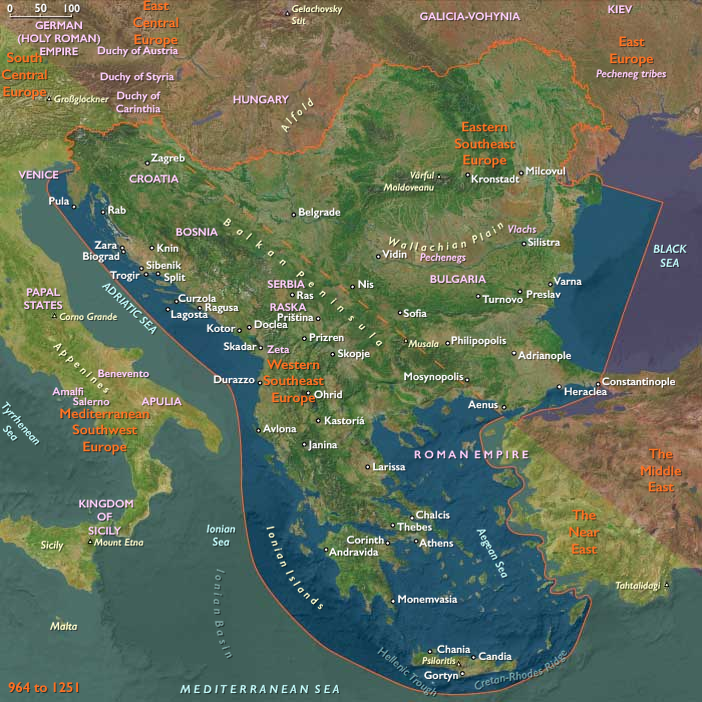
Subregions
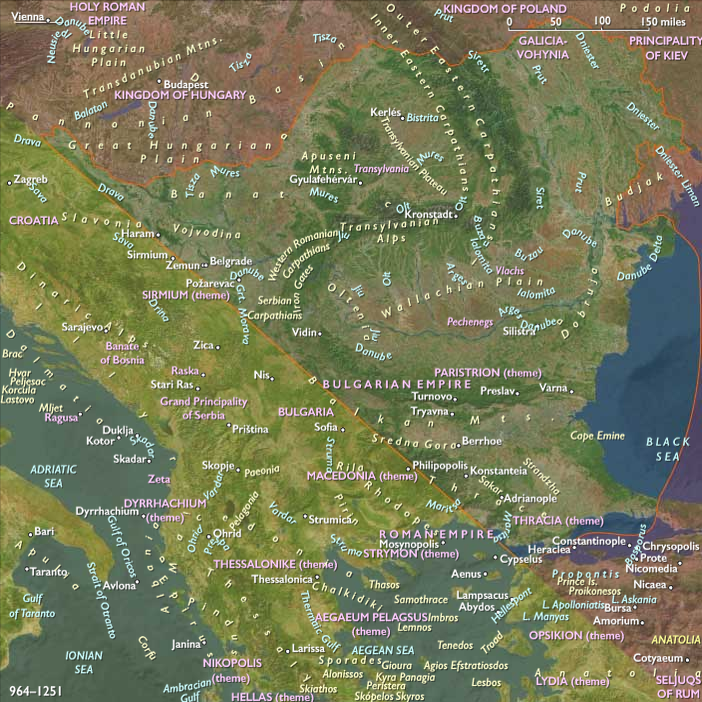
Related Events
Showing 10 events out of 47 total
Years: 1054 - 1054
Locations
People
Groups
- Christianity, Chalcedonian
- Greeks, Medieval (Byzantines)
- Roman Empire, Eastern: Macedonian dynasty
- Normans
- German, or Ottonian (Roman) Empire
- Italy, Catepanate of
- Christians, Roman Catholic
- Christians, Eastern Orthodox
Topics
Subjects
Regions
Subregions