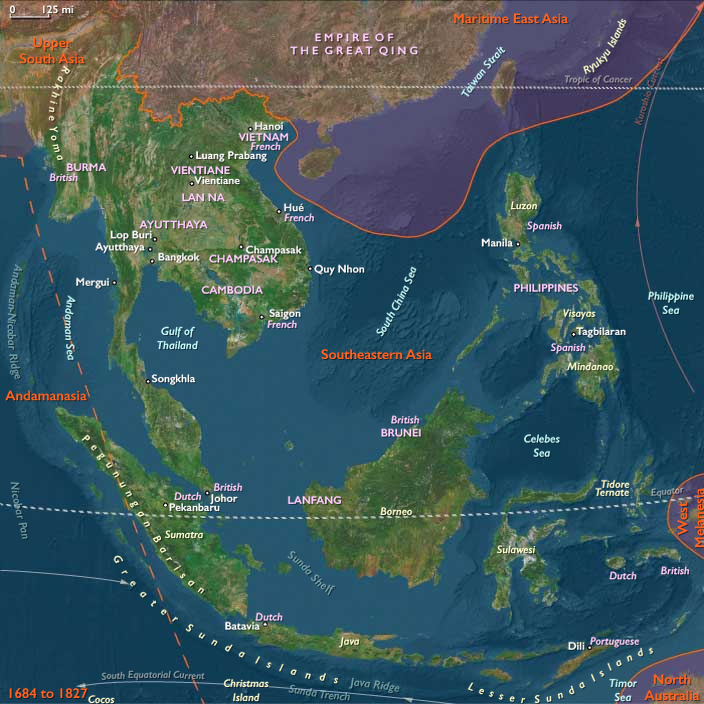
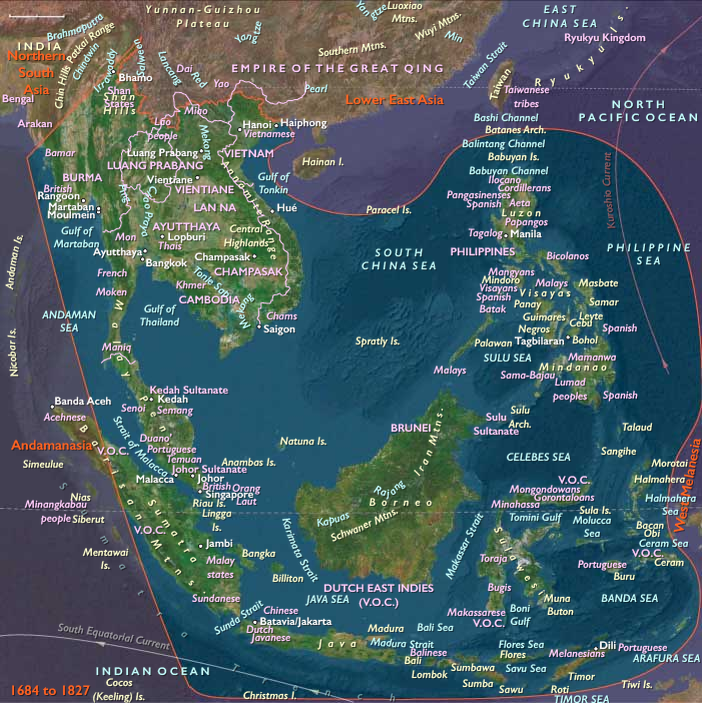
...the Nguyen Lords in the south, who …
Years: 1768 - 1779
...the Nguyen Lords in the south, who rule from their capital, Huế.
Both sides fight each other for control of the nation, while claiming to be loyal to the king.
Life for the peasant farmers is difficult.
Ownership of land has become more concentrated in the hands of a few landlords as time has passed.
The Mandarin bureaucracy is oppressive and often corrupt; at one point, royally sanctioned degrees are put up for sale for whoever is wealthy enough to purchase them.
In contrast to the people, the ruling lords live lavish lifestyles in huge palaces.
The decades-long war between the Trịnh and the Nguyen had ended in 1673, and life for the northern peasants is fairly peaceful.
However, the Nguyen Lords have engaged in a regular series of wars with the weak Khmer Empire, and later, the relatively strong state of Siam.
While the Nguyen usually win, and despite the fact that the new lands they conquer offer new opportunities for the landless poor, the frequent wars take a toll on their popularity.
Locations
People
Groups
- Dai Viet, Kingdom of
- Cambodia, Kingdom of
- Chinese Empire, Qing (Manchu) Dynasty
- Siam, (Thonburi) Kingdom of
Topics
Commodoties
Subjects
Regions
Subregions
Related Events
Filter results
Showing 10 events out of 26116 total
The years 1768 to 1779 may be described as an era of union (in which organizations become increasingly homogenous with unified purpose; economies and efficiencies develop in art, craft, industry, and infrastructure).
Northeast Asia (1768–1779 CE)
Russian Maritime Exploration and Ecological Impact
Between 1768 and 1779, Russian maritime and fur-trading activities in Northeast Asia intensified significantly, driven by ongoing exploration and commercial incentives. The fur trade continued to flourish, primarily targeting valuable sea otters, fur seals, and fox pelts from the Aleutian Islands and surrounding areas, increasingly impacting local ecosystems and indigenous populations.
During these decades, ships routinely stopped at the Commander Islands, primarily to hunt Steller's sea cows, a large sirenian mammal discovered by the German naturalist Georg Wilhelm Steller in 1741 during Vitus Bering's expedition. Initially numbering fewer than fifteen hundred at their discovery, these creatures provided meat, skins for boats, and valuable subcutaneous fat for cooking and lighting. Intensive hunting by sailors, seal hunters, and traders quickly drove the species to extinction by 1768, less than three decades after their discovery.
In addition to the ecological consequences, this period saw increased European maritime exploration of the region. Captain James Cook's third expedition, aimed at discovering a navigable Northwest Passage, significantly influenced European knowledge about Northeast Asia. After Cook's death in the Hawaiian Islands, command passed to Charles Clerke, who continued exploring the northern Pacific coast and proceeded to the Siberian Pacific coast. Clerke, already weakened by illness, died of tuberculosis on August 22, 1779, en route to Kamchatka. He was buried in Kamchatka on August 29, and his second-in-command, John Gore, assumed leadership, eventually guiding the expedition back to Britain.
This era underscores the profound environmental impact of intensified Russian commercial activities and highlights the significant geographical knowledge gained through European exploratory missions.
Kerguelen Islands appeared as the "Ile de Nachtegal" on Philippe Buache's map from 1754 before the island is officially discovered in 1772.
The Buache map has the title Carte des Terres Australes comprises entre le Tropique du Capricorne et le Pôle Antarctique où se voyent les nouvelles découvertes faites en 1739 au Sud du Cap de Bonne Esperance ('Map of the Southern Lands contained between the Tropic of Capricorn and the Antarctic Pole, where the new discoveries made in 1739 to the south of the Cape of Good Hope may be seen').
It is possible this early name was after Tasman's ship "De Zeeuwsche Nachtegaal."
On the Buache map, "Ile de Nachtegal" is located at 43°S, 72°E, about 6 degrees north and 2 degrees east of the accepted location of Grande Terre.
The islands are officially discovered by the French navigator Yves-Joseph de Kerguelen-Trémarec on February 15, 1772.
The next day Charles de Boisguehenneuc lands and claimed the island for the French crown.
Yves de Kerguelen organizes a second expedition in 1773 and arrives at the "baie de l'Oiseau" by December of the same year.
On January 6, 1774 he commands his lieutenant, Henri Pascal de Rochegude, to leave a message notifying any passers-by of the two passages and of the French claim to the islands.
Hereafter, a number of expeditions briefly visit the islands, including that of Captain James Cook in December 1776 during his third voyage, who verifies and confirms the passage of de Kerguelen by discovering and annotating the message left by the French navigator.
Soon after their discovery, the archipelago will be regularly visited by whalers and sealers (mostly British, American and Norwegian) who will hunt the resident populations of whales and seals to the point of near extinction
Vietnam is under the nominal rule of the officially revered, but politically ignored Lê Dynasty during the eighteenth century.
Real power is in the hands of two warring feudal families, the Trịnh Lords of the north, who control and rule from the imperial court in Hanoi, and ...
Taksin, the new king of Siam, launches a war in 1769 to regain control of Cambodia.
The war generally goes against the Nguyen and they are forced to abandon some of the newly conquered lands.
This failure, coupled with heavy taxes and corruption at the local level, causes three brothers from the village of Tay Son to begin a revolt against Lord Nguyen Phúc Thuần.
The Tay Son brothers style themselves as champions of the people.
Over the next year, the revolt gains traction and they win some battles against the Nguyen army units sent to crush their rebellion.
The Tay Son have a great deal of popular support, not only from the poor farmers, but from some of the indigenous highland tribes.
The leader of the three brothers, Nguyen Huệ, is also a very skilled military leader.
Nguyễn Huệ’s stated goal is to end the people's oppression, reunite the country, and restore the power of the Lê emperor in Hanoi.
The Tây Son also promise to remove corrupt officials and redistribute land.
In 1773 the Tay Son capture the port of Qui Nhon, where the merchants, who have suffered under restrictive laws put in place by the Nguyen, give the uprising financial support.
The Nguyen, at last recognizing the serious scale of the revolt, make peace with the Siamese, giving up some land they had conquered in previous decades.
However, their problems are compounded when Trịnh Sam chooses to end the one hundred-year peace and exploit the turmoil in the south by sending his army to attack Phú Xuân (modern day Huế), the Nguyen capital.
The Trịnh army captures the city, forcing the Nguyen to flee to Gia Định (later called Saigon).
The Trịnh army continues to head south and the Tay Son army continues its conquest of other southern cities.
The Nguyen are unpopular at this time, and the forces against them are too powerful.
The Tay Son army captures Gia Định, the last Nguyen stronghold, in 1776, and massacres the town's Han Chinese population.
The entire Nguyen family is killed at the end of the siege, except for one nephew, Nguyen Ánh, who manages to escape to Siam.
While they say they want to restore power to the Lê, one of the brothers, Nguyen Nhạc, proclaims himself Emperor in 1778.
A conflict with the Trịnh is thus unavoidable.
East Europe (1768–1779 CE): Military Triumphs and Enlightened Administration
Political and Military Developments
Expansion Through Military Success
Between 1768 and 1779 CE, Russia experienced significant military successes, notably in the Russo-Turkish War (1768–1774). These victories resulted in territorial expansions into the Black Sea region, significantly enhancing Russia’s strategic position and geopolitical influence.
Administrative Reforms and Enlightenment Ideals
The era saw continued administrative reforms inspired by Enlightenment principles, promoting efficiency, rational governance, and centralized authority. These reforms facilitated effective management of newly acquired territories and the integration of diverse populations.
Active Diplomatic Engagements
Russia’s diplomatic engagements expanded, securing influential alliances and agreements with European powers. Successful diplomacy bolstered Russia's standing in continental politics and strengthened its international position.
Economic and Technological Developments
Continued Economic Prosperity
Economic growth remained robust, driven by ongoing industrialization, agricultural advancements, and expanding trade networks. Economic prosperity supported military expenditures, infrastructure projects, and cultural patronage.
Infrastructure and Technological Advancements
Significant investments continued in transportation and urban infrastructure, enhancing connectivity and administrative efficiency. Advances in military technology and fortifications improved defense capabilities, reinforcing territorial security.
Cultural and Artistic Developments
Flourishing Cultural Life
Cultural patronage by the Russian elite thrived, fostering significant advancements in architecture, the arts, and literature. Continued European influence enriched cultural expressions and contributed to Russia's cultural sophistication.
Intellectual Growth and Education
The intellectual landscape expanded further, marked by increased academic activity and the establishment of new educational institutions. Scholarly exchanges with Europe encouraged intellectual innovation and cultural enrichment.
Settlement Patterns and Urban Development
Urban Expansion and Modernization
Urban centers, notably Saint Petersburg and Moscow, continued their rapid expansion, supported by strategic urban planning and improved infrastructure. These developments greatly enhanced urban livability, economic activity, and administrative capabilities.
Strategic Defense Enhancements
Improvements in urban and regional fortifications ensured robust defenses against external threats, contributing significantly to regional stability and security.
Social and Religious Developments
Strengthening Social Cohesion
Social integration and stability improved further, aided by inclusive policies accommodating diverse ethnic and regional groups. Enlightenment ideals continued to shape societal reforms, enhancing cohesion and administrative effectiveness.
Continued Evolution of Church-State Relations
Relations between the state and the Orthodox Church continued to evolve, marked by ongoing reforms aligning religious institutions with state interests. These adjustments reshaped the Church's societal role, supporting broader governmental objectives.
Long-Term Consequences and Historical Significance
The period from 1768 to 1779 CE witnessed significant military achievements, enlightened governance reforms, and continued cultural flourishing. These developments enhanced Russia’s international status and solidified foundational structures critical for future stability and imperial expansion.

Judicial rulings from Kraków are routinely flouted, while peasants are heavily taxed and practically tied to the land as serfs.
Occasionally the landowners battle each other using armies of Ukrainian peasants.
The Poles and Lithuanians are Roman Catholics and try with some success to convert the Orthodox lesser nobility.
In 1596, they had set up the "Greek-Catholic" or Uniate Church; it dominates western Ukraine to this day.
Religious differentiation leave the Ukrainian Orthodox peasants leaderless, as they are reluctant to follow the Ukrainian nobles.
Cossacks lead an uprising, called Koliivshchyna, starting in the Ukrainian borderlands of the Polish–Lithuanian Commonwealth in 1768.
Ethnicity is one root cause of this revolt, which includea Ukrainian violence that kills tens of thousands of Poles and Jews.
Religious warfare also breaks out among Ukrainian groups.
Increasing conflict between Uniate and Orthodox parishes along the newly reinforced Polish-Russian border on the Dnieper River in the time of Catherine II had set the stage for the uprising.
As Uniate religious practices have become more Latinized, Orthodoxy in this region has drawn even closer into dependence on the Russian Orthodox Church.
Confessional tensions also reflect opposing Polish and Russian political allegiances.
Russia experiences a major social upheaval, the Pugachev Uprising, during the 1768-74 war with the Ottoman Empire.
In 1773 a Don Cossack, Emel'yan Pugachev, announces that he is Peter III.
Other Cossacks, various Turkic tribes that feel the impingement of the Russian centralizing state, and industrial workers in the Ural Mountains, as well as peasants hoping to escape serfdom, all join in the rebellion.
Russia's preoccupation with the war enables Pugachev to take control of a part of the Volga area, but the regular army crushes the rebellion in 1774.
Years: 1768 - 1779
Locations
People
Groups
- Dai Viet, Kingdom of
- Cambodia, Kingdom of
- Chinese Empire, Qing (Manchu) Dynasty
- Siam, (Thonburi) Kingdom of