
The Kingdom of Iberia, whose ruler, Stephen, …
Years: 627 - 627
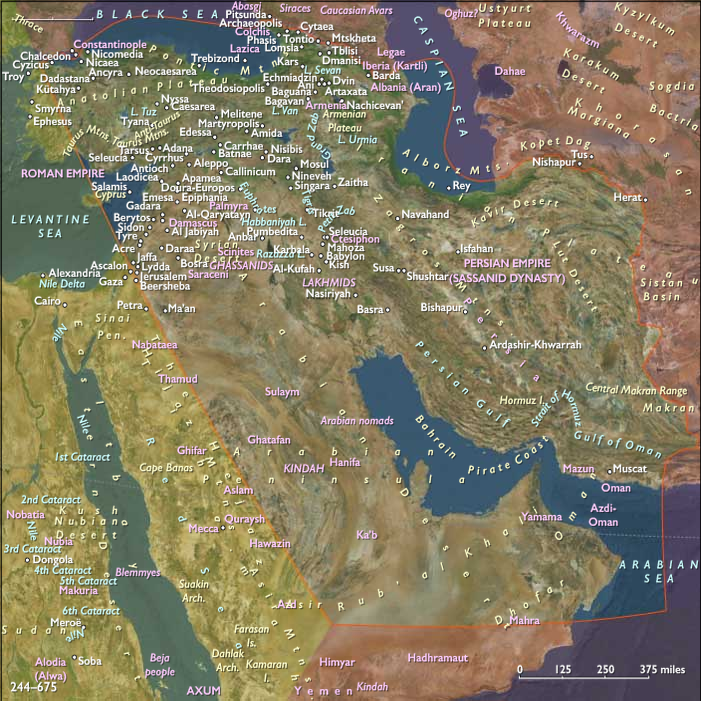
The Kingdom of Iberia, whose ruler, Stephen, had reversed his father’s pro-Roman politics to pro-Iranian and, through loyalty to his Sassanid suzerains, has succeeded in reuniting Iberia under his sway, is he next objective of the Turkic-Constantinopolitan offensive.
In the words of Movses Kagankatvatsi, the Khazars "encircled and besieged the famous and great sybaritic trade city of Tbilisi," whereupon they were joined by Emperor Heraclius with his mighty army.
Heraclius and Tong Yabghu (called Ziebel in the Roman sources) meet under the walls of Narikala.
The yabgu rides up to the emperor, kisses his shoulder and makes a bow.
In return, Heraclius hugs the barbarian ruler, calls him his son, and crowns him with his own diadem.
During the ensuing feast the Khazar leaders receive ample gifts in the shape of earrings and clothes, while the yabghu is promised the hand of the emperor's daughter, Eudoxia Epiphania.
The siege drags on without much progress, punctuated by frequent sallies on the part of the besieged; one of these claims the life of their king, who is taken captive in the fighting and flayed alive on the ordes of Heraclius.
After two months, the Khazars retreat to the steppe, promising to return by the autumn.
Tong Yabghu leaves young Böri Shad, either his son or nephew, in charge of the remaining forty thousand which are to assist Heraclius during the siege.
Before long these depart as well, leaving the Romans to continue the siege alone and prompting jeers from the besieged.
When the Georgians ironically refer to the Emperor as "the goat," hinting at his incestuous marriage, Heraclius recalls a passage from the Book of Daniel about the two-horned ram overthrown by the one-horned goat.
He interprets this as a good sign and strikes southward against Persia.
Locations
People
Groups
- Georgians
- Persian people
- Zoroastrians
- Persian Empire, Sassanid, or Sasanid
- Christians, Armenian Apostolic Orthodox
- Christianity, Chalcedonian
- Oghuz Turks
- Greeks, Medieval (Byzantines)
- Iberia, Principate of
- Western Turkic Khaganate
- Roman Empire, Eastern: Heraclian dynasty
- Chinese Empire, Tang Dynasty
- Khazar Khanate
Topics
Commodoties
Subjects
Regions

Subregions
Related Events
Showing 10 events out of 56849 total
Years: 627 - 627
Locations
People
Groups
- Georgians
- Persian people
- Zoroastrians
- Persian Empire, Sassanid, or Sasanid
- Christians, Armenian Apostolic Orthodox
- Christianity, Chalcedonian
- Oghuz Turks
- Greeks, Medieval (Byzantines)
- Iberia, Principate of
- Western Turkic Khaganate
- Roman Empire, Eastern: Heraclian dynasty
- Chinese Empire, Tang Dynasty
- Khazar Khanate
Topics
Commodoties
Subjects
Regions
Subregions