
The new Sultan has frantically recruited troops …
Years: 1517 - 1517
The new Sultan has frantically recruited troops from various classes of society and Bedouins, and attempted to equip his armies with some amount of cannons and firearms, but all at the last minute and on a limited scale.
Upon Tuman Bey’s rejection of the Ottoman sultan’s conditional offer of peace, Selim sends caliph Al-Mutawakkil III back to Cairo to read Friday prayers in his name as a sign of a coup.
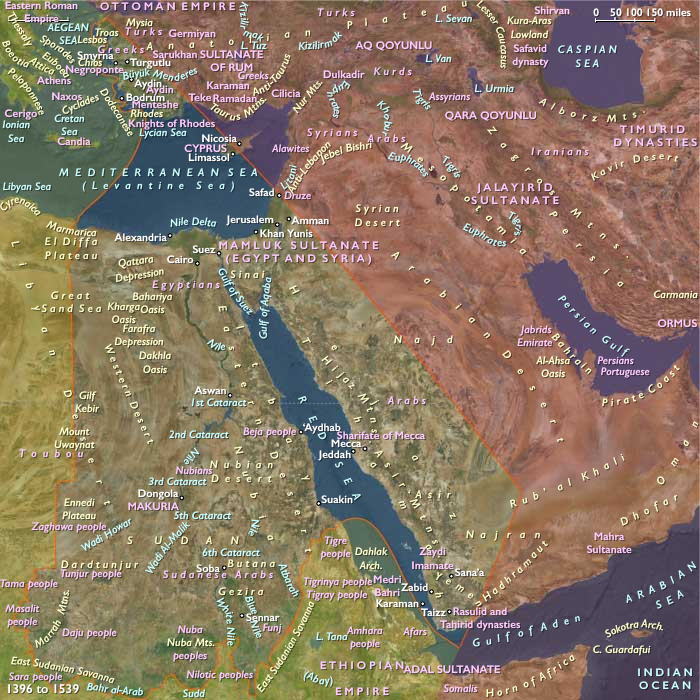
Finally at the doorstep of Cairo on January 24, 1517, the Battle of Ridaniya takes place, in which the Ottoman commander Hadım Sinan Pasha loses his life.
Selim I and Tuman Bay face each other in this battle.
The firearms and guns deployed by Tuman Bay turn out to be almost useless, as the Ottomans manage an attack from the rear.
Tuman bay, who had escaped the battle, attempts a guerrilla campaign but is captured and hanged at the gate of Cairo.
Cairo is captured a few days later and sacked by the Ottomans.
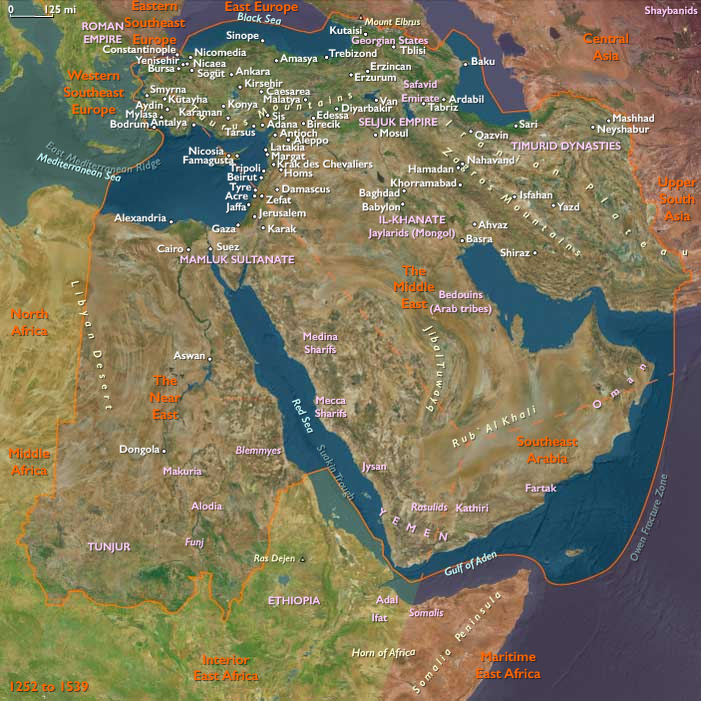
As a consequence, the Sharif of Mecca also submits to the Ottomans, placing the holy cities of Mecca and Medina under Ottoman rule.
Ottoman power now extends as far as the southern reaches of the Red Sea, although control of Yemen remains partial and sporadic.
The campaign had been supported by a fleet of about a hundred ships that have supplied the troops during their campaign to the south.
The conquest has been aided by the support of many Mamluk officials, who have betrayed their masters in return for important positions and revenues promised by the conquerors.
In addition, most of the major populated centers of Syria and Egypt had turned out their Mamluk garrisons, preferring the security and order offered by the Ottomans to the anarchy and terror of the last century of Mamluk dominion.
The Mamluks from 1517 onward constitute only one of the several components that form the political structure of Egypt.
The Ottoman Empire will retain the Mamluks as an Egyptian ruling class, although not in the same form as under the Sultanate, and the Mamluks and the Burji family will succeed in regaining much of their influence, but remain vassals of the Ottomans.
Mamluk culture and social organization will persist at a regional level, and the hiring and education of Mamluk "slave" soldiers will continue, but the ruler of Egypt is an Ottoman governor protected by an Ottoman militia.
The fall of the Mamluk Sultanate effectively puts an end to the Portuguese–Mamluk naval war, but the Ottomans now take over the attempts to stop Portuguese expansion in the Indian Ocean.
The conquest of the Mamluk Empire will also open up the territories of Africa to the Ottomans.
During the sixteenth century, Ottoman power will expand further west of Cairo, along the coasts of North Africa.
Cairo will remain in Ottoman hands until the 1798 French conquest of Egypt, when Napoleon I will claim to have eliminated the Mamluks.
Locations
People
Groups
- Egyptians
- Bedouin
- Islam
- Egypt and Syria, Mamluk Burji Sultanate of
- Ottoman Empire
- Persia, Safavid Kingdom of
- Egypt, Ottoman eyalet of
Topics
- Yemen, Medieval
- Colonization of Asia, Portuguese
- Portuguese–Mamluk naval war
- Ottoman-Mamluk War of 1516-17
Commodoties
Subjects
Regions
Subregions
Years: 1517 - 1517
Locations
People
Groups
- Egyptians
- Bedouin
- Islam
- Egypt and Syria, Mamluk Burji Sultanate of
- Ottoman Empire
- Persia, Safavid Kingdom of
- Egypt, Ottoman eyalet of
Topics
- Yemen, Medieval
- Colonization of Asia, Portuguese
- Portuguese–Mamluk naval war
- Ottoman-Mamluk War of 1516-17
Commodoties
Subjects
Regions
Subregions