
The new Pope is a master diplomat. …
Years: 1244 - 1244
July
The new Pope is a master diplomat.
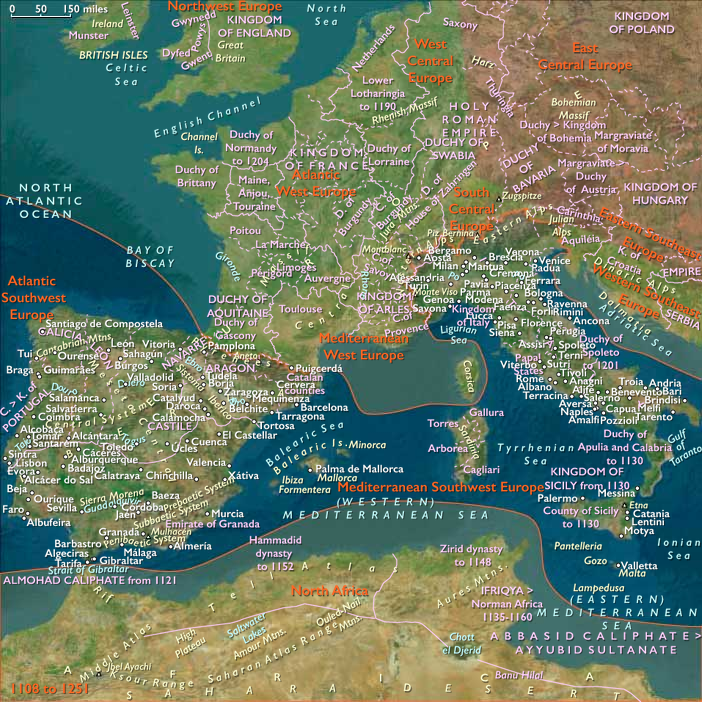
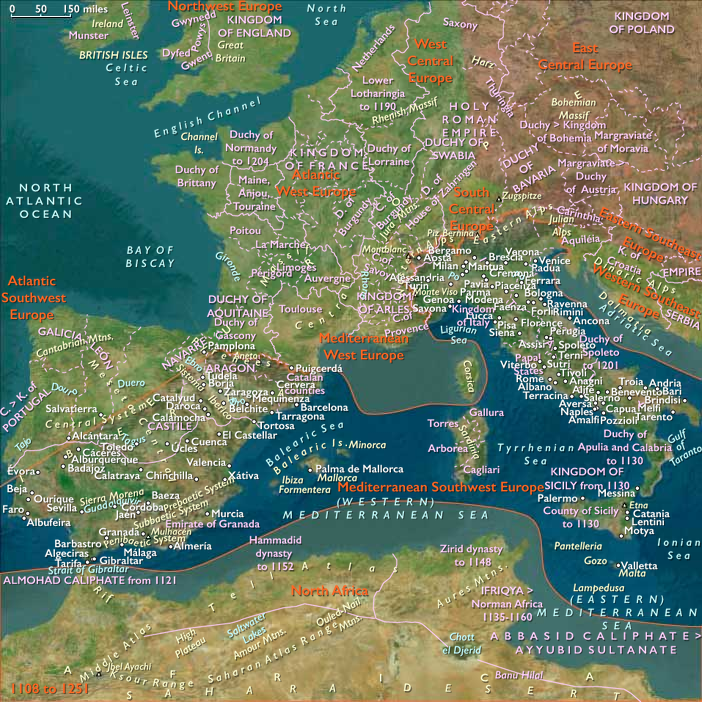
Entering Rome in 1244 a triumphant procession, Innocent forces a lopsided peace on Frederick in an attempt to centralize and strengthen papal power.
Frederick begins to issue demands contrary to the peace agreement, eventually causing Innocent to show his true Guelph face.
Together with most of the Cardinals, Innocent flees via Genoese galleys to the Ligurian republic, arriving on July 7.
His aim is to reach Lyon.
Locations
People
Groups
- Germans
- Papal States (Republic of St. Peter)
- Holy Roman Empire
- Italy, Kingdom of (Holy Roman Empire)
- France, (Capetian) Kingdom of
- Genoa, (Most Serene) Republic of
- Christians, Roman Catholic
- Welf, House of
- Italians (Latins)
- Lombard League
Topics
Commodoties
Subjects
Regions
Subregions
Related Events
Filter results
Showing 10 events out of 46745 total
The Teutonic Knights manage to gather a coalition against Swietopolk: Dukes of Masovia are given territories in Prussia, Dukes of Greater Poland receive Nakel, and Dukes of Pomerellia, brothers of Swietopolk, hope to regain their inheritance.
Swietopolk builds a castle at Zantyr, where Nogat separated from the Vistula, and launched a blockade of Elbing and Balga.
While the castle withstands Teutonic attacks, the blockade is smashed by cogs.
Siegfried III von Eppstein, archbishop of Mainz from 1230, makes Mainz a free city in 1244.
The citizens of Mainz can now run their affairs more independently though their own council; in law, Mainz remains an episcopal city.
It will soon become the center of a powerful league of Rhenish towns.
Basque mercenaries, after many failures against the Cathar fortress of Montségur, are able to secure a location on the eastern side of the summit across a depression, which allows the construction of a catapult.
This forces refugees that are living outside the walls of the castle to move inside, making living conditions difficult.
Apparently by treachery, a passage is found to get access to the barbican, which is conquered in March 1244.
The catapult is moved closer and the living situation inside deteriorates under the day-and-night bombardment.
When an attempt by the garrison fails to dislodge the invaders from the barbican, the defenders signal that they have decided to negotiate for surrender.
Surrender conditions are quickly decided on: All the people in the castle are allowed to leave except those who will not renounce their Cathar faith, primarily the perfecti.
A two-week truce is declared.
The last two weeks are spent praying and fasting.
A number of defenders decide to join about 190 perfecti and receive their consolamentum, bringing the total number of Cathar believers destined to burn to between 210 and 215.
On March 16, led by Bishop Bertrand, the group leaves the castle and goes down to the place where the wood for the pyre has been erected.
No stakes are needed: they mount the pyre and perish voluntarily in the flames.
The remainder of the defenders, including those who had participated in the murder of the inquisitors, are allowed to leave, among them Raymond de Pereille, who will later, like others, be subjected to the Inquisition.
It has been claimed that three or four perfecti survived, leaving he castle by a secret route to recover a treasure of the Cathars that had been buried in a nearby forest in the weeks prior to the surrender.
The treasure not only contains material valuables but also documents and possibly relics.
Nothing about its whereabouts is known.
The taking of Montségur in 1244 makes it possible for the Languedoc province to be incorporated into the French kingdom.
The displaced Khwarezmians, heading south from Iraq towards Egypt, invade Crusader Christian-held Jerusalem on July 11, 1244,
Jerusalem’s citadel, the Tower of David, surrenders on August 23; the Crusader Christian population of the city is expelled, as are Jews.
This will trigger a call from Europe for the Seventh Crusade, but the Crusaders will never again be successful in retaking Jerusalem.
After being conquered by the Khwarezmian forces, the city is to remain under Muslim control until 1917, when the British take it from the Ottomans.
The Khwarezmian forces continue south after their capture of Jerusalem, which has caused great alarm among both the Christian and the Muslim states.
Al-Mansur, the Emir of Homs and an-Nasir Dawud, ruling Kerak, have joined the Templars, the Hospitallers, the Teutonic Knights, the Order of Saint Lazarus and the remaining forces of the Kingdom of Jerusalem to take the field against the Egyptian Sultanate.
The Egyptian army is commanded by a Mamluk officer named Rukn al-Din Baibars.
Battle is joined on the morning October 17, with the Christian knights repeatedly charging the Egyptians and fighting up and down the line.
The Egyptian army holds its ground.
Baibars renews the fight on the morning of October 18, and throws the Khwarezmians against the Damascene troops in the center of the allied line.
The center is shattered by their furious attack.
They turn on the allied left and cut the Bedouin to pieces.
The Emir's cavalry holds stubbornly, but they are nearly annihilated, Al-Mansur finally riding from the field with two hundred and eighty survivors, all that remain of his troops.
The crusaders, threatened by the Egyptians in front and the Khwarezmians on their flank, charge the Mamluks facing them and are initially successful, pushing them back and causing Baibars some concern.
Their assault gradually loses momentum as the Khwarezmid tribesmen attack the rear and the flanks of the Christian forces, which are defended by disorganized infantry.
The well-armed knights fight on doggedly and it takes several hours for their resistance to collapse.
Over five thousand Crusaders die and eight hundred prisoners are taken, including Walter of Brienne, William of Chastelneuf, Master of the Hospital, and the Constable of Tripoli.
Of the troops of the knightly orders, only thirty-three Templars, twenty-seven Hospitallers and three Teutonic Knights survive; Philip of Montfort and the Patriarch of Jerusalem also escape to Ascalon.
However, Armand de Périgord, the Master of the Temple, the Marshal of the Temple, the archbishop of Tyre, the bishop of Lydda and Ramla (St. George), and John and William, sons of Bohemond, Lord of Botron, are all killed.
While the Battle of Hattin holds great symbolic importance as having led to the fall of Jerusalem, it is La Forbie that truly marks the collapse of Christian power in Outremer.
Louis IX’s Decision to Lead the Seventh Crusade (1244): A Vow Amidst Illness
Following his victory over the English at Taillebourg in 1242, Louis IX of France (Saint Louis) fell gravely ill with malaria at Pontoise-lés-Noyon. His condition was so severe that many feared he would not survive. However, upon recovering, he took an extraordinary vow—in December 1244, upon learning of Jerusalem’s capture by Muslim forces, he pledged to lead a crusade to reclaim the Holy Land, launching what became the Seventh Crusade (1248–1254).
The Fall of Jerusalem (1244) and Louis IX’s Response
- In October 1244, Turkic Khwarazmian mercenaries, allied with the Ayyubid Sultanate of Egypt, recaptured Jerusalem, massacring its Christian population.
- This event deeply shocked the Christian world, though enthusiasm for another crusade was waning due to the repeated failures of previous campaigns.
- Despite little support from his barons and advisers, Louis IX took up the cross in December 1244, personally committing himself to a new expedition to reclaim the Holy Land.
Motivations for the Seventh Crusade
-
Religious Devotion
- Louis IX was deeply pious, and his vow reflected his genuine belief in the Crusading ideal.
- He saw the loss of Jerusalem as a moral and spiritual duty that he, as a Christian king, must rectify.
-
Personal Crisis and Divine Inspiration
- His severe illness in 1242 left him near death, and some chroniclers suggest that his vow was made as an act of gratitude for his survival.
- He may have viewed his recovery as a divine sign, compelling him to lead a new crusade.
-
Lack of Enthusiasm Among His Barons
- Unlike earlier crusades, Louis faced considerable reluctance from his nobility.
- Many of his advisers and barons opposed the idea, preferring to focus on securing France rather than engaging in another distant and costly war.
- However, Louis’ strong will prevailed, and his barons were gradually forced to accept his decision.
The Path to the Seventh Crusade (1248–1254)
- Louis IX spent four years preparing his campaign, meticulously organizing supplies, troops, and finances.
- He set his sights on Egypt, viewing it as the key to recapturing the Holy Land.
- His crusade departed in 1248, marking the beginning of one of the most well-organized yet ultimately unsuccessful crusading campaigns.
Legacy of Louis IX’s Decision
- His personal devotion to the Crusades reinforced his reputation as a saintly king, later leading to his canonization as Saint Louis in 1297.
- The Seventh Crusade, despite its failures, demonstrated the last great medieval attempt by France to reclaim the Holy Land.
- His commitment to crusading ideals influenced later crusading movements, though enthusiasm for the cause diminished in Western Europe after repeated defeats.
Louis IX’s decision in December 1244 to lead the Seventh Crusade was a turning point in his reign, reflecting his deep religious convictions and sense of divine duty, even in the face of strong opposition from his own court.
Giovanni da Pian del Carpine appears to have been a native of Umbria, in modern-day Italy, where a place formerly called Pian del Carpine, but now Magione, stands near Perugia, on the road to Cortona.
He was one of the companions and disciples of his countryman Saint Francis of Assisi.
Giovanni bears a high repute in the Franciscan order, and had taken a prominent part in disseminating its teaching in northern Europe, holding successively the offices of warden (custos) in Saxony, and of provincial (minister) of Germany, and afterwards of Spain, perhaps of Barbary, and of Cologne.
He had been in the last post at the time of the great Mongol invasion of eastern Europe and of the disastrous Battle of Legnica, which threatened to cast European Christendom under the leadership of the Great Khan of the Mongol Empire, Ögedei Khan.
The dread of the Tatars was, however, still on people's mind four years later, when Pope Innocent IV dispatched the first formal Catholic mission to the Mongols, partly to protest against the latter's invasion of Christian lands, partly to gain trustworthy information regarding Mongol armies and their purposes.
Behind these there may have lurked the beginnings of a policy much developed later—of opening diplomatic intercourse with a power whose alliance might be valuable against Islam.
Pope Innocent IV has chosen Giovanni to head this mission.
Giovanni is around sixty-five at the time, and apparently is in charge of nearly everything in the mission.
As a papal legate, he bears a letter from the Pope to the Great Khan, Cum non solum.
Giovanni had started from Lyon, where the Pope is in residence, on April 16, 1245, accompanied by another friar, Stephen of Bohemia, who breaks down at Kaniv near Kiev and is left behind.
Béla IV welcomes back tens of thousands of Kun (Cumans) who had fled the country before the invasion, recalling them to Hungary in 1245 to repopulate settlements devastated by war.
The nomadic Cumans subsequently settle throughout the Great Hungarian Plain.
The Cumans can be violent against local people and their nomadic lifestyle is hurtful for the Hungarian peasants, but the king favors them.
Years: 1244 - 1244
July
Locations
People
Groups
- Germans
- Papal States (Republic of St. Peter)
- Holy Roman Empire
- Italy, Kingdom of (Holy Roman Empire)
- France, (Capetian) Kingdom of
- Genoa, (Most Serene) Republic of
- Christians, Roman Catholic
- Welf, House of
- Italians (Latins)
- Lombard League
