The new Bulgarian exarchate has become the …
Years: 1874 - 1874
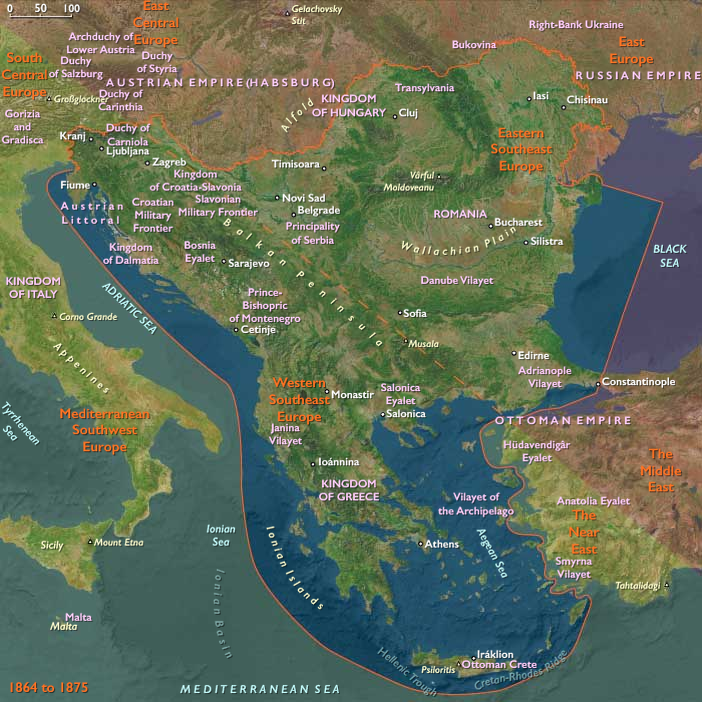
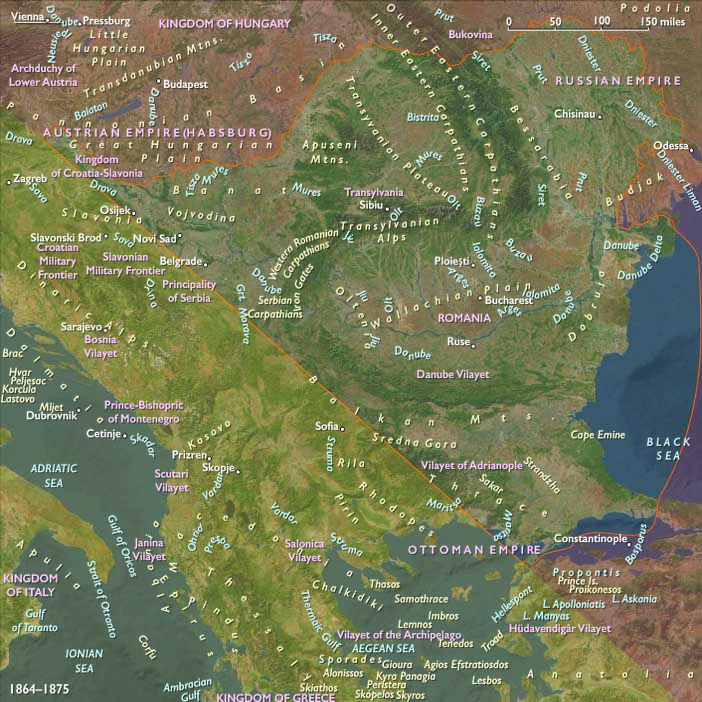
The new Bulgarian exarchate has become the leading force in Bulgarian cultural life; it officially represents the Bulgarians in dealing with the Turks, and it sponsors Bulgarian schools.
The novel administrative system of the exarchate calls for lay representation in governing bodies, thus introducing a note of self-government into this most visible institution.
Locations
Groups
Subjects
Regions
Subregions
Related Events
Filter results
Showing 10 events out of 12508 total
King Lunalilo dies from tuberculosis at the age of thirty-nine on February 3, 1874, at his Marine Residence at Waikiki.
Lunalilo had not enjoyed good health during his reign of one year and twenty-five days.
He had some bad habits; for example, he was an alcoholic.
Lunalilo had developed a lung infection at about the time of the mutiny in the army, and had moved to Kailua-Kona in hopes of regaining his health, but dies a few months later.
Like his predecessor, Lunalilo had not designated an heir to the throne.
It was said he had intended for Queen Dowager Emma to succeed him, but he had died before a formal proclamation could be made.
The most prevalent explanation of this delay is regarding his democratic principles: he wished to have the people choose their next ruler.
However, the constitution of 1864 had charged the legislature, not the people, with the task of electing the next king.
In the end, Kalākaua of the House of Kalākaua is voted to succeed Lunalilo as king.
Upon ascending the throne, Kalākaua names his brother, William Pitt Leleiohoku, as his heir, putting an end to the era of elected kings in Hawaiʻi.
Kalākaua begins his reign with a tour of the Hawaiian islands, which improves his popularity.
The cornerstone of the Aliʻiōlani Hale had been laid in 1872; the building is completed in 1874.
The original purpose had been to replace the contemporary ʻIolani Palace built by Kamehameha III, but this had been dropped in favor of a more useful purpose. (Currently, it is the home of the Hawaiʻi State Supreme Court.)
Other of Kamehameha V’s building projects include the ʻIolani barracks to house the royal guards, a new prison, the Royal Mausoleum, schools and warehouses, an insane asylum, a quarantine building to process the flood of immigrants, and other government structures.
Because of so many new projects, there is heavy strain on Hawaiʻi's resources and by March 31, 1874, Hawaiʻi's national debt stands at over $355,000.
Kalākaua travels to Washington, D.C., in November to meet President Ulysses S. Grant.
In December, Kalākaua sends representatives to the United States to negotiate a reciprocity treaty to help end a depression that is ongoing in Hawaiʻi.

The Spanish sovereignty over the Marshall Islands is recognized by the international community in 1874.
Captain John Charles Marshall, together with Thomas Gilbert, had come to what are today known as the Marshall Islands in 1788.
The islands were named after the first in the Russian (Krusenstern) and French (Duperrey) maps (1820), and later in the British maps.
However, they are claimed under Spanish sovereignty as part of the Spanish East Indies.
Sir Hercules Robinson, who had arrived on September 23, 1874, is appointed as interim Governor.
The United Kingdom had declined its first opportunity to annex Fiji in 1862.
Ratu Seru Epenisa Cakobau had offered to cede the islands, subject to being allowed to retain his Tui Viti (King of Fiji) title, a condition unacceptable to both the British and to many of his fellow chiefs, who had regarded him only as first among equals, if that.
A confederacy of Fijian chiefs had formed in 1865.
Two years later, an American warship had threatened to shell the island on of Levuka.
Amid increasing unrest, Cakobau had been crowned King of Bau by European settlers.
The following year, the Australian-based Polynesia Company had acquired land near Suva, in return for promising to pay Cakobau's debts.
The mounting debts and threats from the United States Navy had led Cakobau to establish a constitutional monarchy with himself as King but with real power in the hands of a Cabinet and Legislature dominated by settlers from Australia.
Lavish overspending had saddled the new kingdom with even greater debt.
In 1872, John Bates Thurston, a government official, had approached the United Kingdom on Cakobau's behalf with an offer to cede the islands, which Britain had accepted.
A second South Island gold discovery, this time in Westland, draws thousands more gold-seekers from Australia and North America.
Westland was originally a part of Canterbury Province, administered from Christchurch in the East coast.
The booming population as a result of the gold rush, together with the difficulty of travel and communication across the Southern Alps, had led first to the creation of a special "Westland County", then the formal separation of Westland from Canterbury to form the short-lived Westland Province (1873–1876).
Westland Province also includes what is now the southern portion of Grey District with the provincial boundary at the Grey and Arnold rivers.
Andrew Clarke, Sir Harry Ord's replacement, seizes the opportunity to expand British influence in the Malay states.
First, he calls all Chinese secret societies together and demands a permanent truce.
Later, through the signing of the Pangkor Treaty on January 20, 1874, Clarke acknowledges Raja Abdullah as the legitimate sultan of Perak.
Immediately, J. W. W. Birch is appointed as a British resident in Perak.
The Klang War ends in 1874.
Raja Mahadi steps down and hands power over to Tengku Kudin and Raja Ismail.
Raja Ismail, on the other hand, who is not party to the Pangkor agreement, is forced to abdicate due to intense pressure applied by Clarke.
The royal family, greatly disappointed with the outcome of the war, views Tengku Kudin with suspicion.
Tengku Kudin's army from Pahang makes the situation worse.
After the war, the army refuses to return to Pahang because they want to collect tax as a payment for their service.
While the British, through Governor Clarke, side with Tengku Kudin, the postwar situation weakens Tengku Kudin's power base.
Therefore, Clarke is forced to freeze his plan to reach out to the royal family through Tengku Kudin.
The construction of the Irrawaddy Valley State Railway in Burma, which begins in 1874, also provides employment in the earthworks for many famine immigrants from Bengal.
The one hundred and sixty-three-mile (two hundred and sixty-two kilometers) Rangoon-to-Prome line, following the Irrawaddy River, will be built over a three-year period with labor imported from India (particularly the areas affected by the Bihar famine of 1873–74).
The reform of Russian military service (1874) is the last of the principal reforms in Alexander's II reign.
The Franco-Prussian War had demonstrated the necessity of building a modern army.
The old system of long term service (twenty-five years) for a limited number of recruits is abandoned, as being too heavy a burden for the people and as providing practically no reserves.
The new conscription system, which provides for a short term of active service followed by several years in the reserve, is introduced by Dmitry Milyutin in 1874.
It is drawn on democratic lines, calling to service all young men of twenty-one without distinction of class.
Exemption is only granted to young men who are the sole breadwinners of their families.
It also gives the army a role in teaching many peasants to read and in pioneering medical education for women.
Germany makes civil marriage compulsory in 1874.
The Bihar famine had proved to be less severe than had originally been anticipated, and one hundred thousand tons of grain is left unused at the end of the relief effort.
Since the expenditure associated with the relief effort is considered excessive, Sir Richard Temple is criticized by various British officials.
Taking the criticism to heart, he revises the official famine relief philosophy, which hereafter will become concerned with thrift and efficiency.
The relief efforts in the subsequent Great Famine of 1876–78 in Bombay and South India will therefore be very modest, which in turn will lead to excessive mortality.
The Gold Coast is the region of West Africa which is now Akanland.
The Gold Coast, Slave Coast, and Ivory Coast are named after the resources there.
Early uses of the term refer literally to the coast and not the interior.
It is not until the nineteenth century that the term comes to refer to areas that are far from the coast.
It is to the east of the Ivory Coast and to the west of the Slave Coast.
The first Europeans to arrive at the coast had been the Portuguese in 1471, who had encountered a variety of African kingdoms, some of which controlled substantial deposits of gold in the soil.
In 1482, the Portuguese had built the Castle of Elmina, the first European settlement on the Gold Coast.
From here they had traded slaves, gold, knives, beads, mirrors, rum and guns.
News of the successful trading had spread quickly, and eventually British, Dutch, Danish, Prussian and Swedish traders arrived as well.
The European traders had built several forts along the coastline.
The Gold Coast had long been a name for the region used by Europeans because of the large gold resources found in the area.
The slave trade has been the principal exchange for many years.
The British Gold Coast had been formed in 1867 when the British government abolishes the African Company of Merchants and seizes privately held lands along the coast.
They also had taken over the remaining interests of other European countries, annexing the Danish Gold Coast in 1850 and the Dutch Gold Coast, including Fort Elmina, in 1872.
Britain has steadily expanded its colony through the invasion of local kingdoms as well, particularly the Ashanti and Fante confederacies.
The Ashanti people, who are the largest ethnic community in the region, had controlled much of the territory before the Europeans arrived and are often in conflict with them.
Four wars, the Anglo-Ashanti Wars, are fought between the Ashanti (Asante) and the British, who are sometimes allied with the Fante.
During the First Anglo-Ashanti War (1863–1864), the two groups had fought because of a disagreement over an Ashanti chief and slavery.