
The nearly thirty-seven year reign of Alexios …
Years: 1085 - 1085
The nearly thirty-seven year reign of Alexios I Komnenos will be full of struggle.
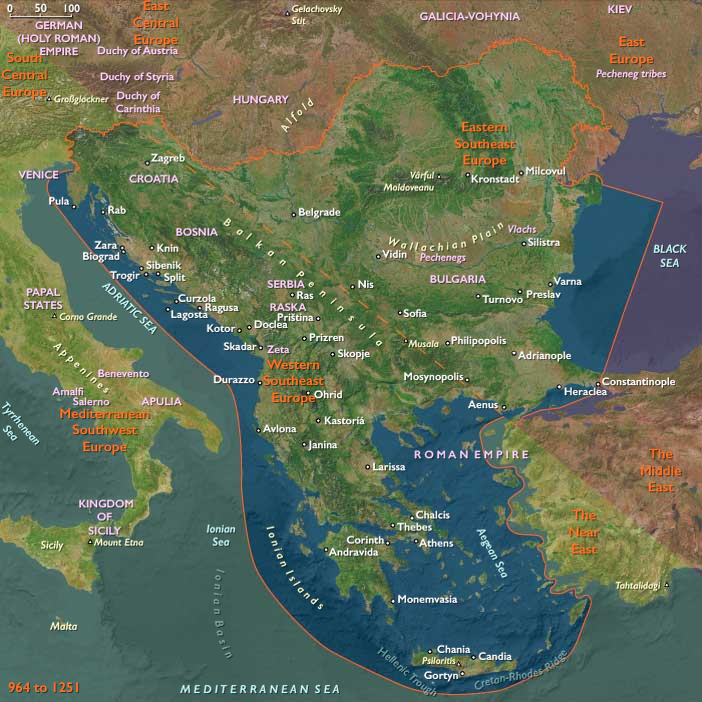
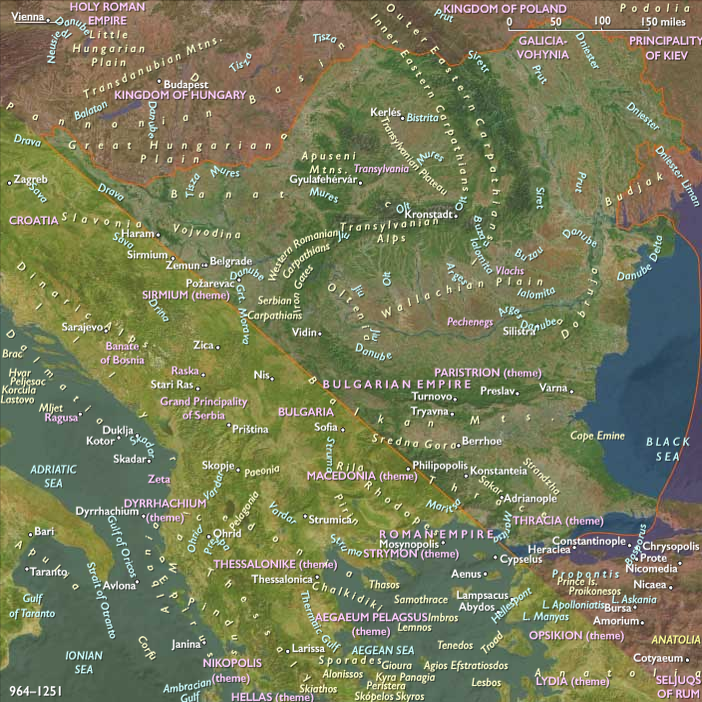
At the outset, he had faced the formidable attack of the Normans, led by Robert Guiscard and his son Bohemund, who had taken Dyrrhachium and Corfu and laid siege to Larissa in Thessaly.
Alexios had suffered several defeats before he was able to strike back with success.
He had enhanced his resistance by bribing the German king Henry IV with three hundred and sixty thousand gold pieces to attack the Normans in Italy, which had forced the Normans to concentrate on their defenses at home in 1083–84.
He has also secured the alliance of Henry, Count of Monte Sant'Angelo, who controls the Gargano Peninsula and dates his charters by Alexios' reign.
Henry's allegiance will be the last example of Constantinople’s political control on peninsular Italy.
Several thousand Paulicians had served in the army of Alexios against the Normans but, deserting the emperor in 1085, many of them had been thrown into prison.
The Norman danger had subsided with the death of Guiscard in 1085, and Constantinople has recovered most of its losses.
Imperial general Gregory Pakourianos, former governor of the now-defunct Iberian theme, is also known as a noted patron and promoter of Christian culture.
He together with his brother Abas (Apasios) had made, in 1074, a significant donation to the Eastern Orthodox Holy Monastery of Iviron on Mount Athos.
He had signed the official Greek version of the Typikon in Armenian.
He also signed his name in Georgian and Armenian characters rather than Greek.
It is assumed that Pakourianos did not know Greek.
Pakourianos had been involved in the coup that removed Nikephoros III.
Alexios had appointed him "megas domestikos of All the West" and has given him many more properties in the Balkans.
He possesses numerous estates in various parts of the Byzantine Empire and is afforded a variety of privileges by the emperor, including exemption from certain taxes.
In 1081, he had commanded the left flank against the Normans at the Battle of Dyrrachium.
A year later, he had evicted the Normans from Moglena, the present day Greece.
With the retreat of the Norman menace, Constantinople's reconquest of Asia Minor from the Seljuq Turks may now seem possible for Alexios, but he is desperately short of manpower, and dependent on foreign mercenaries, mostly barbarians or occasional Western soldiers of fortune, and on his largely Anglo-Saxon Varangian Guard.
He has barely sufficient resources to guard his long frontiers to west and north while watching for further Norman attacks from South Italy, but not enough for a campaign against the Seljuqs, whose further western encroachments had been halted temporarily by an agreement made in 1081 with the Seljuq sultan of Rüm, Suleiman ibn Qutalmïsh of Iznik.
Seljuq expansion southward continues, however, and Suleiman’s capture of Antioch in 1085 is another blow to imperial prestige.
Locations
People
- Alexios I Komnenos
- Gregory Pakourianos
- Henry IV, Holy Roman Emperor
- Henry, Count of Monte Sant'Angelo
- Nikephoros Melissenos
- Tzachas
Groups
- Oghuz Turks
- Greeks, Medieval (Byzantines)
- Paulicians
- Pechenegs, or Patzinaks
- Bogomilism
- Normans
- German, or Ottonian (Roman) Empire
- Turkmen people
- Cuman people, or Western Kipchaks, also called Polovtsy, Polovtsians)
- Christians, Eastern Orthodox
- Rum, Sultanate of
- Roman Empire, Eastern: Komnenos dynasty, restored
Topics
Commodoties
Subjects
Regions
Subregions
Years: 1085 - 1085
Locations
People
- Alexios I Komnenos
- Gregory Pakourianos
- Henry IV, Holy Roman Emperor
- Henry, Count of Monte Sant'Angelo
- Nikephoros Melissenos
- Tzachas
Groups
- Oghuz Turks
- Greeks, Medieval (Byzantines)
- Paulicians
- Pechenegs, or Patzinaks
- Bogomilism
- Normans
- German, or Ottonian (Roman) Empire
- Turkmen people
- Cuman people, or Western Kipchaks, also called Polovtsy, Polovtsians)
- Christians, Eastern Orthodox
- Rum, Sultanate of
- Roman Empire, Eastern: Komnenos dynasty, restored
Topics
Commodoties
Subjects
Regions
Subregions