
The Near East (873–862 BCE): The Ascendancy …
Years: 873BCE - 862BCE
The Near East (873–862 BCE): The Ascendancy of Omri and Alliances in Israel and Judah
Omri's Consolidation and Expansion in Israel
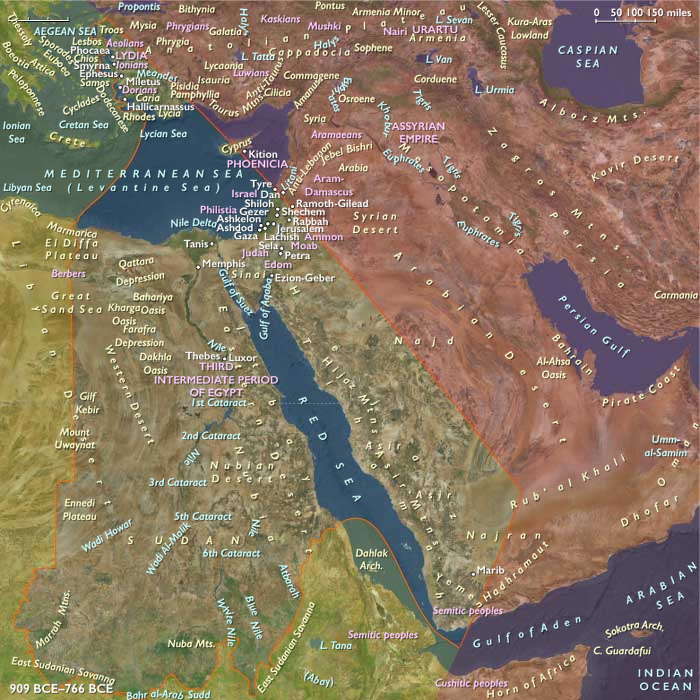
In the Northern Kingdom of Israel, King Omri continues to solidify his rule following the turbulent years of dynastic conflict. After successfully overcoming opposition, Omri further establishes Israel's strength by conquering the territory of Moab. Recognizing the importance of strategic alliances, Omri fosters diplomatic ties with the Phoenician city of Tyre, significantly enhancing Israel's economic and military stature in the region. Around 875 BCE, Omri moves Israel’s capital permanently to the fortified city of Samaria, thereby anchoring his political legacy and stabilizing the kingdom.
Omri’s reputation extends well beyond his lifetime, with Assyrian records frequently referencing Israel as "the land of Omri." Despite his negative portrayal by Biblical authors, contemporary historians regard Omri as one of the most influential and effective rulers in Israel's history.
Ahab's Succession and Further Alliances
Following Omri’s death, his son Ahab ascends the throne, inheriting a kingdom poised for regional prominence. Ahab's marriage to Jezebel, daughter of Ithobaal of Tyre, solidifies Israel’s alliance with the Phoenicians. Under Ahab’s leadership, the longstanding hostility between Israel and Judah finally comes to an end, as he secures a crucial alliance with King Jehoshaphat of Judah, thus concluding nearly half a century of inter-kingdom warfare.
During his reign, Ahab actively engages in military confrontations with the kingdom of Aram (Syria) and undertakes significant infrastructure projects, notably the extensive reconstruction and expansion of the ancient city of Jericho. Today, Jericho is recognized as one of the oldest continuously inhabited settlements on Earth, underscoring its historical importance during Ahab's time.
Stability and Reform under Jehoshaphat in Judah
In the southern kingdom of Judah, King Asa dies in 871 BCE after a long but troubled reign marked by religious reform and political controversy. He is succeeded by his son Jehoshaphat, who assumes the throne at the age of thirty-five and reigns for twenty-five years.
Jehoshaphat initially focuses on strengthening Judah's defenses against potential threats from Israel, yet soon capitalizes on the newfound peace established through his alliance with Ahab. During his rule, Jehoshaphat emphasizes religious education and judicial reform, dispatching priests and Levites throughout the kingdom to instruct the people in the Law, actions praised by Biblical chroniclers for fostering spiritual renewal and stability.
Dynastic Stability in Egypt
In Egypt, the Twenty-second Dynasty sees continued stability with the ascension of Osorkon II in 874 BCE, succeeding Takelot I. Osorkon II’s reign begins amidst significant natural events, notably an exceptionally high flooding of the Nile in 872 BCE that inundates the Temple of Luxor, a sign interpreted variously by contemporary Egyptians.
Summary of the Era
The period from 873 to 862 BCE is characterized by strategic political alliances and strengthened governance across the Near East. In Israel, Omri’s foundational stability paves the way for Ahab’s expansive diplomacy and construction projects, while Judah experiences a period of internal consolidation and religious reform under Jehoshaphat. Concurrently, Egypt maintains its dynastic continuity and relative peace, highlighting a contrasting regional narrative marked by stability amidst the ongoing political complexities in neighboring kingdoms.
People
- Ahab of Israel
- Asa of Judah
- Ben-Hadad I
- Elah of Israel
- Ithobaal I
- Jehoshaphat
- Jezebel
- Omri of Israel
- Osorkon II
- Takelot I
Groups
- Tyre, Kingdom of (Phoenicia)
- Aram-Damascus (Syria), Kingdom of
- Egypt (Ancient), Third Intermediate Period of
- Judah, Kingdom of
- Israel (Northern Kingdom of)
Subjects
Regions
Subregions
Years: 873BCE - 862BCE
People
- Ahab of Israel
- Asa of Judah
- Ben-Hadad I
- Elah of Israel
- Ithobaal I
- Jehoshaphat
- Jezebel
- Omri of Israel
- Osorkon II
- Takelot I
Groups
- Tyre, Kingdom of (Phoenicia)
- Aram-Damascus (Syria), Kingdom of
- Egypt (Ancient), Third Intermediate Period of
- Judah, Kingdom of
- Israel (Northern Kingdom of)
Subjects
Regions
Subregions