
The Near East (837–826 BCE): Aramaean Incursions …
Years: 837BCE - 826BCE
The Near East (837–826 BCE): Aramaean Incursions and Egyptian Fragmentation
Aramaean Aggression and Israelite Decline
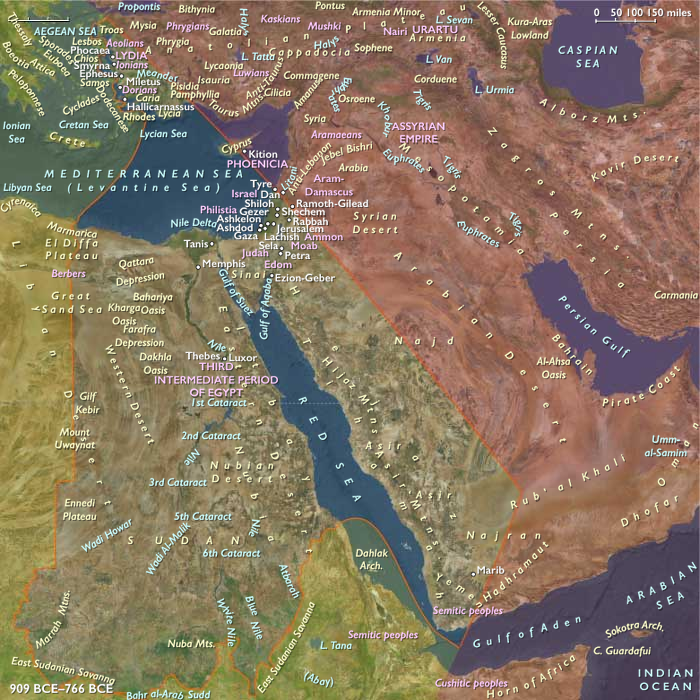
Around 835 BCE, the northern kingdom of Israel experiences devastating conflict as Hazael, the Aramaean king of Damascus, launches an invasion. This critical event is vividly recorded on the Tel Dan Stele, a basalt monument discovered at Tel Dan in northern Israel. The Aramaic inscription recounts Hazael's military victory, explicitly claiming responsibility for the deaths of Jehoram, son of Ahab, king of Israel, and Ahaziah, son of Jehoram, king of Judah. The stele further boasts of turning their towns into ruins and their lands into desolation, underscoring the vulnerability of the Israelite and Judean states during this era.
The kingdom of Israel, already weakened by internal dynastic upheavals and Jehu’s violent purge, struggles to resist external threats. Jehu, who remains king during this tumultuous period, witnesses extreme fluctuations in the kingdom’s stability, ultimately culminating in a catastrophic defeat by Hazael around 815 BCE. This crushing military loss effectively destroys Israel’s army and severely diminishes its political and military influence in the region.
Egypt’s Political Fragmentation
In Egypt, the period witnesses further political fragmentation. Pedubast I, declaring himself pharaoh around 835 BCE (or possibly 824 BCE), establishes the Twenty-third Dynasty. A ruler of Libyan ancestry, Pedubast initially controls Thebes and Upper Egypt while coexisting relatively peacefully with Shoshenq III, who continues to rule Lower Egypt from Memphis and the Delta region under the Twenty-second Dynasty. This division reflects Egypt’s ongoing political fragmentation during the Third Intermediate Period, characterized by regional power struggles and dynastic rivalries rather than outright warfare.
Pedubast's rule is notable for its length and relative stability, lasting approximately twenty-five years. His coexistence with Shoshenq III suggests a pragmatic relationship, highlighting how Egypt’s internal divisions, although politically significant, did not always result in direct conflict.
Summary of the Era
The years 837–826 BCE in the Near East are marked by significant regional instability, particularly through the aggressive expansion of the Aramaean kingdom under Hazael, which profoundly impacts Israel’s strength and territorial integrity. Simultaneously, Egypt faces continued internal divisions as rival dynasties coexist, reflecting broader patterns of fragmentation and localized governance. Together, these developments underscore a period of profound transition and vulnerability, shaping the Near Eastern political landscape for decades to come.
People
Groups
- Aram-Damascus (Syria), Kingdom of
- Egypt (Ancient), Third Intermediate Period of
- Judah, Kingdom of
- Israel (Northern Kingdom of)
Topics
Subjects
Regions
Subregions
Years: 837BCE - 826BCE
People
Groups
- Aram-Damascus (Syria), Kingdom of
- Egypt (Ancient), Third Intermediate Period of
- Judah, Kingdom of
- Israel (Northern Kingdom of)
Topics
Subjects
Regions
Subregions