
The Near East (825–814 BCE): Egyptian Division …
Years: 825BCE - 814BCE
The Near East (825–814 BCE): Egyptian Division and Israelite Struggles
Egyptian Fragmentation Deepens
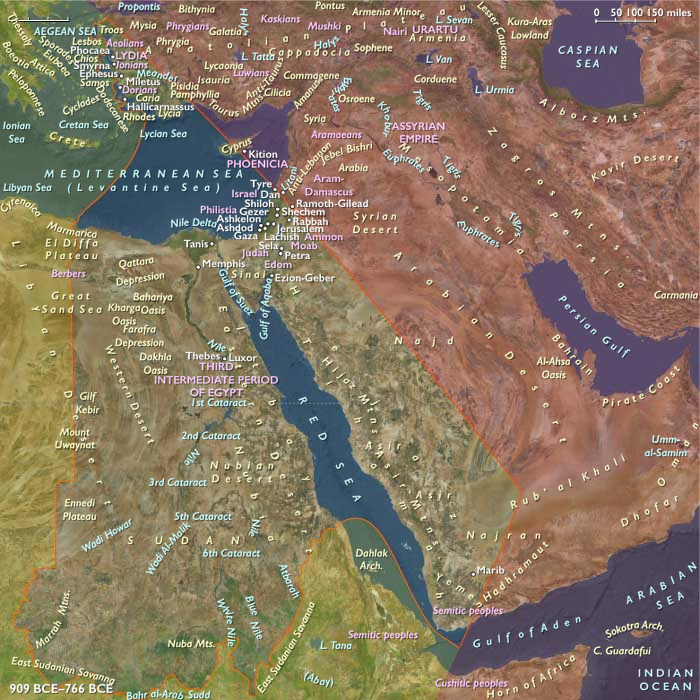
Between 825 and 814 BCE, Egypt's political fragmentation intensifies, particularly after the reign of Osorkon II. By approximately 818 BCE, control of Egypt is effectively divided, with Shoshenq III of the Twenty-second Dynasty ruling over Lower Egypt from Memphis and the Delta region, while Upper and Middle Egypt are governed by Takelot II and his son Osorkon, later known as Osorkon III. Following the death of Takelot II, rivalry erupts between his sons Osorkon and Shoshenq III, plunging Thebes into a civil conflict.
Adding to the political complexity, Pedubast I, a ruler of Libyan ancestry, had earlier declared himself Pharaoh, founding the Twenty-third Dynasty and reigning primarily over Thebes and Upper Egypt. His rule, lasting approximately twenty-five years, represents a further layer of political division. The competition between Pedubast I and the existing line of Takelot II/Osorkon III characterizes this turbulent era, underscoring the extent of Egypt's fragmentation during the Third Intermediate Period.
Jehoahaz and Israel’s Continuing Decline
In the northern kingdom of Israel, the death of King Jehu in 815 BCE marks the beginning of sole rulership for his son Jehoahaz. His reign unfolds against the backdrop of Israel’s diminished military and political power following catastrophic defeats by the Aramaean kingdom of Damascus under Hazael. Israel continues to suffer from the consequences of these military setbacks, facing severe territorial losses and reduced regional influence. Jehoahaz’s rule is characterized by efforts to stabilize a significantly weakened state, which struggles against ongoing external pressures and internal vulnerabilities.
Summary of the Era
The years 825–814 BCE witness profound political upheaval in the Near East, particularly marked by intensified fragmentation within Egypt. The rivalry among Egyptian rulers underscores the period's dynastic complexity and regional instability. Concurrently, Israel continues to endure significant political and military challenges under Jehoahaz, reflecting broader patterns of vulnerability and transition within the region. Collectively, these events highlight the ongoing reshaping of the Near Eastern political landscape, setting the stage for further developments in subsequent decades.
People
Groups
- Aram-Damascus (Syria), Kingdom of
- Egypt (Ancient), Third Intermediate Period of
- Judah, Kingdom of
- Israel (Northern Kingdom of)
Subjects
Regions
Subregions
Years: 825BCE - 814BCE
People
Groups
- Aram-Damascus (Syria), Kingdom of
- Egypt (Ancient), Third Intermediate Period of
- Judah, Kingdom of
- Israel (Northern Kingdom of)
Subjects
Regions
Subregions