The Near East (801–790 BCE): Resurgence in …
Years: 801BCE - 790BCE
The Near East (801–790 BCE): Resurgence in Israel and Resolution in Egypt
Israel’s Revival Under Jeroboam II
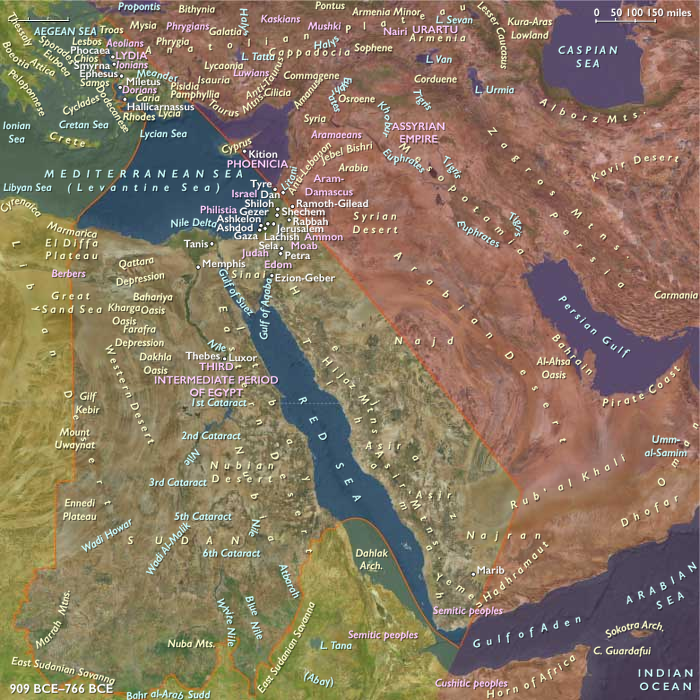
In the northern kingdom of Israel, the era from 801 to 790 BCE is marked by the ascension and impactful reign of Jeroboam II, son of Jehoash. Though minimally detailed by the Deuteronomic historian, archaeological evidence and secondary historical sources depict Jeroboam II as a notably successful monarch. His reign initiates a significant territorial and economic revival, restoring Israel’s boundaries to their ancient extent and reclaiming territories previously lost to Aram-Damascus.
Under Jeroboam II, Israel experiences a marked period of economic prosperity. Increased trade, political stability, and internal development characterize this time, restoring Israel’s status as a major power in the region. Jeroboam II’s effective governance fosters a brief but influential resurgence of northern Israelite strength, temporarily reversing the decline experienced during previous reigns.
Resolution of Egypt’s Dynastic Rivalries
In Egypt, the prolonged period of dynastic conflict reaches a decisive turning point during the thirty-ninth year of Shoshenq III’s reign. After sustained internal warfare, Osorkon B (later known as Osorkon III) decisively defeats rival factions and consolidates power over Middle and Upper Egypt. His victory puts an end to the longstanding factional struggles that had fragmented the country, effectively stabilizing southern Egypt.
With this triumph, Osorkon III establishes a Libyan dynasty in Upper Egypt, initiating a line of succession that includes his successors Takelot III and Rudamun. This dynastic consolidation effectively partitions Egypt into clearly defined spheres of influence, with Shoshenq III’s rule confined to Lower Egypt, while Osorkon III’s newly founded dynasty firmly controls the south. This resolution brings relative stability, albeit in a divided Egypt, after decades of internal conflict.
Summary of the Era
The era 801–790 BCE is marked by contrasting developments: a notable resurgence of Israel under Jeroboam II, who restores stability and territorial expansion, and a decisive resolution of Egypt’s dynastic conflicts, culminating in the establishment of Osorkon III’s Libyan dynasty. These parallel developments reshape political alliances and regional dynamics, offering both kingdoms temporary reprieve and renewed strength in the Near East.
Years: 801BCE - 790BCE
People
Groups
Subjects
Regions
Subregions