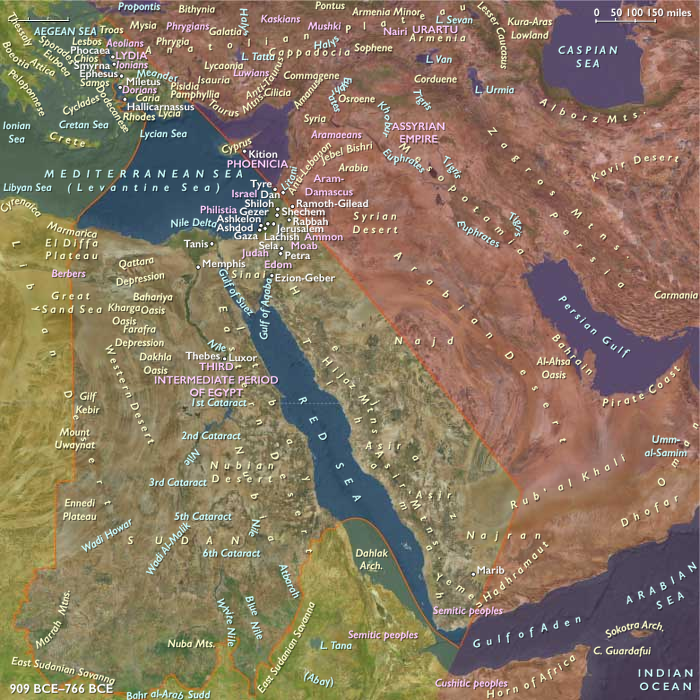
The Near East (777–766 BCE): Judah's Power …
Years: 777BCE - 766BCE
The Near East (777–766 BCE): Judah's Power and Amaziah’s Turbulent End
Between 777 and 766 BCE, the kingdom of Judah experiences a remarkable peak in its political and military strength under the rule of Uzziah (also known as Azariah). His long and prosperous reign sees extensive territorial expansion, significant military advancements, and notable economic growth.
Uzziah successfully campaigns against neighboring nations, securing tribute from the Ammonites and expanding Judah's control westward into Philistia, including the strategic capture of the city of Jamnia, previously inhabited by the Philistines. Domestically, his administration initiates ambitious infrastructure projects. Jerusalem's defenses are strengthened significantly, with walls reconstructed, watchtowers added, and sophisticated siege engines strategically placed to defend the capital. Additionally, Judah's agricultural capacity expands notably through systematic water conservation efforts, reclaiming previously arid regions and enhancing the kingdom’s prosperity.
Simultaneously, Judah’s relations with Edom remain fraught with conflict, extending from earlier tensions during the reign of Uzziah’s predecessor, Amaziah. Earlier in his reign, Amaziah had sought to re-subjugate Edom, even capturing Sela (Petra), the Edomite capital. Initially, Amaziah had punished his father's murderers and demonstrated obedience to religious mandates by sending away mercenaries from Israel upon a prophet’s command. This decision resulted in a decisive victory over Edom; however, Amaziah soon after embraced the very idols taken from the Edomites, leading to religious and political deterioration.
The repercussions of this shift prove disastrous. Amaziah rashly challenges Jehoash, the king of Israel, to battle and suffers a devastating defeat, becoming Jehoash’s prisoner. His humiliating defeat precipitates a deadly conspiracy within Judah itself, culminating in his assassination in 768 BCE at Lachish, to which he had fled for refuge. Amaziah’s body is returned to Jerusalem and buried in the royal sepulcher, marking a grim conclusion to a reign characterized by initial promise and later decline.
Thus, the era 777–766 BCE encapsulates both Judah’s zenith under Uzziah and the tragic end of Amaziah, reflecting a period of significant geopolitical ambition, internal strife, and dramatic reversals of fortune.
Related Events
Showing 10 events out of 66538 total
Years: 777BCE - 766BCE
People
Groups
- Edomites, Kingdom of the
- Ammonites, Kingdom of the
- Philistines
- Judah, Kingdom of
- Israel (Northern Kingdom of)
Subjects
Regions
Subregions