The Near East (4221–4078 BCE): Early Trade …
Years: 4221BCE - 4078BCE
The Near East (4221–4078 BCE): Early Trade Networks and Cultural Exchange
Interregional Trade Expansion
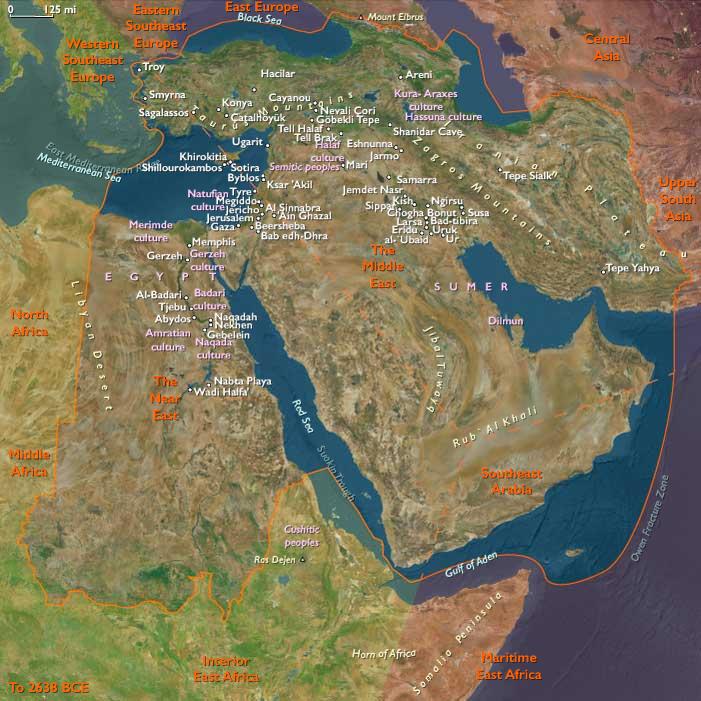
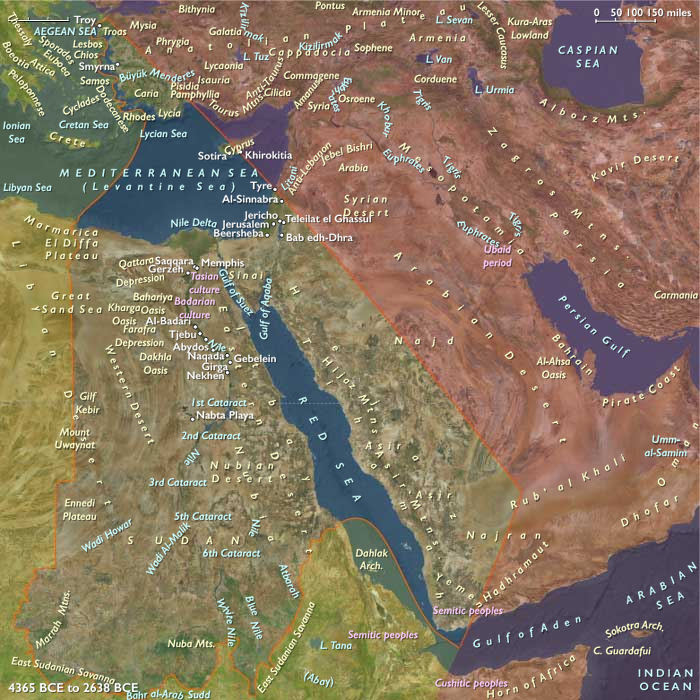
This period witnesses a substantial growth in trade between Upper and Lower Egypt, evidenced by artifacts such as stone vases from the northern regions found at el-Amra. Copper, absent in Egypt's natural environment, is likely imported from Sinai or Nubia, while obsidian, a volcanic glass used for tool-making, and limited amounts of gold are definitively sourced from Nubia. The trade network further includes the desert oases, facilitating broader cultural exchanges and economic interactions across the region. These burgeoning trade routes fostered increasing complexity and interdependence among early Near Eastern societies.
Groups
Topics
Commodoties
Subjects
Regions
Subregions
Related Events
Filter results
Showing 10 events out of 68840 total
The Expansion of Interregional Trade and Human Migration (42nd–41st Centuries BCE)
During the 42nd and 41st centuries BCE, interregional trade in metals began to expand, marking an important shift in economic and technological exchanges across early Neolithic and Chalcolithic societies. This period also saw increased human migration and colonization, as populations moved, established new settlements, and further shaped the cultural and economic landscape of prehistoric Europe and beyond.
Expansion of Metal Trade and Technological Diffusion
- The earliest metalworking traditions emerged in Southeastern Europe, Anatolia, and the Caucasus, where native copper was first exploited for tools, ornaments, and prestige goods.
- Trade networks facilitated the exchange of raw materials, including:
- Copper from the Balkans and Anatolia
- Obsidian from the Near East and the Mediterranean
- Flint and high-quality stone from Northern Europe
- These technological advancements spread westward, influencing early metal-using cultures in Central and Western Europe.
Migration, Colonization, and Cultural Exchange
- Human populations expanded across Europe, leading to the spread of Neolithic farming societies into previously uninhabited or sparsely settled regions.
- New agricultural communities were established, introducing:
- Domesticated crops and livestock to more regions.
- Distinct pottery styles, reflecting cultural identities.
- Architectural innovations, including megalithic tombs and longhouses.
- This period also saw the movement of ideas and technologies, accelerating the development of trade routes and economic specialization.
Significance of this Period
- The expansion of interregional trade laid the groundwork for later Bronze Age metal economies, as societies became more economically interconnected.
- The movement of peoples and cultural diffusion contributed to the formation of diverse regional identities, influencing the social and technological evolution of early civilizations.
- This period represents an early stage of globalization, where long-distance trade, migration, and cultural interactions began shaping the complex societies of the later Neolithic and Chalcolithic periods.
The 42nd and 41st centuries BCE thus marked a pivotal moment in human history, as economic networks expanded, technology advanced, and societies became more interconnected than ever before.
New kinds of graves, named after a grave at Suvorovo, appear about 4200-4000 BCE north of the Danube delta in the coastal steppes of Ukraine near Izmail, more than five hundred years before the geographic expansion evidenced by the presence of horse bones.
Suvorovo graves are similar to and probably derive from earlier funeral traditions in the steppes around the Dnieper River.
Some Suvorovo graves contain polished stone mace-heads shaped like horse heads and horse tooth beads.
Earlier steppe graves also had contained polished stone mace-heads, some of them carved in the shape of animal heads.
Settlements in the steppes contemporary with Suvorovo, such as Sredni Stog II and Dereivka on the Dnieper River, contained twelve to fifteen percent horse bones.
When Suvorovo graves appeared in the Danube delta grasslands, horse-head maces also appeared in some of the indigenous farming towns of the Tripolye and Gumelnitsa cultures in present-day Romania and Moldova, near the Suvorovo graves.
These agricultural cultures had not previously used polished-stone maces, and horse bones were rare or absent in their settlement sites.
Probably their horse-head maces had come from the Suvorovo immigrants.
The Suvorovo people in turn acquire many copper ornaments from the Tripolye and Gumelnitsa towns.
About six hundred agricultural towns in the Balkans and the lower Danube valley, some of which have been occupied for two thousand years, are abandoned after this episode of contact and trade, but still during the period 4200-4000 BCE.
Copper mining ceases in the Balkan copper mines, and the cultural traditions associated with the agricultural towns are terminated in the Balkans and the lower Danube valley.
This collapse of "Old Europe" has been attributed to the immigration of mounted Indo-European warriors, although the collapse could have been caused by intensified warfare, for which there is some evidence.
Mounted raiding could have worsened warfare; the horse-head maces have been interpreted as indicating the introduction of domesticated horses and riding just before the collapse.
However, mounted raiding is just one possible explanation for this complex event.
Also cited as causal factors are environmental deterioration, ecological degradation from millennia of farming, and the exhaustion of easily mined oxide copper ores.
The Middle East (4221–4078 BCE): Rise of Urban Life and the Establishment of Susa
Beginnings of Urbanization and Agriculture
Between 4221 and 4078 BCE, sedentary agriculture became increasingly sophisticated in Mesopotamia, providing a solid foundation for the emergence of urban life and early civilization. During this period, communities also mastered advanced techniques such as the engraving of hard stones, reflecting significant technological progress.
Foundation and Growth of Susa
Around 4200 BCE, one of the oldest settlements in the region—and indeed the world—Susa, began to take shape. Initially, it comprised two distinct settlements identified by archaeologists as the Acropolis (approximately seven hectares) and Apadana (approximately 6.3 hectares). These settlements eventually merged to form Susa proper, spanning roughly eighteen hectares. The Apadana settlement featured impressive fortifications, including walls of rammed earth up to six meters thick.
The establishment of Susa coincided with the abandonment of surrounding villages, possibly representing a strategic initiative to reconstruct the nearby previously destroyed settlement at Chogha Mish. Archaeological evidence indicates a continuous human presence in the vicinity of Susa dating back as far as 7000 BCE, with a painted-pottery culture evident around 5000 BCE.
Chalcolithic Culture and Artifacts at Hacilar
Concurrent with developments in Mesopotamia, the residents of Hacilar during the Early Chalcolithic epoch were notably active in producing elaborately patterned red-on-buff painted pottery. These communities also crafted numerous clay female figurines, depicted either individually or accompanied by animals and children. These artifacts reflect a rich cultural and symbolic life during this formative era.
Broader Impacts and Developments
This period underscores significant advancements in urban planning, fortification techniques, craftsmanship, and artistic expression. The rise of urban centers such as Susa marked a pivotal shift towards increasingly complex social structures and more integrated regional cultures, setting the stage for future civilizations in the ancient Middle East.

Sedentary agriculture and the beginnings of urban life and civilization develop during this age in Mesopotamia, by which time the engraving of hard stones is known.
Copper is first worked in the Fertile Crescent around this time or earlier.
Though the first copper objects may have been valuable because of their rarity, production expands as demand for copper objects grows.
Complex mining techniques develop in Europe before 4000 BCE, by which time European metallurgists master smelting and casting.
The range of copper objects progresses from beads and awls to impressive shaft-hole axes.
Susa, like its Chalcolithic neighbor Uruk, begins as discrete settlements in the Susa I period (about 4000 BCE).
The two settlements called Acropolis (seven hectares) and Apadana (six point three hectares) by archeologists will later merge to form Susa proper (eighteen hectares).
Walls of rammed earth six meters thick enclose Apadana.
The founding of Susa corresponds with the abandonment of nearby villages.
It is possible the founding of the city was an attempt to reestablish the previously destroyed settlement at Chogha Mish.
One of the oldest-known settlements of the region and indeed the world, Susa was possibly founded about 4200 BCE; although the first traces of an inhabited Neolithic village have been dated to around 7000 BCE.
Evidence of a painted-pottery civilization has been dated to around 5000 BCE.
The residents of Hacilar in the Early Chalcolithic epoch manufacture elaborately patterned red-on-buff painted pottery and produce an abundance of clay female figurines, represented alone or with animals and children.
Trade between Upper and Lower Egypt is attested by excavated objects.
A stone vase from the north has been found at el-Amra, and copper, which is not present in Egypt, is apparently imported from the Sinai, or perhaps from Nubia.
Obsidian and an extremely small amount of gold are both definitively imported from Nubia.
Trade with the oases is also likely.
A new wave of immigration to Malta from Sicily beginning in about 4100 BCE is the foundation of the Zebbug and Mgarr phases, and eventually the Ggantija phase, of Maltese temple builders.