
The Near East (3357–3214 BCE): Formation of …
Years: 3357BCE - 3214BCE
The Near East (3357–3214 BCE): Formation of Upper and Lower Egypt
Emergence of Proto-Writing and Unification Efforts
Around 3350 BCE, Egyptians begin employing clay, bone, and ivory tags to label storage boxes, a practice possibly representing an early form of proto-writing. Concurrently, Egyptian society sees the development and unification of regional chiefdoms into provinces along the Nile River. The unification processes occur independently within the two distinct geographical and cultural zones of Egypt—Upper Egypt (the Nile Valley) and Lower Egypt (the Nile Delta).
Distinctive Identity of Upper Egypt (Ta Shemau)
Upper Egypt, known as Ta Shemau ("the land of reeds"), is divided into twenty-two administrative districts known as nomes, stretching from modern Aswan in the south to Atfih (ancient Aphroditopolis) near present-day Cairo. The lotus flower becomes the emblematic symbol representing Upper Egypt. Its primary cultural and political hub is the city of Nekhen (later known as Hierakonpolis), patronized by the vulture goddess Nekhbet.
The formal headgear symbolizing Upper Egypt is the White Crown (Hedjet). Despite no actual crowns surviving archaeologically, artistic representations such as those on the Narmer Palette (discovered at Hierakonpolis) depict the Hedjet clearly, demonstrating its symbolic association with southern rulership. Nekhbet, often portrayed with a vulture’s head and wearing the White Crown, symbolizes divine protection over the kings of Upper Egypt. Depictions from as early as the Naqada II period in northern Nubia suggest that the tradition of the Hedjet predates Egyptian unification, perhaps indicating a southern origin later appropriated by Upper Egyptian rulers.
Distinctive Identity of Lower Egypt (Ta-Mehu)
Lower Egypt, termed Ta-Mehu ("land of papyrus"), spans the fertile but largely undeveloped Nile Delta. Divided into twenty nomes beginning at el-Lisht, Lower Egypt's emblematic symbol is the papyrus reed, and its protective deity is associated with the Red Crown (Deshret), indicative of northern royal authority. The Red Crown is stylistically characterized by a distinctive curled wire-like appendage, symbolizing the proboscis of a honeybee, and thus linked symbolically with bees as well as papyrus. Notably, no physical examples of the Red Crown have survived, leaving its precise construction—possibly of copper, reeds, cloth, or leather—entirely speculative.
In mythology, the deity Geb, god of the earth, bestows rulership of Lower Egypt upon the falcon-headed god Horus, who prominently wears the Red Crown. The Red Crown (Deshret) also symbolizes the Red Land, the harsh deserts surrounding Egypt, associated with chaos and governed by the deity Set (or Seth). Set embodies the arid desert, storms, and foreigners, and is depicted as a mysterious composite creature—the Set animal—with an elongated snout, forked tail, squared ears, and canine form, first appearing possibly in Naqada I era artifacts or definitively by the Protodynastic era.
Urbanization, Architectural Development, and Tomb Evolution
During this era, Egyptian settlements increasingly evolve into fortified, walled towns, marking significant urban developments in both Upper and Lower Egypt. Concurrently, burial practices become more sophisticated, with tomb structures designed to resemble residential houses, sometimes incorporating multiple rooms. Scholars believe these architectural developments primarily emerged from influences originating in the Delta region, gradually diffusing southward.
Hierarchical Governance and Divine Kingship
Egypt’s social and political structure continues to grow more complex. Chiefdoms consolidate into provinces, eventually crystallizing into two distinct kingdoms—Upper and Lower Egypt. Each kingdom develops distinct identities, symbols, and patron deities, gradually setting the stage for the historic unification under a single monarchy. The rulers of these proto-kingdoms legitimize their authority through divine association and symbolic regalia, setting enduring precedents for pharaonic rule.
The appearance of proto-writing, differentiated regional identities, and increasing social stratification exemplify this transformative period. Upper and Lower Egypt's dual but parallel development underpins future Egyptian civilization, laying a robust cultural and political foundation for the historical unification that soon follows.
Groups
- Jericho, Ancient
- Polytheism (“paganism”)
- Egypt (Ancient), Predynastic
- Amratian culture (Naqada I)
- Ghassulian culture
Topics
Commodoties
Subjects
Regions
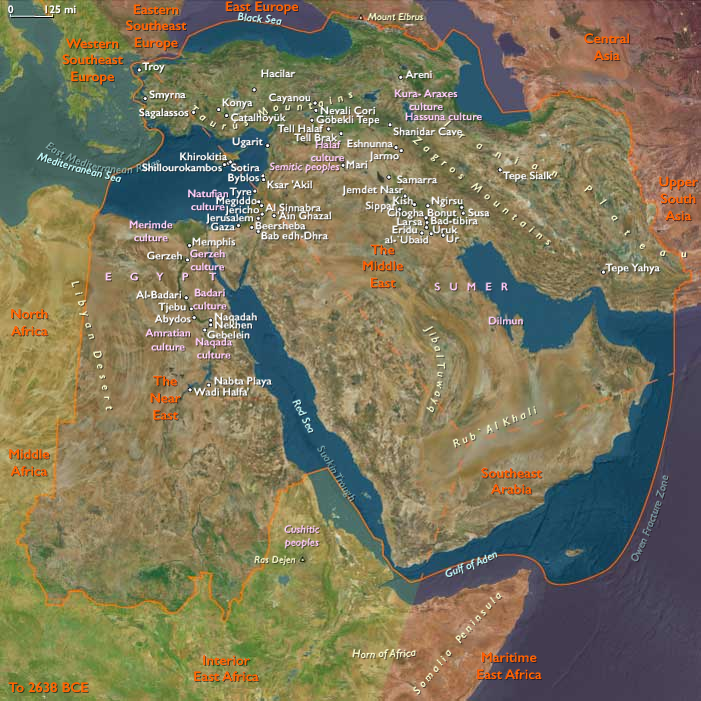
Subregions
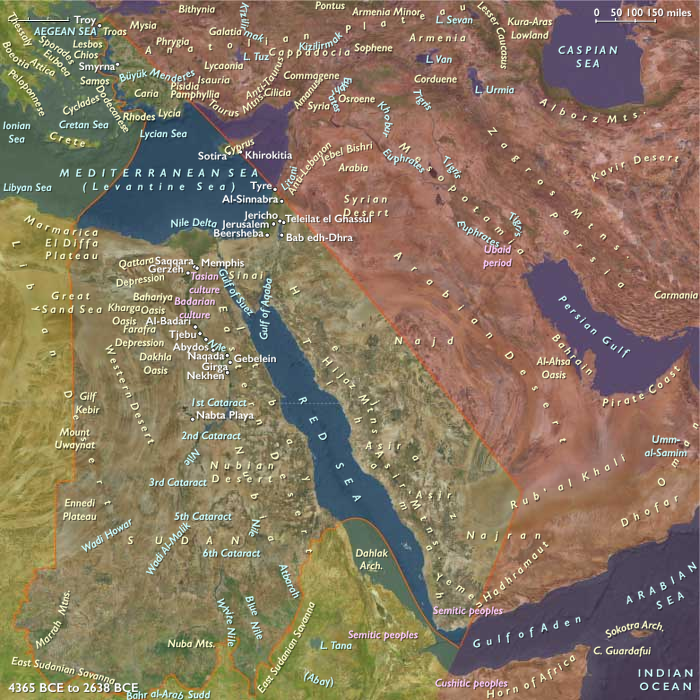
Years: 3357BCE - 3214BCE
Groups
- Jericho, Ancient
- Polytheism (“paganism”)
- Egypt (Ancient), Predynastic
- Amratian culture (Naqada I)
- Ghassulian culture
Topics
Commodoties
Subjects
Regions
Subregions