
Northeastern North America (28,577 to 7822 …
Years: 28557BCE - 7822BCE
Northeastern North America (28,577 to 7822 BCE) Terminal Pleistocene — Early Holocene — Archaic Foundations
Geographic and Environmental Context
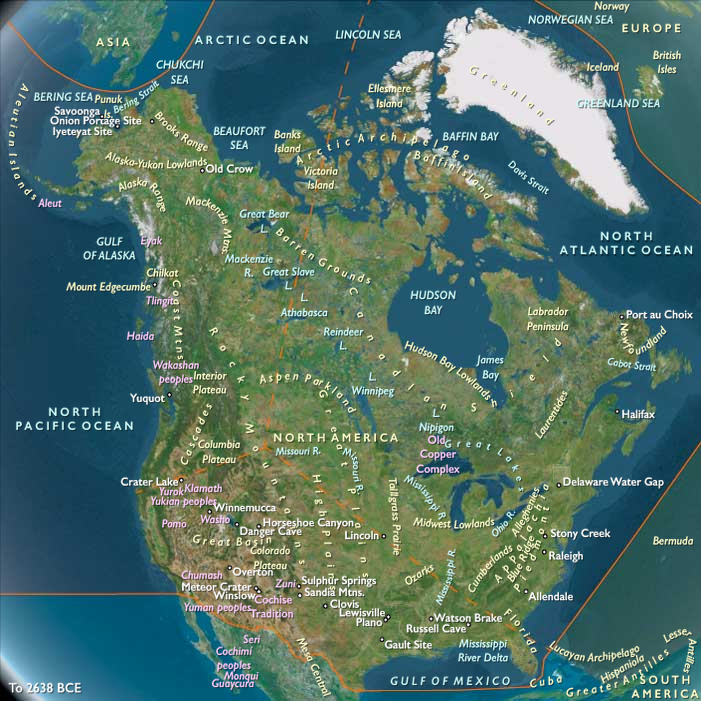
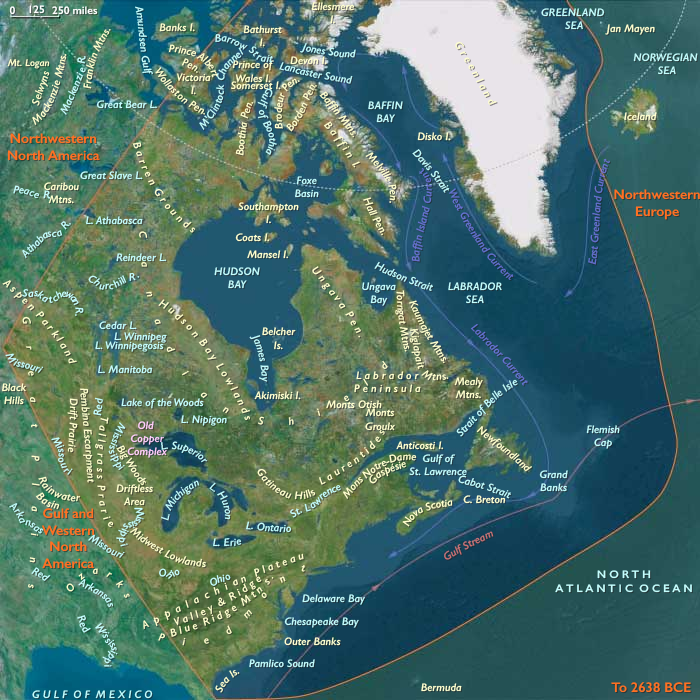
Northeastern North America includes the Atlantic coast from Jacksonville, FL to St. John’s, NL; Greenland; the Canadian Arctic; all Canadian provinces east to the Saskatchewan–Alberta border; and, within the U.S., the Old South, the Appalachian Plateau, Midwest & Great Lakes (including Driftless Area, Midwest Lowlands, Tallgrass Prairie, Big Woods, Drift Prairie, Aspen Parkland).
Anchors: Chesapeake–Delaware–Hudson–Gulf of Maine coasts; St. Lawrence–Quebec–Montreal; Great Lakes & Ohio–Illinois–Mississippi valleys; Appalachian Plateau (Pittsburgh–Knoxville); Hudson Bay rim; Arctic (Baffin, Foxe, Labrador); Greenland (future Norse Eastern/Western Settlements).
Climate & Environmental Shifts
-
Bølling–Allerød → Younger Dryas → Holocene: forests expanded; river–lake productivity rose.
Subsistence & Settlement
-
Early Archaic broad-spectrum foraging; estuarine shell-heaps on Mid-Atlantic/New England; interior fish–deer economies.
Technology & Material Culture
-
Notched/side-notched points; adzes; groundstones appear; dugouts on rivers/estuaries.
Movement & Interaction Corridors
-
St. Lawrence & Great Lakes navigation; Appalachian ridge–valley routes; Chesapeake–Narragansett–Gulf of Maine canoe circuits.
Cultural & Symbolic Expressions
-
Shell heap feasts; early mound/earthwork precursors in interior.
Environmental Adaptation & Resilience
-
River–bay storage buffered seasonality; coastal storm evacuation by canoe.
Transition
By 7,822 BCE, Archaic adaptations were well-established coast–interior.
Groups
Topics
Commodoties
Subjects
Regions
Subregions
Related Events
Showing 10 events out of 69497 total
Years: 28557BCE - 7822BCE
Groups
Topics
Commodoties
Subjects
Regions
Subregions