
The Near East (2493–2350 BCE): Divine Kingship …
Years: 2493BCE - 2350BCE
The Near East (2493–2350 BCE): Divine Kingship and Cultural Sophistication
Consolidation of Divine Kingship
By this age, the concept of divine kingship is fully established, deeply shaping Egyptian political and social structures. The pharaoh is identified explicitly with the god Horus, who symbolizes the unified land of Egypt. Egyptian society perceives the pharaoh as a divine ruler with magical powers to ensure the Nile’s annual floods, essential for agricultural prosperity and social stability.
Administrative Innovations and Record-Keeping
Egypt demonstrates advanced administrative capabilities, exemplified by official records documenting organized courier services for distributing written communications across the kingdom. A significant artifact from this period, the Palermo Stone, meticulously lists Egyptian rulers from predynastic times through the early Fifth Dynasty, highlighting royal activities such as river journeys, religious festivals, construction projects, and military expeditions into Canaan and southern Nubia. Importantly, it also records annual Nile flood levels, indicating sophisticated environmental monitoring.
Osiris Cult and Religious Practices
Around 2400 BCE, Osiris, originally revered as a fertility deity, evolves into a central funerary god and becomes emblematic of deceased pharaohs. Osiris, alongside his consort-sister Isis and their son Horus, forms the divine triad worshiped at Abydos. The myth of Osiris’s murder by his brother Set, followed by Isis’s restoration of Osiris to life (minus one critical piece), embodies Egyptian beliefs about resurrection and eternal life. Consequently, Egyptians adopt elaborate mummification practices, replicating Osiris’s embalmed form, depicted in sculptures as wrapped in white funerary cloth, holding royal and divine symbols—the scepter, crook, and flail.
Advances in Medicine and Science
Egyptian knowledge of medicine significantly advances, reflected in surviving medical papyri from around 2400 BCE. These texts systematically address diseases, symptoms, and treatments, outlining procedures such as using compression to halt bleeding, and providing therapeutic guidance for ailments affecting the eyes, heart, and other internal organs. This indicates a structured approach to medical practice, with emphasis on diagnosis, prognosis, and therapeutic intervention.
Artistic Flourishing and Architectural Refinement
Although the Fifth Dynasty pyramids are smaller than their Fourth Dynasty predecessors, they achieve a superior elegance and refinement. Architectural elements like columns shaped as bundled papyrus stems, crowned by capitals resembling date-palm leaves, replace simpler rectangular forms. White limestone sculptures, finely carved and set atop red granite bases, adorn interiors, further accented by polished basalt flooring, underscoring the artistic sophistication of the era.
Decorative Glass and Craftsmanship
Egyptian artisans master the creation of decorative glassware, producing beads and intricately designed unguent jars. These items, often made of dark blue glass with vibrantly colored zigzag patterns, are crafted around sand cores, showcasing the era’s artistic ingenuity and technical expertise in glassmaking.
Dance, Drama, and Ritual Performance
Egypt develops a sophisticated cultural expression in dance by 2400 BCE, vividly demonstrated in annual festivals at Abydos. These events feature dramatic enactments of the death and resurrection of Osiris, blending austere Egyptian dance styles with dramatic narratives, song, and communal participation. Such rituals represent early forms of mythological pageants and religious mystery plays, highlighting dance’s role as both spectacle and communal event.
Social and Political Evolution
Initially, nomarchs—provincial governors—are royal appointees without local ties or hereditary claims. However, by the mid-Fifth Dynasty, these positions evolve into hereditary titles, transforming nomarchs into powerful landed gentry. Concurrently, the pharaohs begin granting tax-exempt lands to loyal courtiers, laying the groundwork for an emerging feudal structure. This gradual decentralization, especially pronounced in Upper Egypt, signals the beginning of a shift from strictly centralized authority to a more complex feudal system.
Concept of Maat and Royal Governance
Central to Egyptian governance is the principle of maat, embodying justice, truth, and cosmic order, personified by the goddess Maat. The pharaoh, ruling by divine right, is responsible for upholding maat, an obligation that curbs arbitrary exercises of power. Administrative duties, once shared primarily among royal relatives, are increasingly managed by a grand vizier, initially a royal prince, who oversees all governmental departments, thus formalizing and enhancing bureaucratic governance.
This age is marked by refined cultural practices, administrative sophistication, and religious and political structures that profoundly influence Egyptian civilization, laying a robust foundation for enduring legacies in the Near East and beyond.
People
Groups
Topics
Commodoties
- Rocks, sand, and gravel
- Weapons
- Gem materials
- Colorants
- Glass
- Domestic animals
- Grains and produce
- Textiles
- Ceramics
- Strategic metals
- Lumber
- Industrial chemicals
Subjects
- Symbols
- Architecture
- Watercraft
- Sculpture
- Painting and Drawing
- Decorative arts
- Faith
- Government
- Custom and Law
Regions
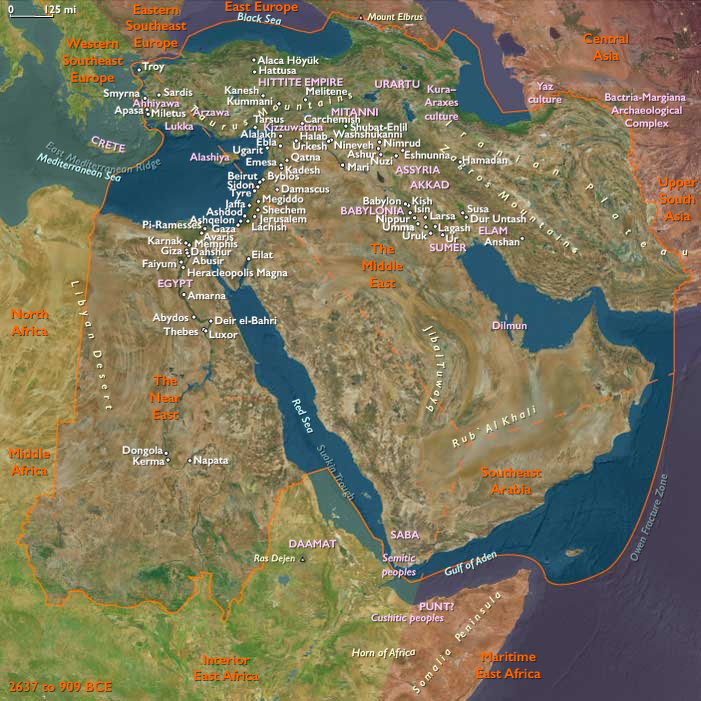
Subregions
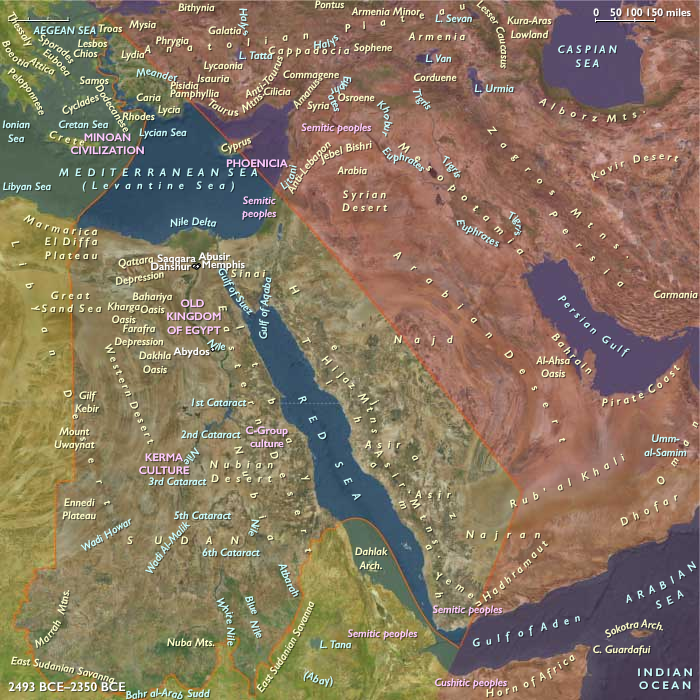
Years: 2493BCE - 2350BCE
People
Groups
Topics
Commodoties
- Rocks, sand, and gravel
- Weapons
- Gem materials
- Colorants
- Glass
- Domestic animals
- Grains and produce
- Textiles
- Ceramics
- Strategic metals
- Lumber
- Industrial chemicals
Subjects
- Symbols
- Architecture
- Watercraft
- Sculpture
- Painting and Drawing
- Decorative arts
- Faith
- Government
- Custom and Law
Regions
Subregions