
The Near East (1733–1630 BCE): Hyksos Invasion …
Years: 1773BCE - 1630BCE
The Near East (1733–1630 BCE): Hyksos Invasion and Cultural Shifts
The Arrival and Influence of the Hyksos
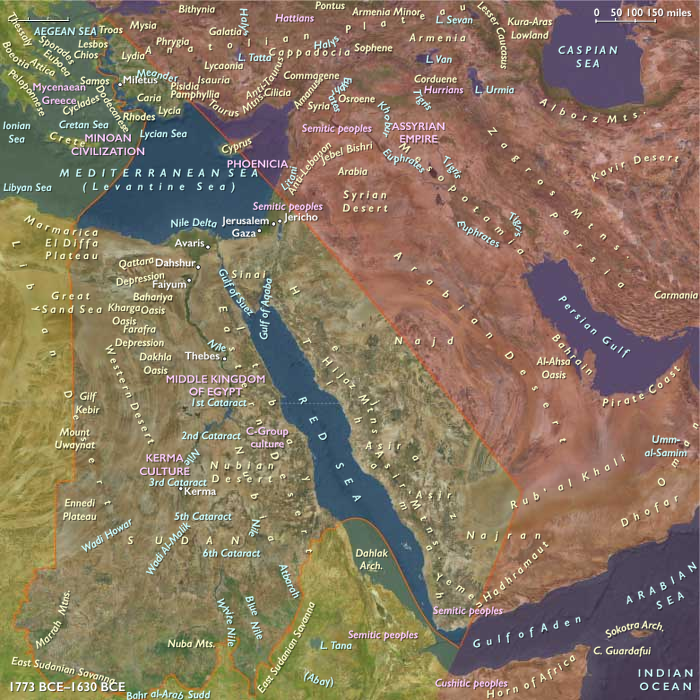
Around 1720 BCE, Asian nomads known as the Hyksos invade Egypt, signaling the end of the Middle Kingdom. Originating from Asia, these Semitic-speaking peoples establish their rule from Avaris (modern Tell ed-Dab'a/Khata'na) in the eastern Nile Delta. The Hyksos introduce new technologies to Egypt, notably the chariot, fundamentally altering military strategies. The Egyptian Thirteenth Dynasty, already weakened by internal issues such as famine and plague, struggles to resist this incursion. Ultimately, Egypt splinters, ushering in the Second Intermediate Period.
Changes in Nubia (Kush)
Egypt’s withdrawal from Nubia following the Hyksos invasion leads to the collapse of established forts along the Nile. Filling this power vacuum, an indigenous and culturally distinct kingdom emerges at Kerma, near present-day Dongola, becoming a significant regional power independent of Egyptian influence.
Advances in Egyptian Medicine
Medical practices continue to advance during this period. The Edwin Smith Papyrus, dating from the seventeenth century BCE but reflecting even older traditions (possibly as early as 3000 BCE), details treatments for various dental ailments, marking the beginnings of systematic dental extraction.
Political Fragmentation and Dynastic Complexity
Following the brilliant Twelfth Dynasty, Egypt enters a turbulent phase marked by the relatively weaker Thirteenth Dynasty, which rules from Itjtawy, near the Faiyum. Despite internal challenges, this dynasty maintains some degree of governance stability until about 1730 BCE, when increased fragmentation occurs. Dynastic shifts see ephemeral monarchs often dominated by powerful viziers, reflecting diminished royal authority. Notably, King Merneferre Ay (1700–1677 BCE) reigns as a vassal under Hyksos dominance.
Hyksos Governance and Cultural Integration
Under the Hyksos' Fifteenth and Sixteenth dynasties (circa 1648–1540 BCE), Egypt experiences relative peace and prosperity. The Hyksos rulers adopt Egyptian language and religious practices, staffing their administrations largely with Egyptians. Their respectful integration fosters an environment of cultural continuity despite foreign rule.
Canaanite Cities and Urban Expansion
Cities in Canaan, such as Jericho and Tell as-Sakan, witness significant urban renewal during this period. Jericho strengthens and expands its fortifications around 1700 BCE, reflecting growing prosperity. A second city arises atop earlier ruins at Tell as-Sakan, indicating renewed urban development under Hyksos oversight.
Jerusalem's Early Development
In the seventeenth century BCE, Jerusalem witnesses major fortifications, with massive walls constructed to protect its crucial water supply. The city, known earlier as Rusalimum, becomes more prominent, linked culturally and religiously to regional Semitic traditions.
Minoan Influence in Anatolia
Trade with Minoan civilization significantly impacts Anatolia, particularly the city of Miletus, beginning around 1900 BCE. Archaeological findings at Miletus confirm this influence, supporting ancient legends of population influxes from Crete.
Mathematical and Literary Innovations
This period sees considerable advancements in mathematical and literary knowledge. Egyptian fraction notation evolves significantly, as exemplified by texts such as the Rhind Mathematical Papyrus and the Moscow Mathematical Papyrus, which provide detailed mathematical insights. Egyptian literature also flourishes, with notable works emerging or being refined in this period, such as the pseudo-prophetic Prophecy of Neferti and didactic narratives like The Eloquent Peasant.
Legacy of the Middle Kingdom and Transition
The Hyksos invasion decisively ends Egypt’s prosperous Middle Kingdom, transitioning into the politically fragmented Second Intermediate Period. Nonetheless, the era's cultural, intellectual, and technological developments leave lasting legacies, profoundly shaping subsequent Near Eastern civilizations.
People
Groups
- Polytheism (“paganism”)
- Kushitic Civilization
- Canaanite culture, ancient
- Anatolia, archaic
- Kerma, Kingdom of
- Amorites
- Minoan (Cretan) culture, Middle
- Hittites
- Egypt (Ancient), Middle Kingdom of
- Egypt (Ancient), Second Intermediate Period of
- Hyksos, Kingdom of
Topics
Commodoties
- Rocks, sand, and gravel
- Weapons
- Gem materials
- Colorants
- Glass
- Domestic animals
- Grains and produce
- Textiles
- Ceramics
- Strategic metals
- Lumber
- Industrial chemicals
- Aroma compounds
Subjects
- Symbols
- Architecture
- Watercraft
- Sculpture
- Painting and Drawing
- Decorative arts
- Faith
- Government
- Custom and Law
- Medicine
- Human Migration
Regions
Subregions
Related Events
Showing 10 events out of 67790 total
Years: 1773BCE - 1630BCE
People
Groups
- Polytheism (“paganism”)
- Kushitic Civilization
- Canaanite culture, ancient
- Anatolia, archaic
- Kerma, Kingdom of
- Amorites
- Minoan (Cretan) culture, Middle
- Hittites
- Egypt (Ancient), Middle Kingdom of
- Egypt (Ancient), Second Intermediate Period of
- Hyksos, Kingdom of
Topics
Commodoties
- Rocks, sand, and gravel
- Weapons
- Gem materials
- Colorants
- Glass
- Domestic animals
- Grains and produce
- Textiles
- Ceramics
- Strategic metals
- Lumber
- Industrial chemicals
- Aroma compounds
Subjects
- Symbols
- Architecture
- Watercraft
- Sculpture
- Painting and Drawing
- Decorative arts
- Faith
- Government
- Custom and Law
- Medicine
- Human Migration
Regions
Subregions