
The Near East, 1900 to 1911 CE: …
Years: 1900 - 1911
The Near East, 1900 to 1911 CE: Rising Nationalism and Social Unrest
The Dinshawi Incident and Egyptian Nationalism
Egyptian nationalism intensifies significantly after the infamous Dinshawi Incident of 1906. British officers, while shooting pigeons near the Delta village of Dinshawi, accidentally wound the wife of the local imam. A confrontation erupts, resulting in injuries among both the villagers and British officers, with one officer dying from heatstroke as he attempts to return to his camp. British forces respond harshly, executing four villagers, sentencing others to imprisonment and public flogging, and brutally punishing suspects without fair trials. The severity and injustice of these actions galvanize public opinion, sparking widespread nationalist and anti-British sentiments throughout Egypt.
Emergence of Egyptian Political Parties
Egyptian political consciousness rapidly evolves in response to these events, leading to the establishment of political parties in 1907. Two major parties dominate the political landscape: the National Party (Al Hizb al Watani) led by the charismatic Mustafa Kamil, and the more moderate Umma Party (Al Hizb al Umma).
The National Party, strongly anti-British and immediately demanding full independence, attracts traditionalists and conservatives by emphasizing Islamic identity. Its publication, Al Liwa, amplifies nationalist rhetoric. Conversely, the Umma Party, led by influential figures such as Ahmed Lutfi el-Sayed, advocates gradual reform and cooperation with British authorities to achieve eventual independence. Their publication, Al Jaridah, promotes constitutional reform and social progress. The death of Mustafa Kamil in 1908 significantly weakens the National Party, though it continues as a symbol of uncompromising nationalism.
Labor Movements and Urban Social Change
Egypt's working-class movement emerges forcefully during this period. Poor working conditions, low wages, and the absence of government protections lead to numerous strikes and the formation of workers’ associations, notably among cigarette wrappers, railroad, and port workers. The National Party supports these labor actions by providing schools, publicity, and legal assistance, further intertwining labor activism with nationalist goals. Despite harsh repression, labor activism remains resilient, indicating a maturing political awareness among Egypt's working class.
British Administration and Societal Transformation
Egypt remains under firm British control, administered by a succession of influential British consuls general, notably Lord Cromer (1883–1907), Sir John Eldon Gorst (1907–1911), and subsequently Lord Herbert Kitchener (1911–1914). Cromer's autocratic rule prioritizes economic stability through fiscal austerity but neglects education and industry, fostering resentment among Egyptians.
His successor, Gorst, attempts conciliation by promoting moderate nationalism but fails due to both nationalist inflexibility and British reluctance to cede control. Lord Kitchener, arriving in 1911 with a reputation from his conquest of Sudan, introduces constitutional reforms in 1913, expanding representative institutions and offering limited political participation.
Governance and Stability in Anglo-Egyptian Sudan
Under the Anglo-Egyptian Condominium in Sudan, governance structures solidify after initial instability. British authorities introduce formal legal and administrative frameworks, modeled partly on British India, to stabilize the region. They codify land tenure, taxation, and criminal law, establishing sharia courts staffed largely by Egyptian judges. Occasional Mahdist revolts flare briefly, notably in 1900, 1902–03, 1904, and 1908, yet are quickly suppressed. Governance is centralized under an executive council established in 1910, marking a transition to structured colonial administration.
Regional Tensions and Early Zionist Settlements
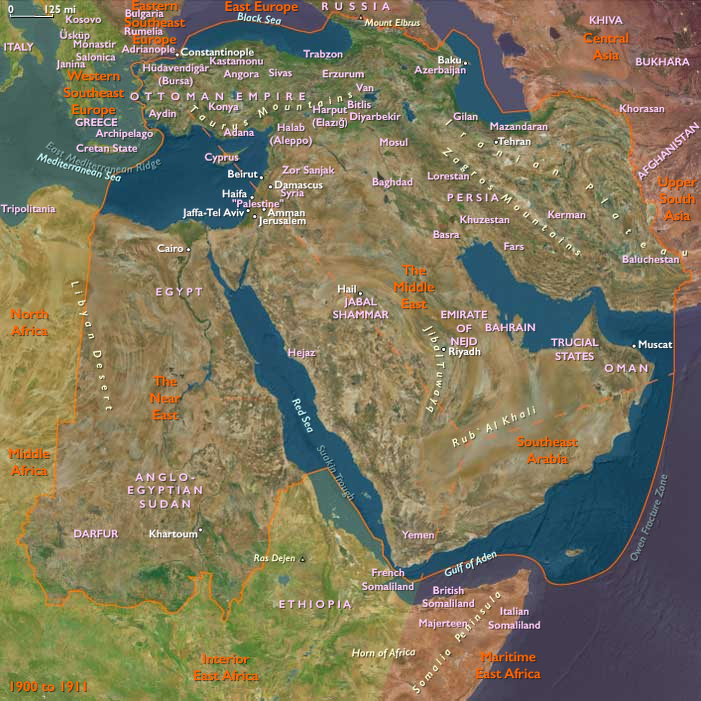
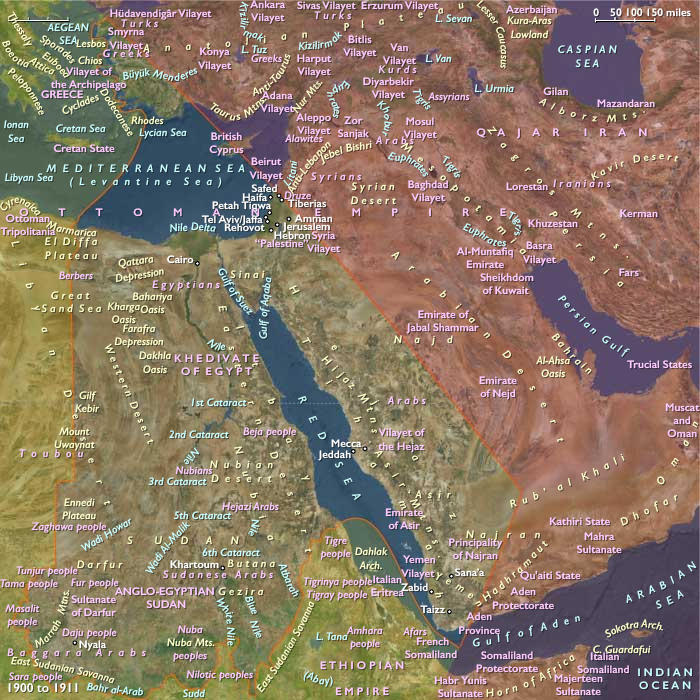
Throughout the Near East, tensions emerge amid Ottoman rule. The Ottoman authorities establish Circassian settlements in present-day Jordan, seeking to stabilize frontier regions. Simultaneously, the early stages of Zionist settlement unfold in Palestine, following the establishment of the Zionist Organization by Theodor Herzl in 1897. By the eve of the First World War, the Jewish population in Palestine rises significantly, fueling increasing local Arab resistance.
Legacy of the Era: Foundation of Modern Nationalism
The era from 1900 to 1911 sees the crystallization of Egyptian nationalism, driven by incidents like Dinshawi and the emergence of organized political parties and labor movements. Concurrently, British administrative policies reinforce economic stability but exacerbate political and social discontent. These years set the stage for intensified struggles over identity, independence, and governance, shaping the political trajectory of Egypt, Sudan, and the broader Near East for decades to come.
People
- Ahmed Lutfi el-Sayed
- Evelyn Baring, 1st Earl of Cromer
- Herbert Kitchener, 1st Earl Kitchener
- John Eldon Gorst
- Mustafa Kamil Pasha
- Theodor Herzl
Groups
- Egyptians
- Arab people
- Circassians
- Jews
- Islam
- Ottoman Empire
- Palestine, Ottoman
- Egypt, British Protectorate of
- Sudan, Anglo-Egyptian
Topics
Commodoties
Subjects
Regions
Subregions
Related Events
Showing 10 events out of 9033 total
Years: 1900 - 1911
People
- Ahmed Lutfi el-Sayed
- Evelyn Baring, 1st Earl of Cromer
- Herbert Kitchener, 1st Earl Kitchener
- John Eldon Gorst
- Mustafa Kamil Pasha
- Theodor Herzl
Groups
- Egyptians
- Arab people
- Circassians
- Jews
- Islam
- Ottoman Empire
- Palestine, Ottoman
- Egypt, British Protectorate of
- Sudan, Anglo-Egyptian
Topics
Commodoties
Subjects
Regions
Subregions