
The Near East, 1852 to 1863 CE: …
Years: 1852 - 1863
The Near East, 1852 to 1863 CE: Economic Shifts and Societal Transformations
The Suez Canal and Economic Concessions
In 1854, Egypt’s ruler, Sa'id Pasha, grants his friend, French engineer Ferdinand de Lesseps, a significant concession to construct a canal linking the Red Sea and the Mediterranean. The resulting Suez Canal Company undertakes the project under terms highly favorable to the company but costly to Egypt. The agreement includes granting the company a strip of tax-free land between the Nile and the canal site, allowing lucrative cultivation along a freshwater canal built there. Additionally, Sa'id provides labor for the canal’s construction, amounting effectively to forced labor.
Agricultural and Industrial Developments
Following the economic setbacks after Muhammad Ali's rule, Sa'id attempts economic revival by reintroducing key agricultural, educational, and irrigation projects initiated by his father. Under Sa'id’s administration, Egypt passes its first land law in 1858, formally establishing private land ownership rights. He dismantles previous agricultural monopolies, permitting landowners to freely sell their produce and select their crops. Sa'id also modernizes the Egyptian military by standardizing military service and implementing Egypt’s first organized pension system for public servants.
Decline of Industrial Ambitions and Rise of Cotton Export
Muhammad Ali’s ambitious plan to industrialize Egypt had largely failed by the time of his death, undermined by internal limitations and external European pressures. Despite these setbacks, Egyptian agriculture experiences significant growth, particularly in cotton exports. Driven by British demand, Egypt’s export of long-staple cotton increases dramatically, tripling between 1840 and 1860. During the American Civil War, cotton production in Egypt expands even further, with prices rising significantly due to global shortages.
Socioeconomic Changes and the Emergence of New Classes
The integration of Egypt into the global capitalist economy profoundly reshapes its social structure. A powerful elite emerges, primarily composed of large landowners of Turco-Circassian descent, alongside a growing middle class of medium-sized Egyptian landowners. In rural areas, rising debts force peasants off their land, prompting migration to urban centers where they swell the ranks of the urban poor and unemployed. Concurrently, cities witness the rise of a professional middle class including civil servants, lawyers, teachers, and technicians, alongside the influx of Western ideas and cultural practices.
Slavery and Administrative Changes in Sudan
In 1854, under European pressure, Egypt officially ends state participation in the slave trade and completely prohibits slave trading by 1860. However, enforcement is weak, allowing private slave traders, equipped with steamboats and firearms, to continue operations, overwhelming local resistance. This unchecked trade contributes to the rise of private armies and "bush empires" led by groups such as the Baqqara Arabs in southern Sudan.
During this period, Ottoman authorities also introduce secular commercial and criminal legal codes in Egypt and Sudan, reducing the influence of traditional Islamic qadi courts to personal status issues. The administration promotes orthodox Islamic teachings favored by the Ottoman government, staffing mosques and schools with personnel trained at Cairo's renowned Al-Azhar University. However, many Sudanese reject this official orthodoxy, preferring traditional religious practices.
Sudanese Economic Development and Continued Exploitation
In Sudan, the Egyptian government encourages economic growth primarily through state monopolies exporting slaves, ivory, and gum arabic. Tribal land previously held communally increasingly transitions to private ownership, often controlled by influential tribal leaders who sell land to external buyers. Despite attempts at diversification, the slave trade remains the dominant economic activity in Sudan until its gradual suppression in the late 1860s.
Legacy of the Era: Societal and Economic Reorientation
The era from 1852 to 1863 highlights significant transformations in Egypt and Sudan, driven by economic integration into global markets, agricultural expansion, and profound societal shifts. These changes, while initially fostering economic growth, deepen Egypt's dependency on European markets and contribute to internal social stratification, shaping the political and economic contours of the Near East for decades to come.
People
Groups
- Arab people
- Islam
- Ottoman Empire
- Britain (United Kingdom of Great Britain and Ireland)
- Egypt, (Ottoman) Viceroyalty of
- Sudan, Turco-Egyptian
Commodoties
Subjects
Regions
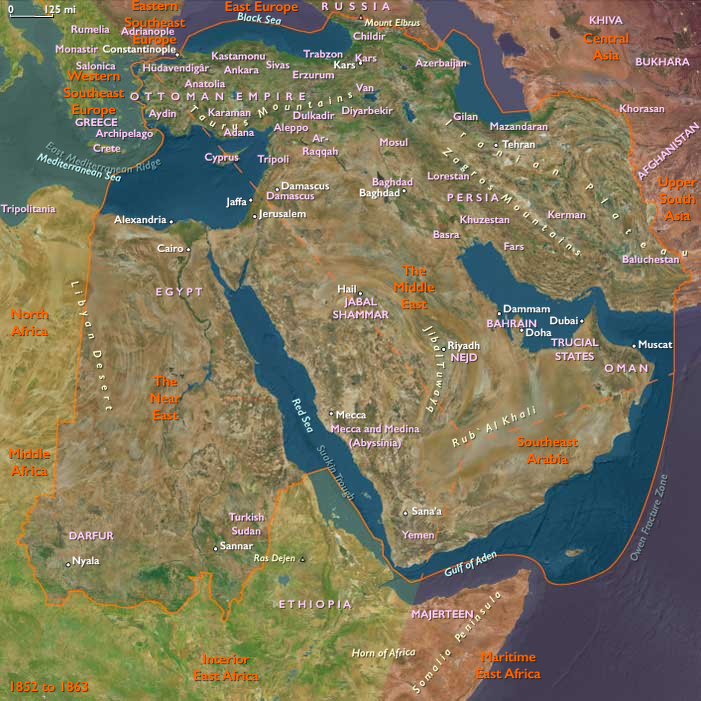
Subregions
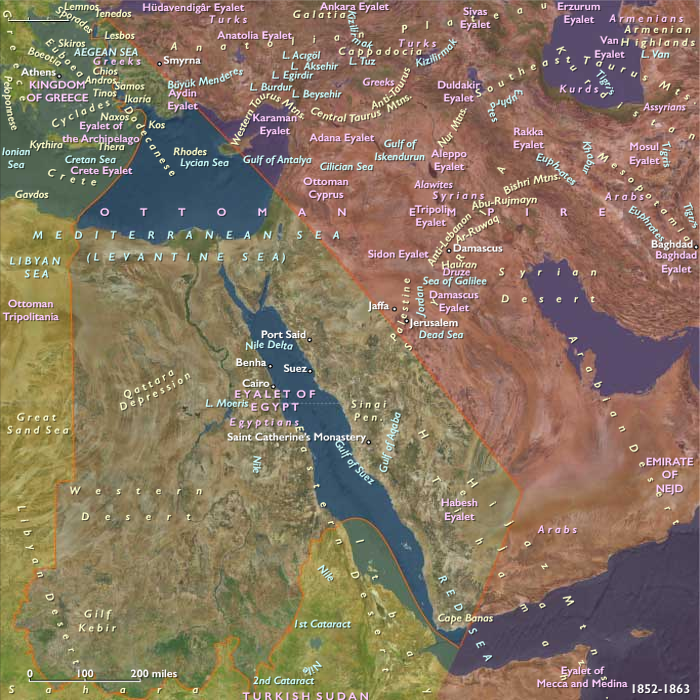
Related Events
Showing 10 events out of 16184 total
Years: 1852 - 1863
People
Groups
- Arab people
- Islam
- Ottoman Empire
- Britain (United Kingdom of Great Britain and Ireland)
- Egypt, (Ottoman) Viceroyalty of
- Sudan, Turco-Egyptian
Commodoties
Subjects
Regions
Subregions