
The Near East (1629–1486 BCE): Revival, Expansion, …
Years: 1629BCE - 1486BCE
The Near East (1629–1486 BCE): Revival, Expansion, and Cultural Innovation
Egyptian Revival and the New Kingdom
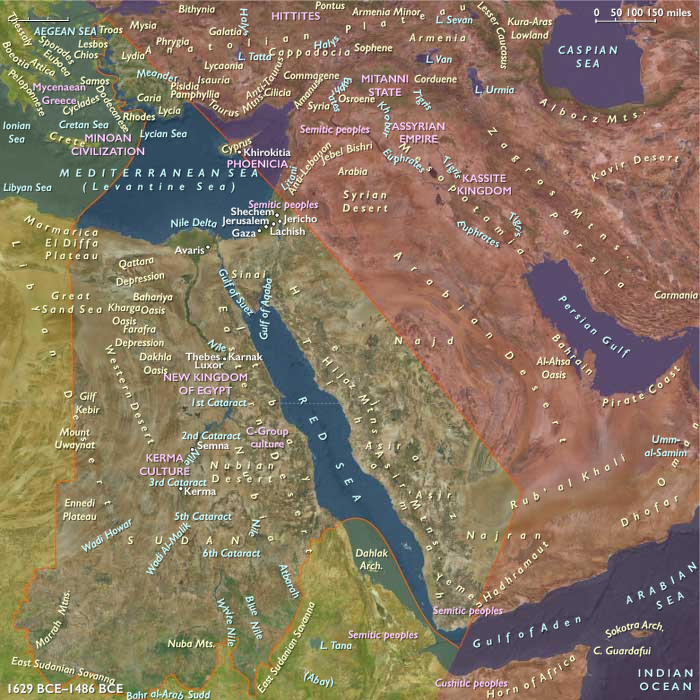
Egyptian power revives dramatically during the New Kingdom (ca. 1570–1100 BCE) under the founding pharaoh, Ahmose I, who expels the Hyksos around 1567 BCE. Ahmose I incorporates Kush into Egypt as a province governed by a viceroy, extending administrative control down to the fourth cataract. Tributary regions reach as far as the Red Sea and the confluence of the Blue and White Nile rivers. Local Kushite chiefs ensure loyalty through tributary payments of gold and slaves and by sending their children as pages to the pharaoh's court.
Architectural and Burial Innovations
Around 1500 BCE, Pharaoh Amenhotep I moves away from pyramid construction, introducing rock-hewn tombs in the cliffs of western Thebes (modern Luxor). His successors adopt this innovation, creating tomb complexes in the Valley of the Kings and nearby valleys for queens and princes, setting a lasting architectural precedent.
Cypriot Cultural Developments
During this era, Cyprus undergoes significant cultural shifts. Many Neolithic villages are abandoned as populations relocate to the central plain (Mesaoria) and mountain foothills. Cypriot pottery acquires distinctive shapes and designs, and small figurines representing fertility goddesses appear. Influences from the Minoan civilization of Crete are significant, though few Minoans settle permanently. A script developed for Cypriot commerce remains undeciphered.
Nubian Civilization at Kerma
The indigenous Nubian state centered at Kerma reaches its zenith, marked by original ceramics and considerable affluence, especially prominent during Egypt’s Second Intermediate Period. This kingdom poses a significant challenge to Egypt’s southern borders during periods of internal Egyptian strife.
Literary and Artistic Flourishing
The Egyptian Coffin Texts evolve into the more standardized Book of the Dead during the Eighteenth Dynasty, featuring detailed funeral and judgment scenes illustrated on papyrus. Egyptian art enters a classic phase marked by refined elegance and precision, while traditional artistic standards are maintained.
Advances in Medicine and Technology
Significant medical advancements include the detailed medical instructions of the Ebers Papyrus (circa 1600 BCE), offering valuable treatments and prescriptions, including castor oil and tannic acid. Egyptians also adopt the water clock by around 1600 BCE, enhancing their precision in time measurement. The introduction of opium for both medicinal and surgical purposes is documented, reflecting advanced pharmaceutical knowledge.
Hyksos Cultural Legacy and Integration
Although expelled, the Hyksos leave behind a notable cultural legacy. Egyptians adopt Hyksos military innovations such as the chariot and composite bow. Minoan-like frescoes at Avaris, the former Hyksos capital, indicate extensive trade with the broader Aegean world. Egyptian culture integrates elements from these Semitic rulers, including pottery styles, architectural designs, and fortifications.
Urban and Trade Expansion in Canaan
Canaanite cities like Jericho, Shechem, Tell as-Sakan, and Gaza prosper significantly during this period. Jericho expands its fortifications around 1700 BCE and reaches its Bronze Age zenith before its destruction around 1550 BCE. Gaza becomes strategically significant, reflecting increased competition among regional empires until its destruction linked to the expulsion of the Hyksos.
Jerusalem and the Hyksos Connection
Jerusalem, historically referenced as Rusalimum, undergoes significant fortifications to protect its water systems. Legends recorded later by Egyptian historian Manetho associate Jerusalem’s early prominence with Hyksos activity, connecting the city with broader regional shifts and potential origins of early Hebrew narratives.
Mathematical Innovations
This era witnesses continued sophistication in mathematics, notably Egyptian fraction notation illustrated by texts like the Rhind Mathematical Papyrus and Moscow Mathematical Papyrus. These texts advance mathematical thought and provide extensive insight into Egyptian numerical practices.
Political Reunification and Egyptian Dominance
The expulsion of the Hyksos around 1570 BCE and subsequent reunification of Egypt under Ahmose I mark the rise of the Eighteenth Dynasty, inaugurating a celebrated era of Egyptian history marked by territorial expansion, centralized power, cultural innovation, and enduring influence across the Near East.
People
Groups
- Polytheism (“paganism”)
- Kushitic Civilization
- Canaanite culture, ancient
- Anatolia, archaic
- Kerma, Kingdom of
- Amorites
- Minoan (Cretan) culture, Middle
- Hittites
- Mycenaean Greece
- Egypt (Ancient), Second Intermediate Period of
- Hyksos, Kingdom of
- Minoan (Cretan) culture, Late
- Egypt (Ancient), New Kingdom of
Topics
Commodoties
- Rocks, sand, and gravel
- Weapons
- Gem materials
- Colorants
- Glass
- Domestic animals
- Grains and produce
- Textiles
- Ceramics
- Strategic metals
- Lumber
- Industrial chemicals
- Aroma compounds
Subjects
- Symbols
- Architecture
- Watercraft
- Sculpture
- Painting and Drawing
- Decorative arts
- Faith
- Government
- Custom and Law
- Horology
- Human Migration
- Medicine
- Mathematics
Regions
Subregions
Related Events
Showing 10 events out of 67677 total
Years: 1629BCE - 1486BCE
People
Groups
- Polytheism (“paganism”)
- Kushitic Civilization
- Canaanite culture, ancient
- Anatolia, archaic
- Kerma, Kingdom of
- Amorites
- Minoan (Cretan) culture, Middle
- Hittites
- Mycenaean Greece
- Egypt (Ancient), Second Intermediate Period of
- Hyksos, Kingdom of
- Minoan (Cretan) culture, Late
- Egypt (Ancient), New Kingdom of
Topics
Commodoties
- Rocks, sand, and gravel
- Weapons
- Gem materials
- Colorants
- Glass
- Domestic animals
- Grains and produce
- Textiles
- Ceramics
- Strategic metals
- Lumber
- Industrial chemicals
- Aroma compounds
Subjects
- Symbols
- Architecture
- Watercraft
- Sculpture
- Painting and Drawing
- Decorative arts
- Faith
- Government
- Custom and Law
- Horology
- Human Migration
- Medicine
- Mathematics
Regions
Subregions