
The Near East (1828–1971 CE): Canals, …
Years: 1828 - 1971
The Near East (1828–1971 CE): Canals, Mandates, Revolutions, and Wars of State-Building
Geography & Environmental Context
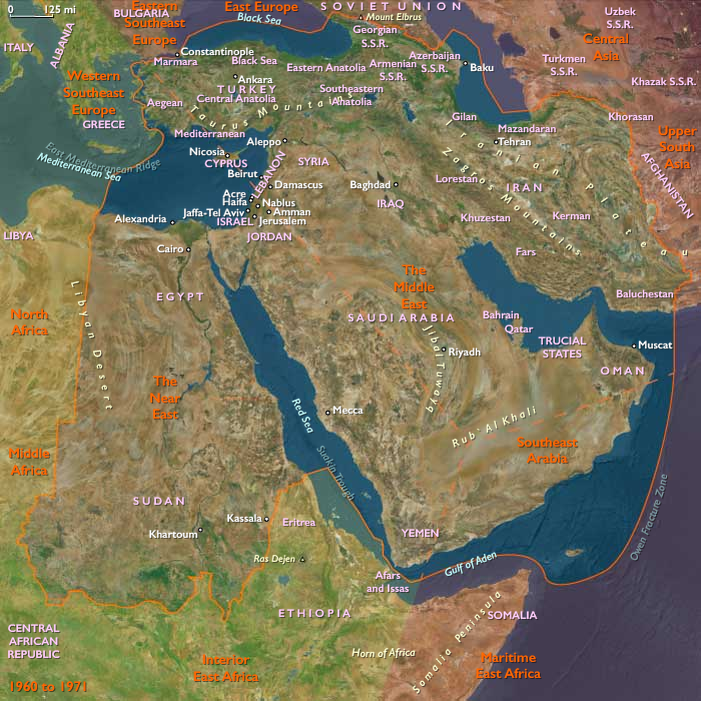
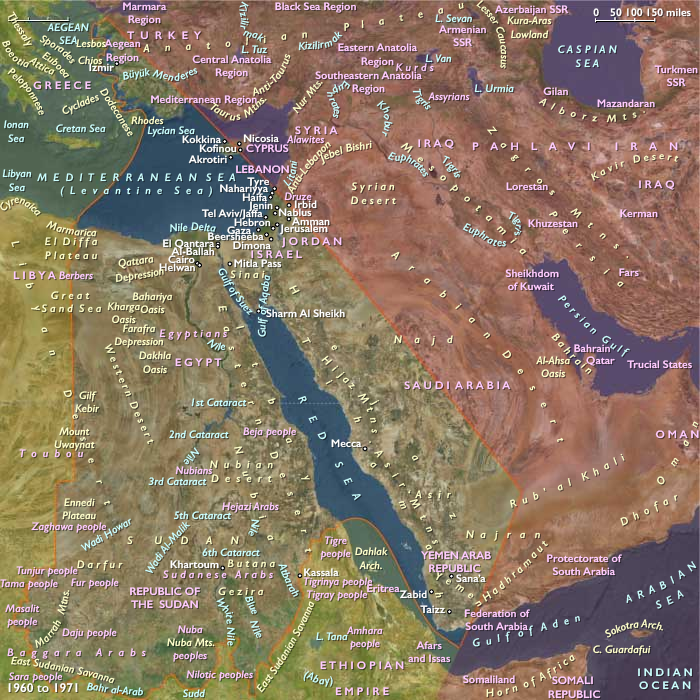
The Near East comprises Israel, Egypt, Sudan, western Saudi Arabia (the Hejaz), most of Jordan, southwestern Cyprus, southwestern Turkey, and Yemen. Anchors include the Nile Valley and Delta; Sinai; the Suez Isthmus and canal corridor; the Levantine coast from Gaza to Haifa; the Jordan Valley/Dead Sea basin; the Hejaz mountains and holy cities; Adana–Antalya and the Taurus foothills; southwestern Cyprus; and the Yemeni highlands and Tihāmah coast. River corridors, oases, and pilgrimage routes tied deserts, littorals, and mountain terraces into one strategic web.
Climate & Environmental Shifts
Late Little Ice Age variability gave way to warmer 20th-century trends, but water remained fate: Nile flood failures (e.g., 1877–78) and later regulation under the Aswan Low Dam (1902, raisings) and High Dam (1960–70) re-timed flows, sediments, and fisheries. Dust storms and drought pulses hit Jordan and the Negev; the Hejaz depended on erratic wadis and wells. In Sudan, Sahelian rainfall swings stressed grazing and Gezira canal allocations. Yemen’s terrace agriculture rose and fell with monsoon irregularity; cyclones occasionally lashed the Red Sea and Arabian coasts.
Subsistence & Settlement
-
Egypt & Sudan: From the cotton boom (Crimean War, U.S. Civil War) to state irrigation and the Gezira Scheme (from 1925), export agriculture reoriented peasant fellahin labor. Cairo, Alexandria, and canal towns (Port Said, Ismailia, Suez) surged; Khartoum–Omdurman and riverine Sudanese towns became administrative and trade hubs, then capitals at independence (Sudan, 1956).
-
Levant & Jordan: Mixed cereals, olives, and citrus persisted; irrigated citrus at Jaffa and valley schemes in Jordan expanded. After 1948, refugee camps, new towns, and state farming projects reshaped settlement on both sides of the Jordan.
-
Israel (from 1948): Rapid urbanization (Tel Aviv, Haifa), coastal citrus and cotton, irrigated Negev schemes, and collective kibbutzim and moshavim reconfigured land use.
-
Hejaz (western Saudi Arabia): Mecca–Medina economies centered on hajj provisioning, construction, and services; Jidda grew as the gateway port.
-
Yemen: Highland terraces (sorghum, coffee, qat) supported dense villages; Aden (British, 1839–1967) was a coaling and bunkering hub, later a refinery port.
-
SW Turkey & SW Cyprus: Citrus, tobacco, cotton, and coastal trade tied Antalya–Adana basins and Cypriot ports into Mediterranean circuits; SW Cyprus shifted from mixed farming to remittance- and tourism-adjacent services by mid-century.
Technology & Material Culture
Irrigation barrages, canals, and later high dams transformed the Nile and Gezira. The Suez Canal (opened 1869) revolutionized global shipping, spawning company towns and a cosmopolitan dockside material culture. Railways (Cairo–Aswan; Haifa lines; Hejaz Railway to Medina, partial after 1908), and later highways and pipelines, re-mapped mobility. Urban crafts modernized into mills, ginneries, refineries, cement works, and shipyards (Alexandria, Suez, Aden, Haifa). Print, records, cinema, radio, and then television spread from Cairo and Jaffa to remote valleys; domestic life pivoted from mud-brick and courtyard houses toward apartment blocks and concrete terraces.
Movement & Interaction Corridors
-
Canal & Red Sea trunk: The Suez Canal fused Mediterranean and Indian Ocean worlds; bazaars, souks, and shipping firms connected Port Said to Bombay and Marseille.
-
Pilgrimage highways: Annual hajj flows—by steamer and road—underwrote Hejazi economies; 20th-century health, water, and transport investments scaled the pilgrimage.
-
Mandates & air routes: British and French mandate systems (to the north and east) touched this subregion via ports and pipelines; air corridors (Cairo, Lydda/Lod, Jidda, Aden) knitted it to empire and, later, post-imperial networks.
-
Refuge and labor: After 1948, Palestinian displacement reshaped Gaza, Jordan, and Israel; Sudanese and Egyptian workers circulated along river and canal fronts; Yemeni and Hejazi workers moved between Aden, Jidda, and the Gulf.
Cultural & Symbolic Expressions
Cairo’s presses, al-Azhar reforms, and the Nahda (Arab renaissance) seeded newspapers, novels, and constitutional ideas; Umm Kulthūm, ʿAbd al-Wahhāb, and film studios made Egypt the Arabic world’s cultural capital. Zionist revival in Hebrew letters, schools, and settlement institutions culminated in Israeli state culture after 1948. Coptic institutions in Egypt, Jewish and Christian communities in Palestine/Israel, Greek communities in Cyprus, and Zaydi religious life in Yemen signaled deep pluralism. The hajj remained the ritual axis of the Hejaz. Street murals, political posters, and radio speeches (from Nasser to King ʿAbdullāh, from Imam Yahyā to President al-Sallāl, the first head of the Yemen Arab Republic) turned modern media into public ritual.
Environmental Adaptation & Resilience
-
Water mastery: Barrages, canals, and later the High Dam stabilized irrigation but altered silt, fisheries, and disease ecologies; drainage and sāqiya replacement reduced water-borne burdens even as schistosomiasis lingered.
-
Terrace care: In Palestine, Jordan, and Yemen, stone terraces and cisterns conserved soil and water; spring captures and wadis were regulated for villages and kibbutzim.
-
Pastoral pivots: In Sudan and the Hejaz, herders shifted routes with drought; market sedentarization advanced along roads and rail.
-
Urban services: Public health campaigns (malaria control, vaccination), modern hospitals, and grain boards buffered shocks; rationing and port provisioning sustained cities during wars and closures.
Political & Military Shocks
-
Egypt & Sudan: ʿUrābī Revolt (1881–82) and British occupation (1882); Anglo-Egyptian Condominium in Sudan (1899); Egyptian Revolution (1952); Suez Crisis (1956) after canal nationalization; Sudanese independence (1956) and post-colonial realignments.
-
Hejaz & western Arabia: Hashemite control ended with Saudi conquest (1925); pilgrimage administration and urban growth accelerated under the new state.
-
Israel–Arab wars: 1948–49 war and armistices; 1956 Suez War; 1967 Six-Day War (Sinai, Gaza, West Bank, Golan outside our strict list but West Bank affects Jordan); War of Attrition (1969–70) along the Suez.
-
Jordan: Emirate (1921), independence (1946), refugee integration after 1948, and Black September (1970) tensions.
-
Cyprus (SW): British administration (from 1878), enosis debates, and independence (1960) set the stage for later crises.
-
Yemen: Imamate rule in the north; Aden under Britain; North Yemen Civil War (1962–70) pitted republicans and royalists with Egyptian and Saudi intervention; South Yemen independence (1967) transformed Aden.
-
Turkey (SW): From Ottoman to Republic (1923); land and port development in Adana–Antalya, integration with national reforms.
Transition
Between 1828 and 1971, the Near East shifted from an Ottoman-provincial world of canals, caravans, and terraces into a mosaic of post-imperial states and mass politics. The Suez Canal remade global trade; British occupation, mandate-era corridors, and Zionist settlement recast demographics and power; 1948, 1956, and 1967 etched borders through cities and fields. Nasserist high modernism—dams, factories, land reform—collided with cold-war alignments and regional wars. In the Hejaz, the hajj scaled into a modern infrastructural pilgrimage; in Yemen, revolutions and decolonization closed the imperial coaling age of Aden. By 1971, the subregion’s everyday life—from Nile canals and Jordan terraces to Hejazi hostels and Yemeni hill towns—was reordered by states, mass media, and wars, setting the stage for oil-era geopolitics and yet-deeper contests over water, land, and sovereignty.
People
- Abanindranath Tagore
- Abd al-Wahhab
- Abdullah I of Jordan
- Abdullah al-Sallal
- Abu al-Dhahab
- Ali Bey Al-Kabir
- Gamal Abdel Nasser
- Umm Kulthum
- Yahya Muhammad Hamid ed-Din
Groups
- Jews
- Coptic Orthodox Church of Alexandria
- Islam
- Muslims, Sunni
- Muslims, Shi'a
- Zaidiyyah
- Christians, Roman Catholic
- Christians, Eastern Orthodox
- Cyprus, Kingdom of
- Ottoman Empire
- Palestine, Ottoman
- Egypt, Ottoman eyalet of
- Cyprus, Ottoman
- Holy League (Mediterranean)
- Darfur, Keira Sultanate of
- British Empire
- Wahhabism
- Saud, House of
- French First Republic
- Egypt, (Ottoman) Viceroyalty of
- Sudan, Turco-Egyptian
- Cyprus, Ottoman viyalet of
- Cyprus, British
- ZO (Zionist Organization)
- Zionism
- Sudan, Anglo-Egyptian
- Yemen, Mutawakkilite Kingdom of (North Yemen)
- Turkey, provisional revolutionary
- Palestine and Trans-Jordan
- Transjordan, Emirate of
- Turkey, Republic of
- Palestine, British Mandate of
- Cyprus, British Crown Colony of
- Britain (United Kingdom of Great Britain and Northern Ireland)
- Transjordan, Kingdom of
- Palestinians
- Israel
- Jordan, Hashemite Kingdom of
- Sudan, Republic of The
- Hashemite Arab Federation
- Cyprus, Republic of
- North Yemen (Yemen Arab Republic)
- PLO (Palestine Liberation Organization)
- Yemen, South, People's Republic of
- Yemen, People's Democratic Republic of (South Yemen)
Topics
- Nahda, the, or Arab Enlightenment
- Crimean War
- American Civil War (War between the States, War of the Rebellion, War of Secession, War for Southern Independence)
- First World War in Egypt
- World War, First (World War I)
- First World War in Palestine
- World War, Second (World War II)
- Cold War
- Cyprus Emergency
- North Yemen Civil War
- Cypriot War of 1963-64, Greek-Turkish
- Cypriot Crisis
- Six-Day War
- Attrition, War of
- Black September in Jordan
Commodoties
Subjects
Regions
Subregions
Related Events
Showing 10 events out of 19829 total
Years: 1828 - 1971
People
- Abanindranath Tagore
- Abd al-Wahhab
- Abdullah I of Jordan
- Abdullah al-Sallal
- Abu al-Dhahab
- Ali Bey Al-Kabir
- Gamal Abdel Nasser
- Umm Kulthum
- Yahya Muhammad Hamid ed-Din
Groups
- Jews
- Coptic Orthodox Church of Alexandria
- Islam
- Muslims, Sunni
- Muslims, Shi'a
- Zaidiyyah
- Christians, Roman Catholic
- Christians, Eastern Orthodox
- Cyprus, Kingdom of
- Ottoman Empire
- Palestine, Ottoman
- Egypt, Ottoman eyalet of
- Cyprus, Ottoman
- Holy League (Mediterranean)
- Darfur, Keira Sultanate of
- British Empire
- Wahhabism
- Saud, House of
- French First Republic
- Egypt, (Ottoman) Viceroyalty of
- Sudan, Turco-Egyptian
- Cyprus, Ottoman viyalet of
- Cyprus, British
- ZO (Zionist Organization)
- Zionism
- Sudan, Anglo-Egyptian
- Yemen, Mutawakkilite Kingdom of (North Yemen)
- Turkey, provisional revolutionary
- Palestine and Trans-Jordan
- Transjordan, Emirate of
- Turkey, Republic of
- Palestine, British Mandate of
- Cyprus, British Crown Colony of
- Britain (United Kingdom of Great Britain and Northern Ireland)
- Transjordan, Kingdom of
- Palestinians
- Israel
- Jordan, Hashemite Kingdom of
- Sudan, Republic of The
- Hashemite Arab Federation
- Cyprus, Republic of
- North Yemen (Yemen Arab Republic)
- PLO (Palestine Liberation Organization)
- Yemen, South, People's Republic of
- Yemen, People's Democratic Republic of (South Yemen)
Topics
- Nahda, the, or Arab Enlightenment
- Crimean War
- American Civil War (War between the States, War of the Rebellion, War of Secession, War for Southern Independence)
- First World War in Egypt
- World War, First (World War I)
- First World War in Palestine
- World War, Second (World War II)
- Cold War
- Cyprus Emergency
- North Yemen Civil War
- Cypriot War of 1963-64, Greek-Turkish
- Cypriot Crisis
- Six-Day War
- Attrition, War of
- Black September in Jordan
Commodoties
Subjects
Regions
Subregions