
The Near East (1341–1198 BCE): Religious Restoration, …
Years: 1341BCE - 1198BCE
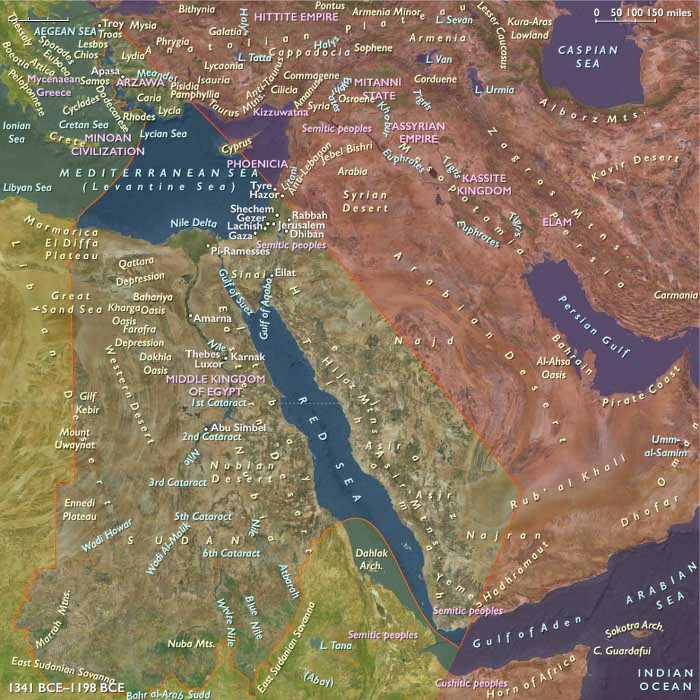
The Near East (1341–1198 BCE): Religious Restoration, Imperial Ambitions, and Regional Shifts
The End of Akhenaten's Reforms and Restoration under Tutankhamen
Following the death of Akhenaten, his radical monotheistic reforms centered on the sun-disc deity Aten collapse, primarily due to ensuing economic instability and popular resentment. His successor, Tutankhamen (1347–1337 BCE), swiftly restores traditional religious practices, reopening temples, reinstating priesthoods, and reestablishing the worship of the traditional pantheon, especially Amun-Ra. Akhenaten’s capital, Akhetaten (Tell al Amarna), is deserted, symbolizing the rejection of his monotheistic experiment.
The Wealth and Artistry of the New Kingdom
The reign of Tutankhamen leaves a remarkable cultural legacy, best exemplified by the lavish treasures discovered in his nearly intact tomb in the Valley of the Kings. This trove showcases the extraordinary skills of Egyptian artisans in gold, ivory, precious stones, and other fine materials, offering insight into court life and funerary practices of the late Eighteenth Dynasty.
Ramesses II and Monumental Construction
The reign of Ramesses II (1279–1213 BCE) marks the apex of monumental construction in Egypt. His numerous building projects include the impressive Ramesseum, his mortuary temple in Thebes; the great hypostyle hall at Karnak; the massive rock-hewn temples of Abu Simbel; and the establishment of his new capital city, Pi-Ramesses, in the eastern Delta. These constructions signify both the grandeur of his reign and Egypt’s continuing wealth and imperial ambitions.
Military and Diplomatic Endeavors
Ramesses II confronts significant external challenges, notably from the Hittites, leading to the renowned Battle of Kadesh (circa 1274 BCE). Initially a setback, this confrontation eventually results in the first recorded international peace treaty between Egypt and the Hittite Empire, stabilizing regional politics in the face of common threats such as incursions by the enigmatic "Sea Peoples."
Cultural and Social Developments
Egyptian society in this era provides notable autonomy and rights for women. They are able to own property, manage businesses, initiate divorces, and occasionally represent absent husbands in official capacities. However, holding political office remains beyond their reach.
Technological Advancements and Cultural Influence
Significant technological advancements emerge, such as improved chariot design with six-spoked wheels and repositioned axles for stability. Water clocks become more refined, allowing precise measurement of time, critical for religious rituals and governance.
Mycenaean Influence in Western Anatolia
Mycenaean Greek influence extends into western Anatolia, particularly around the city of Miletus (Millawanda), which becomes a central Mycenaean stronghold. Texts from the Hittite archives mention ongoing political struggles and territorial disputes involving Mycenaean rulers, illustrating the dynamic intercultural interactions of this period.
The Late Bronze Age Collapse in Canaan
The period witnesses growing instability in Canaan. Cities like Gezer and Hazor experience repeated cycles of fortification and destruction amid shifting alliances, invasions by nomadic groups such as the Habiru, and Egyptian military interventions. The end of the Late Bronze Age (circa 1250–1150 BCE) marks widespread urban destruction, economic disruption, and Egyptian withdrawal from the region.
The "Trojan War" and Troy VII
Archaeological layer Troy VII at Hissarlik corresponds closely with the legendary city described in Homer’s epic narratives, dated to around the late thirteenth century BCE. The fortifications and extensive food storage facilities indicate preparedness for a prolonged siege, echoing the legendary accounts of conflict described in Greek tradition.
Conclusion
From 1341 to 1198 BCE, the Near East undergoes profound religious shifts, significant military and diplomatic encounters, substantial cultural developments, and major urban upheavals. This transformative era sets the stage for the end of the Bronze Age, significantly reshaping regional politics, economy, and society for centuries to come.
People
Groups
- Polytheism (“paganism”)
- Kushitic Civilization
- Canaanite culture, ancient
- Anatolia, archaic
- Kerma, Kingdom of
- Amorites
- Minoan (Cretan) culture, Middle
- Hittites
- Ashur, or “Assyria, (Old) Kingdom of”
- Mycenaean Greece
- Hapiru, or Habiru
- Hyksos, Kingdom of
- Minoan (Cretan) culture, Late
- Egypt (Ancient), New Kingdom of
- Babylonian Kingdom of the Kassites
- Assyria, (Middle) Kingdom of
Topics
Commodoties
- Rocks, sand, and gravel
- Weapons
- Gem materials
- Colorants
- Glass
- Domestic animals
- Grains and produce
- Textiles
- Ceramics
- Strategic metals
- Lumber
- Industrial chemicals
- Aroma compounds
Subjects
- Symbols
- Architecture
- Watercraft
- Sculpture
- Painting and Drawing
- Decorative arts
- Faith
- Government
- Custom and Law
- Horology
- Human Migration
- Medicine
- Mathematics
Regions
Subregions
Related Events
Showing 10 events out of 67384 total
Years: 1341BCE - 1198BCE
People
Groups
- Polytheism (“paganism”)
- Kushitic Civilization
- Canaanite culture, ancient
- Anatolia, archaic
- Kerma, Kingdom of
- Amorites
- Minoan (Cretan) culture, Middle
- Hittites
- Ashur, or “Assyria, (Old) Kingdom of”
- Mycenaean Greece
- Hapiru, or Habiru
- Hyksos, Kingdom of
- Minoan (Cretan) culture, Late
- Egypt (Ancient), New Kingdom of
- Babylonian Kingdom of the Kassites
- Assyria, (Middle) Kingdom of
Topics
Commodoties
- Rocks, sand, and gravel
- Weapons
- Gem materials
- Colorants
- Glass
- Domestic animals
- Grains and produce
- Textiles
- Ceramics
- Strategic metals
- Lumber
- Industrial chemicals
- Aroma compounds
Subjects
- Symbols
- Architecture
- Watercraft
- Sculpture
- Painting and Drawing
- Decorative arts
- Faith
- Government
- Custom and Law
- Horology
- Human Migration
- Medicine
- Mathematics
Regions
Subregions