
The Near East (1197–910 BCE): Collapse, Realignment, …
Years: 1053BCE - 910BCE
The Near East (1197–910 BCE): Collapse, Realignment, and New Beginnings
Decline of Egyptian Influence
By the eleventh century BCE, the authority of Egypt's New Kingdom dynasties significantly diminishes, resulting in the fragmentation of Egypt itself and the loss of Egyptian control over Kush. Little information is available about Kush's subsequent three centuries, marking a gap in historical records.
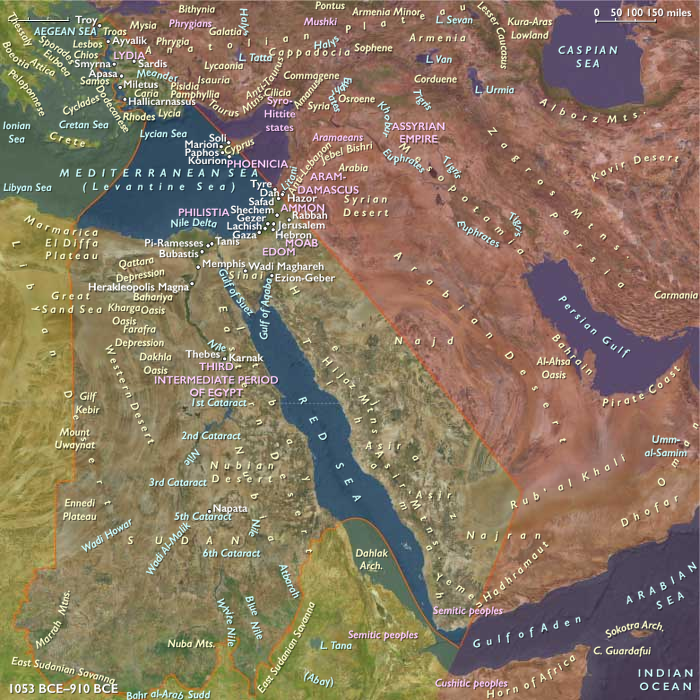
During this period, Egypt enters the Third Intermediate Period, characterized by a fractured kingship. The pharaohs of the Twenty-first Dynasty rule from Tanis (San al Hajar al Qibliyah), while an autonomous theocracy emerges in Thebes. Eventually, Libyan-descended rulers dominate the Twenty-second and Twenty-third dynasties, reflecting Egypt's shifting political landscape.
Rise of the Israelites and Philistines
Between 1220 and 1190 BCE, the conquest of Canaan by the Israelite tribes concludes, with tribes settling lands both west and east of the Jordan River. Around this period, the Philistines, originating from Mycenaean Greece as part of the Sea Peoples, invade coastal Canaan, establishing dominance particularly in Gaza—from which "Palestine" eventually derives its name.
Philistine settlements such as Ashkelon, Ashdod, Ekron, and Gath reveal clear Mycenaean influences, notably in their distinctive bichrome pottery. Architectural and cultic remnants at Ekron further highlight their Aegean origins and cultural traditions.
Within a century and a half, the Philistines leverage superior iron weaponry and military organization to control southern coastal Palestine and parts of the Judaean hill country. This prompts the Israelites to seek a centralized monarchy under Saul ben Kish, the first king of Israel, around the mid-eleventh century BCE.
Cypriot Cultural Synthesis
Cyprus experiences significant cultural changes, transitioning from the Late Bronze Age to the Iron Age, influenced by mainland settlers and the widespread introduction of iron technology. Foundation myths documented by classical authors attribute the establishment of numerous Cypriot towns, including Salamis and Paphos, to Greek heroes following the Trojan War. Greek settlements continue to grow, with significant archaeological evidence pointing toward their increasing dominance.
Greek Expansion in Western Anatolia
The west coast of Anatolia sees a major Greek migration during this "Dark Age," resulting in settlements such as Aeolis and the foundation of notable cities including Ephesus and Priene. These settlements mark the transition from sporadic Mycenaean colonization to more extensive and permanent Greek settlement, significantly influencing regional culture and politics.
South Arabian Prosperity
Around 1000 BCE, generous rainfall in southern Arabia fosters agricultural prosperity, complemented by the lucrative trade of frankincense and myrrh. This economic wealth supports the development of city-states and small kingdoms, notably Saba (Sheba). This prosperity later leads Romans to call the region Arabia Felix ("happy Arabia").
Nubian Independence and Cultural Flourishing
Following Egypt’s decline around 1070 BCE, Nubia (Kush) reemerges as an independent kingdom centered at Napata. Nubian society thrives, adopting elements of Egyptian culture including gods such as Ammon and Isis. Kushite burial practices become distinctive, featuring burial mounds and pyramids, marking the emergence of a culturally distinct Nubian civilization.
Israelite Monarchy and Regional Realignment
The political landscape of Canaan shifts significantly after Solomon's reign. The biblical narrative describes a split in the United Monarchy into the kingdoms of Israel and Judah, initiating a period marked by internal conflict, external threats, and shifting alliances. Historical evidence independent of biblical accounts remains scarce, and ongoing archaeological research continues to explore these complex developments.
Alphabetic Writing and Linguistic Evolution
During this period, the Proto-Sinaitic script evolves into the Proto-Canaanite alphabet, laying foundations for future writing systems, including Phoenician. Around the tenth century BCE, archaic Biblical Hebrew emerges, as evidenced by inscriptions like the Gezer calendar, marking the beginning of Hebrew's written tradition.
Rise of Phoenician Trade and Diplomacy
Independent Phoenician cities, notably Tyre, develop robust trade networks across the Mediterranean. Tyre surpasses Sidon as the dominant Phoenician city, fostering diplomatic and commercial ties with kingdoms such as Israel. This period sees collaborative ventures, exemplified by the partnership between King Solomon of Israel and King Hiram of Tyre, who jointly develop trade routes and undertake significant building projects, including Jerusalem's First Temple.
Conclusion
Between 1197 and 910 BCE, the Near East experiences profound transformations: the fragmentation of Egyptian power, the rise of independent kingdoms, cultural synthesis in Cyprus and Anatolia, the flourishing of Nubian civilization, and significant technological and linguistic advancements. These developments profoundly shape the region’s history, setting the stage for subsequent geopolitical and cultural dynamics.
People
Groups
- Polytheism (“paganism”)
- Cyprus, Archaic
- Greece, archaic
- Canaanite culture, ancient
- Anatolia, archaic
- Nubian culture, ancient
- Minoan (Cretan) culture, Late
- Egypt (Ancient), New Kingdom of
- Assyria, (Middle) Kingdom of
- Tyre, Kingdom of (Phoenicia)
- Philistines
- Syro-Hittite states
- Kush, Kingdom of
- Egypt (Ancient), Third Intermediate Period of
- Priene, Greek City-State of
- Miletus (Ionian Greek) city-state of
- Judah, Kingdom of
- Israel (Northern Kingdom of)
- Assyria, (New) Kingdom of (Neo-Assyrian Empire)
Topics
Commodoties
- Rocks, sand, and gravel
- Weapons
- Gem materials
- Colorants
- Glass
- Domestic animals
- Grains and produce
- Textiles
- Ceramics
- Strategic metals
- Lumber
- Industrial chemicals
- Aroma compounds
Subjects
- Symbols
- Architecture
- Watercraft
- Sculpture
- Painting and Drawing
- Decorative arts
- Faith
- Government
- Custom and Law
- Horology
- Human Migration
- Medicine
- Mathematics
Regions
Subregions
Years: 1053BCE - 910BCE
People
Groups
- Polytheism (“paganism”)
- Cyprus, Archaic
- Greece, archaic
- Canaanite culture, ancient
- Anatolia, archaic
- Nubian culture, ancient
- Minoan (Cretan) culture, Late
- Egypt (Ancient), New Kingdom of
- Assyria, (Middle) Kingdom of
- Tyre, Kingdom of (Phoenicia)
- Philistines
- Syro-Hittite states
- Kush, Kingdom of
- Egypt (Ancient), Third Intermediate Period of
- Priene, Greek City-State of
- Miletus (Ionian Greek) city-state of
- Judah, Kingdom of
- Israel (Northern Kingdom of)
- Assyria, (New) Kingdom of (Neo-Assyrian Empire)
Topics
Commodoties
- Rocks, sand, and gravel
- Weapons
- Gem materials
- Colorants
- Glass
- Domestic animals
- Grains and produce
- Textiles
- Ceramics
- Strategic metals
- Lumber
- Industrial chemicals
- Aroma compounds
Subjects
- Symbols
- Architecture
- Watercraft
- Sculpture
- Painting and Drawing
- Decorative arts
- Faith
- Government
- Custom and Law
- Horology
- Human Migration
- Medicine
- Mathematics
Regions
Subregions