
The Near East (1252–1395 CE): Mamluk Dominance …
Years: 1252 - 1395
The Near East (1252–1395 CE): Mamluk Dominance and Cultural Integration
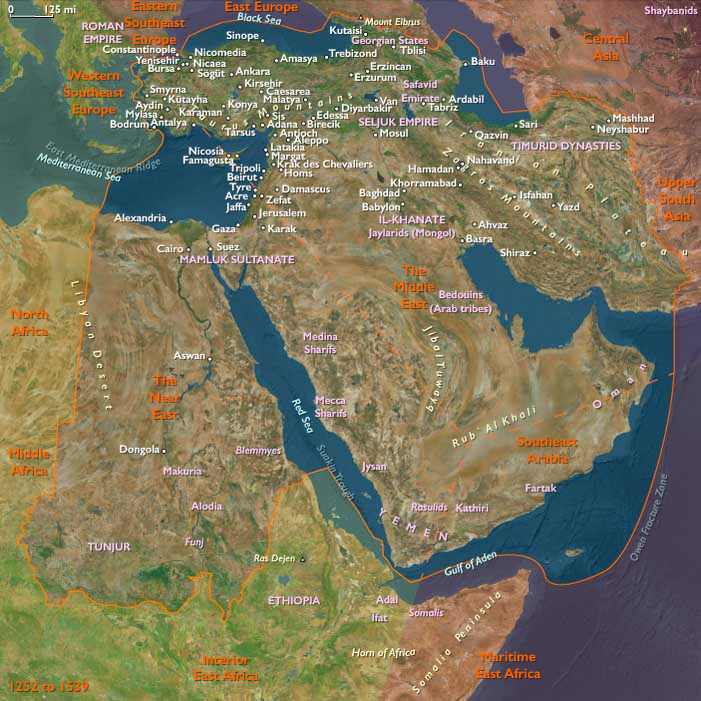
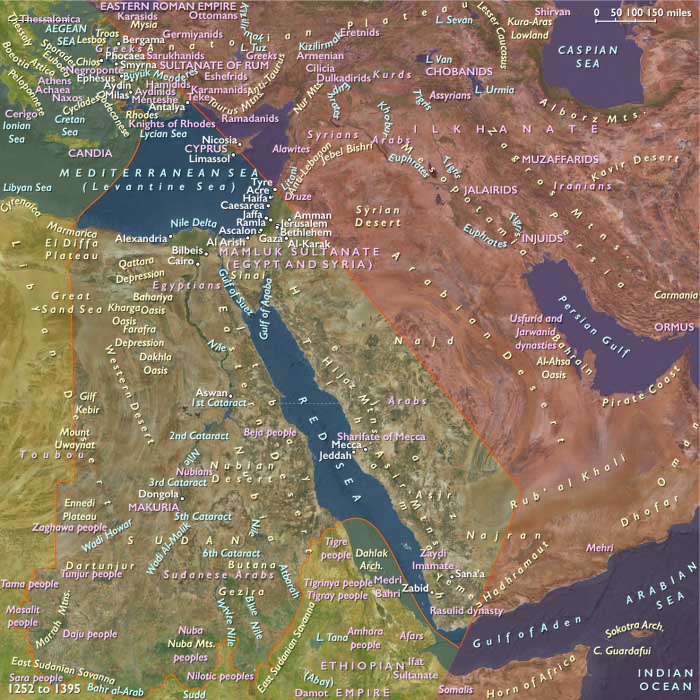
From the Nile’s fertile floodplains to the sandstone escarpments of Arabia and the ancient valleys of Nubia, the Near East in the Lower Late Medieval Age stood as the strategic and spiritual heart of the Islamic world. It was a region where power flowed through the twin arteries of the Nile and the Red Sea, where pilgrimage and trade converged, and where a dynamic synthesis of cultures, faiths, and technologies gave the region a renewed unity after the turmoil of Mongol and Crusader invasions.
Following the fall of Baghdad to the Mongols in 1258, Egypt emerged as the new center of Islamic authority under the Mamluks, a military aristocracy of Turkic, Circassian, and Kurdish slave origins who rose from regimental ranks to the sultan’s throne. The Mamluks decisively halted Mongol expansion at the Battle of ʿAyn Jālūt in 1260, securing Syria and Egypt under their protection. Sultan Baybars I (r. 1260–1277) fortified desert roads, reorganized the postal network, and absorbed the remaining Crusader territories. The final Latin strongholds—Antioch, Tripoli, and Acre—fell by 1291, restoring full Muslim control over the eastern Mediterranean for the first time since the early Abbasid centuries.
Under Qalawun (r. 1279–1290) and his successors, Cairo became the empire’s beating heart. The Qalawun complex, with its mosque, hospital, and madrasa, stood among many new foundations that transformed the city’s silhouette. Al-Nasir Muhammad’s long rule (1293–1341) brought stability and wealth through the restoration of irrigation canals and expansion of the Nile Delta’s estates. Alexandria’s port revived as Mediterranean merchants—Genoese, Venetian, and Catalan—returned for pepper, sugar, and textiles. In Damascus and Aleppo, artisans of glass, brass, and silk created luxury goods exported across the Islamic world. The Mamluk system of waqf endowments sustained these urban economies, while networks of Sufi hospices, madrasas, and caravanserais provided spiritual and social infrastructure for travelers and the poor.
Across Palestine and Syria, the Mamluks rebuilt cities devastated by war. In Jerusalem, new mosques, schools, and fountains framed the Ḥaram al-Sharīf, affirming the city’s sacred status within the rejuvenated Sunni order. Pilgrimage flourished once more: caravans from Cairo and Damascus converged annually toward Mecca and Medina along fortified desert routes. ʿAyn Jālūt, once a battlefield, now marked the secure border between Egypt’s dominions and the Mongol successor states of the Middle East.
The Mamluk administrative system, a fusion of military discipline and bureaucratic oversight, endured despite plague and political intrigue. The Black Death (1347–1351) struck heavily—killing perhaps a third of Egypt’s population—but the state’s granaries, irrigation, and guild networks hastened recovery. Plague memorials and endowments became acts of piety; scholarship at al-Azhar, long dormant under earlier dynasties, revived into one of the leading intellectual centers of Islam.
Beyond the Nile’s southern cataracts, the Nubian kingdoms underwent transformation. Arab tribes migrating from the north and east intermarried with Beja and Nubian peoples, fostering a slow and voluntary Islamization. When the Mamluks intervened in 1276, they installed a Muslim ruler in Dongola, reducing the ancient Christian kingdom to a vassal. By the fourteenth century, the Jaʿalin and Juhayna tribes dominated the middle Nile, the former settling as cultivators, the latter roaming the steppes between the river and the Red Sea. Conversion offered tax advantages and social mobility, and the resulting Arab–Nubian synthesis laid the foundation of modern Sudanese identity.
The disintegration of the medieval Nubian Christian states also set in motion a long southward demographic ripple. As Arabization and Islamization advanced along the Nile, communities displaced from Nubia and the surrounding savannas moved into the upper reaches of the White Nile and the Great Lakes region. This process, often described as the Nilotic expansion, included the gradual migration of the Luo and related groups, whose movement fostered extensive ethnic, linguistic, and cultural diversification across eastern and central Sub-Saharan Africa.
To the east, the Red Sea connected Egypt and Arabia with Yemen, Aden, and India. Qus and Qift in Upper Egypt supplied caravans that crossed the Eastern Desert to ʿAydhāb and Suakin, where goods from the Indian Ocean—pepper, spices, cottons, and pearls—were unloaded for the Nile convoys to Cairo. Southward, Aden and Jiddahbecame twin portals for pilgrims and commerce. From the harbors of Yanbuʿ and Jiddah, ships sailed to East Africa, while the overland pilgrimage roads converged on Mecca and Medina, maintained by the Mamluks as both religious trust and geopolitical necessity. The flow of pilgrims sustained markets for leather, grain, and livestock along the route; wells and forts dotted the Hijaz, inscribed with the names of sultans who had endowed them.
On Cyprus, the Lusignan monarchy survived the Crusader collapse, its ports of Famagusta and Kyrenia becoming commercial waystations between Latin Europe and Mamluk Syria. Venetian and Genoese merchants established sugar plantations that drew enslaved labor from the Black Sea and Africa—an early prototype of the plantation economies that would later expand across the Atlantic world. Religious tension accompanied this economic vigor: the papal Bulla Cypria (1260) sought to impose Latin rites on Orthodox Cypriots, but Greek Christianity endured, shaping a resilient island culture under Latin rule.
Through all these transformations, the region remained an integrated crossroads of belief. In Cairo, Damascus, and Jerusalem, jurists of the four Sunni schools codified law; Sufi saints and philosophers interpreted divine unity through poetry and ritual; Jewish and Christian communities contributed to scholarship, finance, and trade. Cairo’s synagogues and Aleppo’s Armenian quarters stood within sight of mosques and madrasas, the product of a long coexistence that survived even epidemic and invasion.
By the late fourteenth century, Mamluk Egypt and Syria stood as the strongest Sunni power between the Maghrib and the Oxus. To their east, the Jalayirids and Muzaffarids inherited Ilkhanid traditions until Timur’s conquests reshaped Iran. To their south, Arab–Nubian and Nilotic societies prospered along the Nile; to their west, Cypriot and Venetian traders sustained Mediterranean exchange; and to their east and south, the Red Sea and Indian Ocean routes ensured that the spice and pilgrimage trades continued to flow through Cairo’s customs houses.
Thus by 1395 CE, the Near East had re-emerged from a century of turbulence as a unified religious and economic sphere—Sunni in its orthodoxy, cosmopolitan in its cities, and global in its maritime reach. Cairo’s minarets, Jerusalem’s sanctuaries, and Mecca’s shrines anchored a civilization that, even in the shadow of plague and invasion, continued to harmonize faith, learning, and commerce across the meeting point of Africa and Asia.
People
Groups
- Nubians
- Luo peoples
- Arab people
- Ja'alin tribe
- Beja people
- Juhaynah
- Makuria, Kingdom of
- Islam
- Egypt in the Middle Ages
- Muslims, Sunni
- Muslims, Shi'a
- Abbasid Caliphate (Baghdad)
- France, (Capetian) Kingdom of
- Luo people of Kenya and Tanzania
- Christians, Roman Catholic
- Christians, Eastern Orthodox
- Jerusalem, Latin Kingdom of
- Mongols
- Venice, (Most Serene) Republic of
- Damascus, Ayyubid Dynasty of
- Egypt, Ayyubid Sultanate of
- Roman Empire, Eastern: Angelid dynasty
- Teutonic Knights of Acre (House of the Hospitalers of Saint Mary of the Teutons in Jerusalem)
- Cyprus, Kingdom of
- Mongol Empire
- Egypt and Syria, Mamluk Bahri Sultanate of
- Makuria, Kingdom of
- France, (Valois) Kingdom of
- Egypt and Syria, Mamluk Burji Sultanate of
Topics
- Crusades, The
- Mongol Conquests
- Mongol Invasion of the Abbasid Caliphate
- Ain Jalut, Battle of
- Mongol invasions of the Levant
- Mongol Invasions of Syria
- Mongol raids into Palestine
- Acre, Siege of
Commodoties
Subjects
Regions
Subregions
Related Events
Showing 10 events out of 46611 total
Years: 1252 - 1395
People
Groups
- Nubians
- Luo peoples
- Arab people
- Ja'alin tribe
- Beja people
- Juhaynah
- Makuria, Kingdom of
- Islam
- Egypt in the Middle Ages
- Muslims, Sunni
- Muslims, Shi'a
- Abbasid Caliphate (Baghdad)
- France, (Capetian) Kingdom of
- Luo people of Kenya and Tanzania
- Christians, Roman Catholic
- Christians, Eastern Orthodox
- Jerusalem, Latin Kingdom of
- Mongols
- Venice, (Most Serene) Republic of
- Damascus, Ayyubid Dynasty of
- Egypt, Ayyubid Sultanate of
- Roman Empire, Eastern: Angelid dynasty
- Teutonic Knights of Acre (House of the Hospitalers of Saint Mary of the Teutons in Jerusalem)
- Cyprus, Kingdom of
- Mongol Empire
- Egypt and Syria, Mamluk Bahri Sultanate of
- Makuria, Kingdom of
- France, (Valois) Kingdom of
- Egypt and Syria, Mamluk Burji Sultanate of
Topics
- Crusades, The
- Mongol Conquests
- Mongol Invasion of the Abbasid Caliphate
- Ain Jalut, Battle of
- Mongol invasions of the Levant
- Mongol Invasions of Syria
- Mongol raids into Palestine
- Acre, Siege of
Commodoties
Subjects
Regions
Subregions