The navies of Rhodes and Pergamon, having …
Years: 190BCE - 190BCE
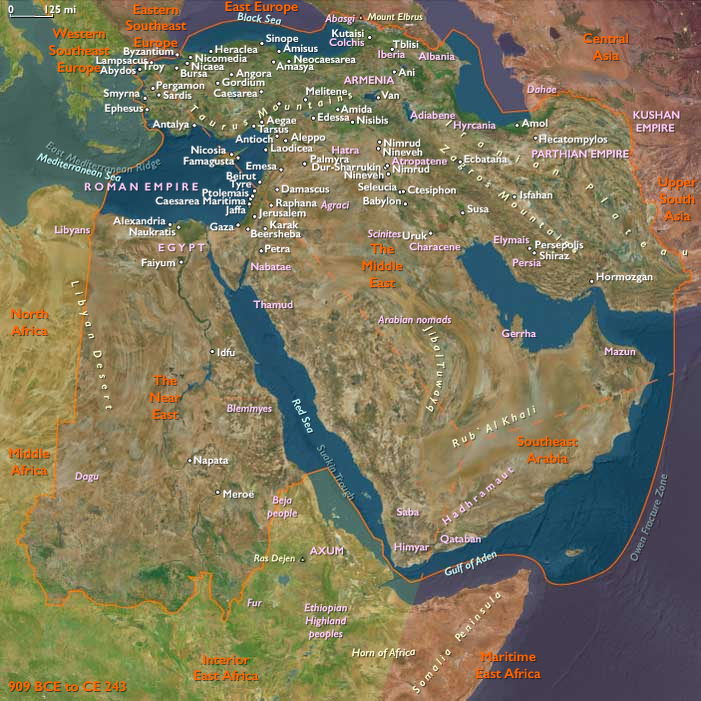
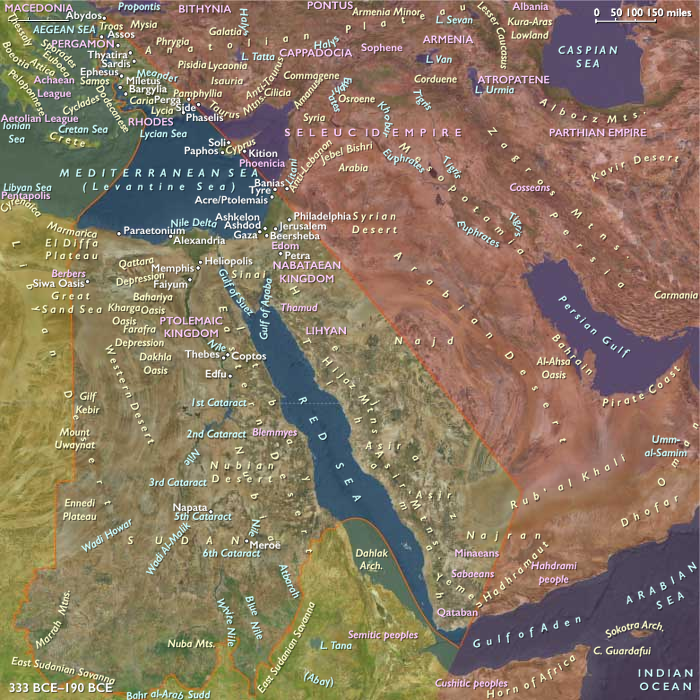
The navies of Rhodes and Pergamon, having joined the Roman cause, have won two victories over the fleets of Antiochos III off the coast of Anatolia.
The Roman army, meeting no resistance in 190, crosses the Hellespont.
The Phocaeans, allied with the Seleucids against Rome and Pergamon, so savagely repel the Roman forces, however, that the praetor Lucius Aemilius Regillus is obliged to withdraw his men and entreat the citizens not to take the war so seriously; his infuriated troops take advantage of the truce to sack the city.
Locations
People
Groups
- Roman Republic
- Aetolian League
- Greece, Hellenistic
- Greeks, Hellenistic
- Macedon, Antigonid Kingdom of
- Pergamon (Pergamum), Kingdom of
- Achaean League, Second
- Seleucid Empire
Topics
Commodoties
Subjects
Regions
Subregions
Related Events
Filter results
Showing 10 events out of 63455 total
Antiochus is now eager to negotiate on the basis of Rome's previous demands, but the Romans now insist that he first evacuate the region west of the Taurus Mountains.
When he refuses, Antiochus is decisively defeated in winter 190-189 in the Battle of Magnesia near Mt. Sipylus (not far from Sardis), where he fights with a heterogeneous army of seventy thousand men against an army of thirty thousand Romans and their Pergamene allies.
The military skill of Eumenes II of Pergamon contribute substantially to the victory.
Scipio Africanus and his brother have fought Rome's victorious war, but Flamininus has remained active in diplomacy.
One of the terms demanded of Antiochus by the Romans is that Hannibal should be surrendered.
Accounts of Hannibal's subsequent actions vary: either he flees via Crete to the court of King Prusias of Bithynia, or he joins the rebel forces in Armenia, where Artaxias and Zariadres, Antiochus' satraps, have revolted against Seleucid rule.
Philip has meanwhile aided Rome against her enemies on the Greek peninsula.
As a reward, his tribute is remitted and his younger son Demetrius restored in 190.
The area around Bologna, located at the foot of the Apennine Mountains, has been inhabited since the ninth century BCE, as evidenced by the archaeological digs in the nineteenth century in nearby Villanova.
This period, and up to the sixth century, is in fact generally referred to as Villanovian, and had various nuclei of people spread out around this area.
Etruria began in the seventh and sixth centuries BCE to have an influence on this area, and the population went from Umbrian to Etruscan.
The town was renamed Felsina.
The city and the surrounding area were conquered in the fourth century BCE by the Boii, a Celtic tribe from Transalpine Gaul.
The tribe settled down and mixed so well with the Etruscans, after a brief period of aggression, that they created a civilization that modern historians call Gaul-Etruscan (one of the best examples is the archaeological complex of Monte Bibele, in the Apennines near Bologna).
After the Battle of Telamon in 225 BCE, in which the forces of the Boii and their allies were badly beaten, the tribe had reluctantly accepted the influence of the Roman Republic, but with the outbreak of the Punic Wars the Celts once more went on the warpath.
They first helped Hannibal's army cross the Alps then they supplied him with a consistent force of infantry that proved itself decisive in several battles.
With the downfall of the Carthaginians came the end of the Boii as a free people: in 196 BCE, the Romans had destroyed many settlements and villages (Monte Bibele is one of them); they then establish the colonia of Bononia around 190 BCE.
The settlers include three thousand Latin families led by the consul Lucius Valerius Flaccus.
The Celtic population will ultimately be absorbed into the Roman society but the language will survive in some measure in the modern Bolognese dialect, which linguists say belongs to the Gallo-Italic group of languages and dialects.
The great general Scipio Africanus had been named censor for 199 and princeps senatus leader of the Senate).
Entering his second consulship in 194, Africanus had pressed unsuccessfully for continued Roman presence in Greece to check the insatiable expansionism of Seleucid king Antiochos III.
His brother Lucius Cornelius Scipio had, with the influence of Africanus, been elected praetor in 193, with Sicily as his province; however, Scipio's declining influence was not sufficient to get him elected consul in 191 BCE.
He is finally elected consul in 190 BCE with his co-consul being his brother's old second-in-command Gaius Laelius, and gains authorization to recruit a force for a campaign against Antiochus.
Accompanying Lucius as a legate is his brother, Africanus.
A seven-foot tall (two point one meter) marble statue of a sleeping satyr, either carved by an unknown Hellenistic sculptor of the Pergamene school, in the late third or early second century BCE or a Roman copy of high quality will gain later fame as the Barberini Faun.
Its present form was given it by a series of restorers in Rome, ending with Vincenzo Pacetti.
The statue was found in the 1620s in the moat below the Castel Sant'Angelo, Rome, which in Antiquity had been Hadrian’s Mausoleum. Work on the fortification was undertaken by the Barberini Pope Urban VIII in 1624.
The sculpture made its first documented appearance in a receipt for its restoration, June 6, 1628, when it already belonged to the Pope's nephew, Cardinal Francesco Barberini.
When discovered, the statue was heavily damaged; the right leg, parts of both hands, and parts of the head were missing.
The historian Procopius recorded that during the siege of Rome in 537 the defenders had hurled down upon the Goths the statues adorning Hadrian's Mausoleum, and Johann Winckelmann speculated that the place of discovery and the statue's condition suggested that it had been such a projectile.
Vietnamese historians regard Trieu Da as a defender of their homeland against an expanding Han empire.
In 111 BCE, however, the Chinese armies of Emperor Wu Di defeat the successors of Trieu Da and incorporate Nam Viet into the Han empire.
The Chinese are anxious to extend their control over the fertile Red River Delta, in part to serve as a convenient supply point for Han ships engaged in the growing maritime trade with India and Indonesia.
Maritime East Asia (189–46 BCE): Han Dynasty Expansion and Cultural Renaissance
Between 189 BCE and 46 BCE, MAritime East Asia—comprising lower Primorsky Krai, the Korean Peninsula, the Japanese Archipelago below northern Hokkaido, Taiwan, and southern, central, and northeastern China—experiences significant territorial expansion, cultural revival, and technological progress under the Han dynasty.
Establishment and Administration of the Han Dynasty
Following a brief civil war, the Han Dynasty (206 BCE–220 CE) emerges, establishing its capital at Chang'an. The Han rulers maintain much of the Qin administrative structure but temper centralized rule by introducing vassal principalities to facilitate governance. Confucianism, previously suppressed under Qin, becomes the official state ideology, and Confucian scholars become central to civil administration, establishing the earliest civil service examination system.
This era also sees a remarkable cultural renaissance, notably through the work of historian Sima Qian (145–87 BCE), whose Shiji (Historical Records) documents Chinese history comprehensively from legendary periods through Emperor Wu Di (141–87 BCE). Intellectual, literary, and artistic endeavors flourish, profoundly influencing subsequent generations.
Military Expansion and the Silk Road
The Han dynasty is marked by substantial military prowess, expanding westward into the Tarim Basin region (modern Xinjiang), thereby securing and promoting the Silk Road, a crucial trade route linking China with Antioch, Baghdad, and Alexandria. This route becomes synonymous with the export of Chinese silk to the Roman Empire.
Han armies also penetrate into northern Vietnam and northern Korea, where they establish commanderies, notably Lelang (Nangnang) near modern-day P'yongyang. These commanderies facilitate cultural and commercial exchanges, though their governance remains fragile and heavily reliant on diplomatic tributary relationships, symbolized by intermarriages and periodic exchanges of gifts with local rulers.
Developments on the Korean Peninsula
In Korea, the most notable polity is Old Choson, flourishing along the Liao and Taedong rivers, known for its bronze culture and formidable military strength. Under the leadership of Wiman (194–180 BCE), who synthesizes Chinese influence with indigenous traditions, Wiman Choson expands significantly but ultimately falls to Han conquest in 108 BCE.
This era coincides with the peninsula’s shift from bronze to iron culture, profoundly enhancing agricultural productivity through iron tools such as hoes, plowshares, and sickles. Increased grain cultivation supports population growth and lays continuous agrarian foundations for later unified Korean states.
The Han–Xiongnu Conflict
In response to increasing threats from nomadic Xiongnu tribes on the northern frontier, Emperor Wu Di initiates the prolonged Han–Xiongnu War (133 BCE–89 CE). This shift from defensive to offensive strategy characterizes Han foreign policy, further solidifying its control over frontier regions and protecting key trade routes.
Technological and Mathematical Advancements
The Han dynasty witnesses remarkable technological achievements, including the invention of paper and porcelain. In mathematics, the influential text Nine Chapters on the Mathematical Art (Jiu Zhang Suan Shu) introduces negative numbers and innovative methods for solving simultaneous equations, marking significant milestones in mathematical history.
Legacy of the Age: Consolidation and Cultural Synthesis
Thus, the age from 189 to 46 BCE under the Han dynasty marks a pivotal period of territorial expansion, cultural revival, and technological innovation. This era establishes enduring administrative, philosophical, and technological frameworks that profoundly influence East Asian civilization for centuries.

A new Chinese dynasty, called Han (206 BCE- CE 220), had emerged with its capital at Chang'an after a short civil war.
The new empire has retained much of the Qin administrative structure but has retreated a bit from centralized rule by establishing vassal principalities in some areas for the sake of political convenience.
The Han rulers modify some of the harsher aspects of the previous dynasty; Confucian ideals of government, out of favor during the Qin period, are adopted as the creed of the Han empire, and Confucian scholars gain prominent status as the core of the civil service.
A civil service examination system also is initiated.
Intellectual, literary, and artistic endeavors revive and flourish.
The Han period produces China's most famous historian, Sima Qian (145-87 BCE?), whose Shiji (Historical Records) provides a detailed chronicle from the time of a legendary Xia emperor to that of the Han emperor Wu Di (141-87 BCE).
Technological advances also marked this period.
Two of the great Chinese inventions, paper and porcelain, date from Han times.
The Han dynasty, after which the members of the ethnic majority in China, the "people of Han," are named, is notable also for its military prowess.
The empire expands westward as far as the rim of the Tarim Basin (in modern Xinjiang-Uygur Autonomous Region), making possible relatively secure caravan traffic across Central Asia to Antioch, Baghdad, and Alexandria.
The paths of caravan traffic are often called the "silk route" because the route is used to export Chinese silk to the Roman Empire.
Chinese armies also invade and annexed parts of northern Vietnam and northern Korea toward the end of the second century BCE.
Han control of peripheral regions is generally insecure, however.
To ensure peace with non-Chinese local powers, the Han court develops a mutually beneficial "tributary system."
Non-Chinese states are allowed to remain autonomous in exchange for symbolic acceptance of Han overlordship.
Tributary ties are confirmed and strengthened through intermarriages at the ruling level and periodic exchanges of gifts and goods.
It is illustrative of the relentlessly different historiography practiced in North Korea and South Korea, as well as both countries' dubious projection backward of Korean nationalism, that North Korean historians will deny that the Lelang district was centered in Korea and place it northwest of the peninsula, possibly near Beijing.
Perhaps this is because Lelang is clearly a Chinese city, as demonstrated by the many burial objects showing the affluent lives of Chinese overlords and merchants.
Years: 190BCE - 190BCE
Locations
People
Groups
- Roman Republic
- Aetolian League
- Greece, Hellenistic
- Greeks, Hellenistic
- Macedon, Antigonid Kingdom of
- Pergamon (Pergamum), Kingdom of
- Achaean League, Second
- Seleucid Empire