
The Origins of the Plantagenet Name and …
Years: 1144 - 1144
January
The Origins of the Plantagenet Name and the Rise of Angevin Power (1144 CE)
The name Plantagenet, which would later become synonymous with one of the most powerful dynasties in English history, originated as a nickname for Geoffrey V of Anjou, known as Geoffrey the Handsome. The term derives from the common broom plant (Latin: planta genista), and it is widely believed that Geoffrey earned the nickname either because he wore a sprig of the plant in his hat or due to its golden flowers and medieval associations with vitality and growth.
The Plantagenets and the House of Anjou
- The surname Plantagenet was only applied retroactively to the descendants of Geoffrey of Anjou and was not used contemporaneously.
- It was not formally adopted as a family name until Richard Plantagenet, Duke of York (father of Edward IV and Richard III) assumed the name in 1448.
- The Plantagenets were also known as the Angevins, as their paternal ancestors were the Counts of Anjou, an autonomous county in northern France.
The dynasty traces its origins to the Counts of Gatinais, whose marriage into the Angevins connected them to Ingelger, a 9th-century nobleman and progenitor of the First House of Anjou.
One of the most prominent Angevins was Fulk V, who became King of Jerusalem, passing the County of Anjou to his son, Geoffrey Plantagenet. It was Geoffrey’s grandson, Henry II, who would be the first of the family to rule England, establishing the Plantagenet dynasty.
Geoffrey Plantagenet's Conquest of Normandy and the Treaty with Louis VII (1144)
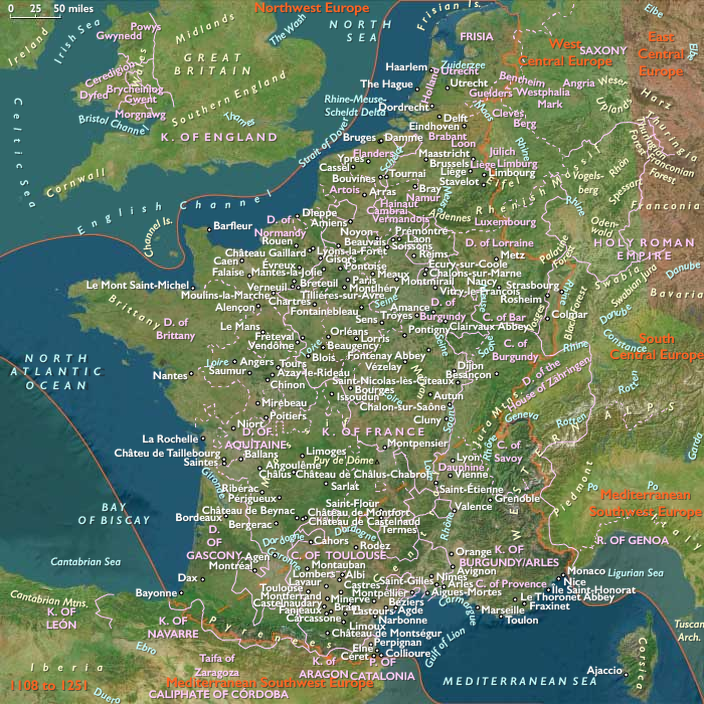
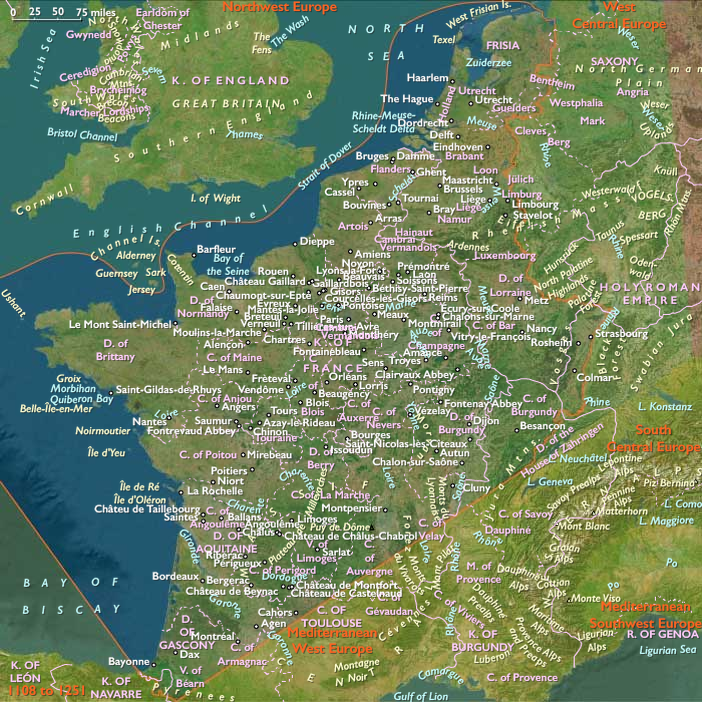
As part of the ongoing civil war in England—known as The Anarchy (1135–1153)—Geoffrey Plantagenet had been actively expanding his control over Normandy, in support of his wife, Empress Matilda, the rightful heir to Henry I of England.
- By January 14, 1144, Geoffrey successfully crossed the Seine and entered Rouen, securing all of Normandy west and south of the river.
- In order to be recognized as Duke of Normandy by Louis VII of France, Geoffrey agreed to cede half of the Vexin to the French king.
At the time, this seemed a strategic success for Louis VII, as the Vexin was a crucial buffer zone between Normandy and the Île-de-France. However, in the long run, this concession would only strengthen Angevin power, setting the stage for the future Plantagenet Empire.
Locations
People
Groups
- Anjou, County of
- Normandy, Duchy of
- France, (Capetian) Kingdom of
- England, (Norman) Kingdom of
- Augustinians, or Order of St. Augustine
Topics
Commodoties
Subjects
Regions
Subregions
Years: 1144 - 1144
January
Locations
People
Groups
- Anjou, County of
- Normandy, Duchy of
- France, (Capetian) Kingdom of
- England, (Norman) Kingdom of
- Augustinians, or Order of St. Augustine
Topics
Commodoties
Subjects
Regions
Subregions