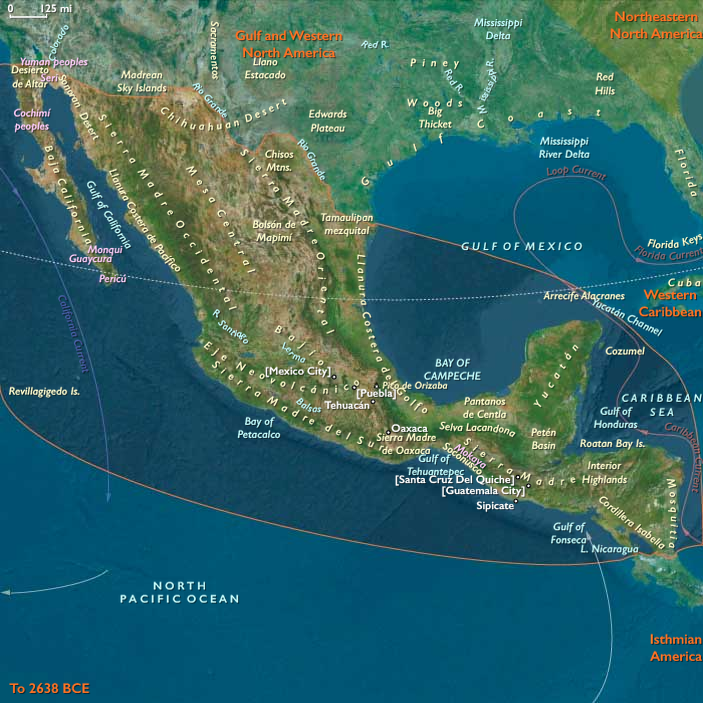
The year 3114 BCE is the mythical …
Years: 3213BCE - 3070BCE
The year 3114 BCE is the mythical starting point of the current Mesoamerican Long Count calendar cycle, according to the most widely accepted correlations between the Western calendar and the calendar systems of pre-Columbian Mesoamerica.
The Long Count calendar, used and refined most notably by the Maya civilization but also attested in some other (earlier) Mesoamerican cultures, consisted of a series of interlocked cycles or periods of day-counts, which mapped out a linear sequence of days from a notional starting point.
The system originated sometime in the Mid- to Late Preclassic period of Mesoamerican chronology, during the latter half of the first millennium BCE.
The starting point of the most commonly used highest-order cycle—the b'ak'tun-cycle consisting of thirteen b'ak'tuns of 144,000 days each—was projected back to an earlier, mythical date.
This date is equivalent to August 11, 3114 BCE in the proleptic Gregorian calendar (or 6 September in the proleptic Julian calendar), using the correlation known as the "Goodman-Martinéz-Thompson (GMT) correlation".
The GMT-correlation is worked out with the Long Count starting date equivalent to the Julian Day Number (JDN) equal to 584283, and is accepted by most Mayanist scholars as providing the best fit with the ethnohistorical data.
Two succeeding dates, the twelfth and thirteenth of August (Gregorian) have also been supported, with the thirteenth (JDN = 584285, the "astronomical" or "Lounsbury" correlation) attracting significant support as according better with astronomical observational data.
Although it is still contended which of these three dates forms the actual starting base of the Long Count, almost all contemporary Mayanists definitively accept the correlation to one of this triad of dates.
All other earlier or later correlation proposals are now discounted.
The end of the thirteenth b'ak'tun is either on December 21 or 23 of 2012.
Related Events
Showing 10 events out of 68717 total
Years: 3213BCE - 3070BCE
Topics
- Subboreal Period during the Neolithic Subpluvial
- Early Bronze Age I (Near and Middle East)
- Piora Oscillation ending the Neolithic Subpluvial
- Subboreal Period
Subjects
Regions
Subregions