
The Muslims of al-Andalus had by 884 …
Years: 897 - 897
The Muslims of al-Andalus had by 884 become increasingly uneasy by the expansion of the Christian counties to the north.
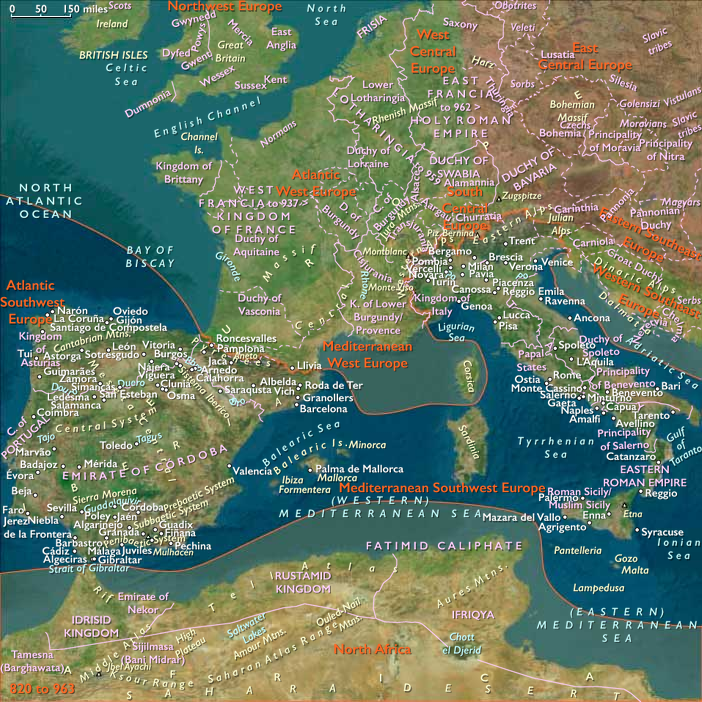
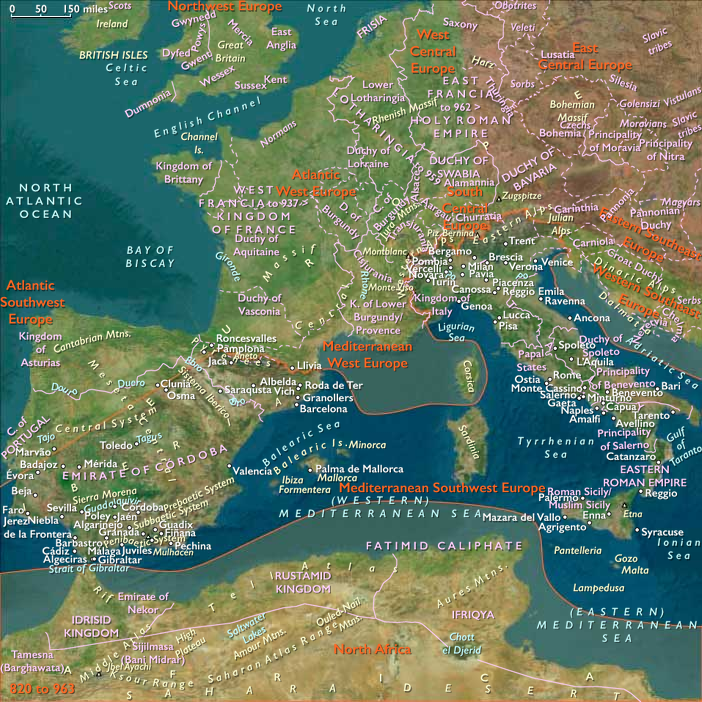
Count Wilfred, called the Hairy, had established defensive positions or castles in Ausona at Cardona, Bergueda, and Vall de Lord; some are even south of the River Llobregat in the Vall de Cervelló.
Essentially the frontiers of Wilfred's counties have now extended too far to remain irrelevant.
The Muslim ruler Ismail ibn Musa ibn Qasi has fortified Lleida in response.
Provoked by this, Wilfred attacks Ismail at Lleida.
The attack, however, is a disaster.
The historian Ibn al Athir describes the massacre of the attackers by the city's defenders.
Buoyed by this success, Ismail's successor Lubb ibn Muhammed ibn Qasi attacks Barcelona in 897.
Wilfred dies in battle on August 11, 897.
He is buried in the monastery at Ripoll.
Wilfred's actions as a Frankish vassal towards carving out his own domain from several counties and moving out of the sphere of influence of the Carolingian crown—coupled with his re-creation of the County of Ausona and the restoration of the Bishopric of Vic—lays out the territorial and patrimonial base for the House of Barcelona.
The weakening of Frankish royal authority in the Hispanic March is principally the result of the establishment of hereditary succession of the counties rather than by choice of the monarch.
In 895, Miró the Old had died and his county of Roussillon had passed, without interference from King Odo, to Sunyer II of Empúries.
In fact, Wilfred the Hairy himself was never confirmed by any monarch as Count of Ausona.
The importance of this development in the Middle Ages cannot be overstated.
As hereditary succession became the custom, it became accepted as law and the kings lost control over the counts.
The counts had become sovereigns in their own dominions.
The lack, however, of a legal basis for inheritance leads to various experiments in hereditary succession.
When Wilfred dies in 897, his counties are divided among his sons.
Wilfred Borrell and Sunyer (oldest and youngest) rule over Barcelona, Girona, and Ausona; Miró over Cerdanya and Conflent; and Sunifred over Urgell.
It is uncertain whether this distribution had been the intention of Wilfred, or a decision eventually reached by the brothers themselves.
Locations
People
Groups
- Christianity, Chalcedonian
- Muslims, Sunni
- Banu Qasi
- Córdoba, Umayyad Emirate of
- Marca Hispanica
- Urgell, County of
- Cerdanya, County of
- Barcelona, County of
- Francia Occidentalis (West Francia, or France), Kingdom of
Topics
Commodoties
Subjects
Regions
Subregions
Years: 897 - 897
Locations
People
Groups
- Christianity, Chalcedonian
- Muslims, Sunni
- Banu Qasi
- Córdoba, Umayyad Emirate of
- Marca Hispanica
- Urgell, County of
- Cerdanya, County of
- Barcelona, County of
- Francia Occidentalis (West Francia, or France), Kingdom of
Topics
Commodoties
Subjects
Regions
Subregions