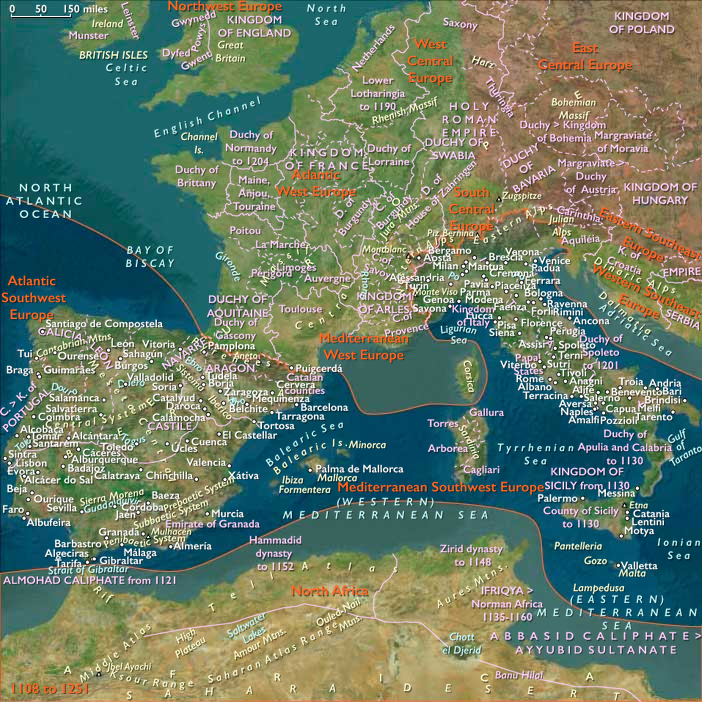
The Muslim rulers of Valencia erect the …
Years: 1150 - 1150
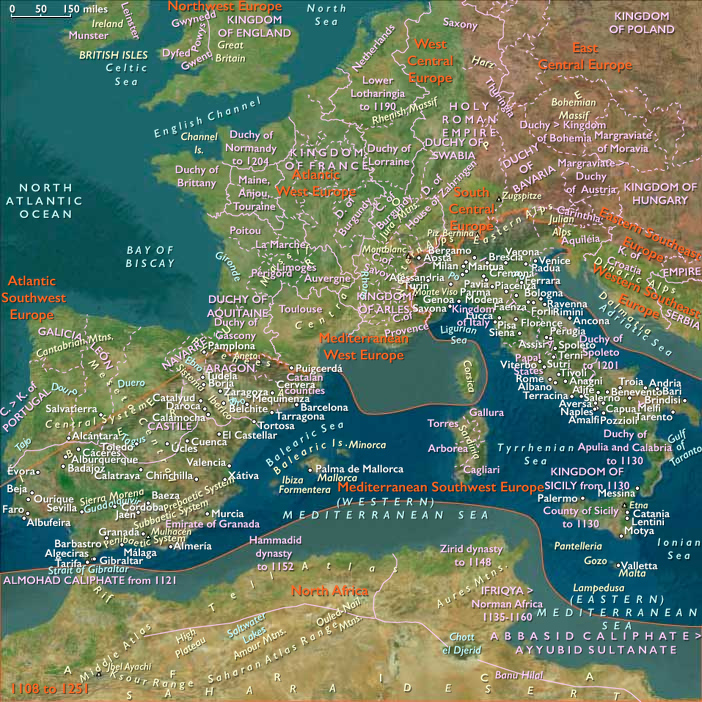
The Muslim rulers of Valencia erect the first European paper mill at Jativa in about 1150.
Locations
Groups
Topics
Commodoties
Subjects
Regions
Subregions
Related Events
Filter results
Showing 10 events out of 48715 total
Suryavarman II has built the colossal (4920 by 4265 feet/1500 by 1300-meters) temple complex known as Angkor Wat during a reign of nearly four decades.
Dedicated to Vishnu, it has been built as the king's state temple and capital city.
The largest monument ever built in the capital, Angkor Wat fills the temple mountain it is meant to emulate, like all Angkor’s previous temple mountains, with three-dimensional images and miles of relief sculpture that cover every inch of available wall space.
According to Guinness World Records, it is the largest religious structure in the world.
Work seems to have come to an end on the king's death around 1150, with some of the bas-reliefs unfinished.
As the best-preserved temple at the site, it is the only one to have remained a significant religious center since its foundation—first Hindu, then Buddhist.
The modern name, Angkor Wat, in use by the sixteenth century, means "City Temple": Angkor is a vernacular form of the word nokor which comes from the Sanskrit word nagara (capital), while wat is the Khmer word for temple.
Prior to this time the temple is known as Preah Pisnulok, after the posthumous title of its founder.
Inscriptional evidence suggests that Suryavarman II died between 1145 and 1150, possibly during a military campaign against Champa.
He is succeeded by Dharanindravarman II, a cousin, son of the brother of the king’s mother.
A period of weak rule and feuding begins.
A final Khmer expedition to Champa in 1150 ends in a disastrous withdrawal.
Jaya Harivarman, as the victor in the Khmer-Cham War of 1144-50, must now deal with several challenges to his authority.
His brother-in-law, Vamasaraja, initiates a rebellion with the support of Cham hill tribes.
Defeated in 1150, he seeks help from Dai Viet, whose ruler sends him five thousand troops, which Vamasaraja leads into battle on the plains of Dalva and Lavang, where he loses to Jaya Harivarman’s forces from Vijaya; the Dai Viet soldiers incur heavy losses.
Suryavarman evidently sends yet another invasion force into Champa in 1150; the Khmer-Cham War ends with the latter’s annihilation.
Kawasaki, adjacent to Tokyo on the north and to Yokohama on the south, is founded in about 1150; it is under the control of the Inage clan.
Emperor Xizong of Jin, who has reigned from 1135 as an emperor of the Jin Dynasty that controls northern China from 1135-1149, is the eldest son of the founder of the Jin Dynasty Wanyan Aguda.
His birth name was Wányán Hélá; his Han Chinese name is Wányán Dǎn.
Although after Aguda's death in 1123 the Jin throne had been inherited by Aguda's brother Wuqimai, Aguda's top general Nianhan and chancellor Xiyin had convinced Wuqimai to declare young Dan his heir apparent in 1132.
Accordingly, Dan had inherited the Jin throne after the death of Wuqimai in 1135.
He is murdered in a coup d'état on Julian calendar day January 9, 1150, by his marshal Wanyan Liang, a son of the influential Wanyan Woben, who in his turn was a son of the dynasty's founder Wanyan Aguda.
As a usurper of the Jin throne, Liàng, who takes the reign name Hailing, is suspicious of other members of the Jurchen aristocracy, and, immediately upon seizing the power, starts assassinating or executing potential rivals.
In a mass execution of several aristocratic families, the lineage of Wanyan Wuqimai is exterminated, to secure the position of the lineage of Wuqimai's brother Aguda, to which Hailing himself belongs.
Hailing, capitalizing on the Jin Empire's being recognized as the "superior" state by other powers of the region after its victory over Song had been formalized in 1141, embarks on a program of making Jin Empire the Chinese Empire.
To legitimize himself as a Chinese ruler, he lifts Wuqimai's prohibition of wearing Chinese dress, and adopted an array of Chinese practices and institutions, such as holding of sacrificial ceremonies in the northern and southern suburbs of his capital.
The reign of Pribislav-Henry, Wendish duke of Brandenburg, over the Hevelli tribe, probably supported by the Ascanians, had started after the murder of the previous prior Hevelli prince Meinfried in 1127.
Around 1129, having no sons of his own, Pribislav-Henry had given the area between Brandenburg and Lehnin to his son-in-law, who is the oldest son of Albert the Bear.
Emperor Lothair III had approved the gift and made Albert margrave of the Northern March in 1134.
After three years of campaigning, diplomatic measures have proven more successful, and by an arrangement made with Pribislav, Albert, after a short war of succession, secures this district when the duke dies childless in 1150.
Albert has colonized the region with German settlers.
The crusade has caused great loss of life among the Wends, and they will consequently offer little opposition to German colonization of the Elbe-Oder region in the following centuries.
(The Wends themselves are enserfed and will be gradually assimilated by the Germans, with the exception of a minority in the traditional region of Lusatia, in present-day eastern Germany, who are today known as Sorbs.)
Mahmud's descendants continue to rule over a gradually diminishing empire until 1150, when 'Ala'-ud-Din Husayn of Ghur, a mountain-locked region in central Afghanistan, sacks and burns Ghazna and expels the last Ghaznavid ruler to India.
The city and region of Pula, at the southern tip of the Istria Peninsula at the head of the Bay of Pula, had been attacked after the fall of the Western Roman Empire by the Ostrogoths, Pula being virtually destroyed in 476 by Odoacer, a Germanic foederati general.
The town was ruled by the Ostrogoths from 493 to 538, and in 540 came under the rule of the Exarchate of Ravenna.
Pula had prospered during this period and become the major port of the imperial fleet and integral part of the East Roman Empire.
The Basilica of Saint Mary Formosa was built in the sixth century.
Following the collapse of the Exarchate of Ravenna in 751, Pula from 788 had been ruled by the Frankish kingdom under Charlemagne, with the introduction of the feudal system.
Pula had then become the seat of the elective counts of Istria until 1077.
Control of the city passes in 1150 to the Venetians, who had taken the town in 1148.
The city's fate and fortunes for centuries hereafter will be tied to those of Venetian power.
The death of Alfonso I, called the Battler or the Warrior, the king of Aragón and Navarre from 1104 until his death in 1134, had led to a succession crisis in Aragon, and the nobles of Navarre had taken advantage to reestablish an independent monarchy, crowning a grandnephew (through an illegitimate brother) of the assassinated Sancho IV.
King García Ramírez, the grandson of Rodrigo Díaz, better known as El Cid, is the son of Ramiro Sánchez of Monzón and Cristina Rodríguez Díaz de Vivar.
Sometime after 1130, but before his succession, García had married Marguerite de l'Aigle, who has borne him a son and successor, Sancho VI, as well as two daughters who have each married kings: the elder, Blanca, born after 1133, has married Sancho III of Castile, while the younger, Margaret, named after her mother, has married William I of Sicily.
García's relationship with his first queen was, however, shaky.
She took on many lovers and showed favoritism to her French relatives.
She had borne a second son named Rodrigo, whom her husband has refused to recognize as his own.
On 24 June 1144, in León, García had married Urraca, called "La Asturiana" (the Asturian), illegitimate daughter of Alfonso VII by Guntroda Pérez, to strengthen his relationship with his overlord.
An ally of Castile in the Reconquista, García has been instrumental in the conquest of Almería in 1147.
In 1146, he had occupied Tauste, which belonged to Aragon, and Alfonso had intervened to mediate a peace between the two kingdoms.
By his marriage to Urraca, García had also become a brother-in-law of Raymond Berengar IV, with whom he had confirmed a peace treaty in 1149.
The count has been promised to García's daughter Blanca while already engaged to Petronilla of Aragon, but García dies on November 21, 1150 in Lorca, near Estella, before the marriage can be carried out.
Buried in the cathedral of Santa María in Pamplona, García is succeeded by his eldest son, leaving one daughter by Urraca: Sancha, who is to marry Gaston V of Béarn.
He leaves a widow in the person of his third wife, Ganfreda López.
His successor, as Sancho VI, is the first to use the title "King of Navarre" as the sole designation of his kingdom, dropping Pamplona out of titular use.

Cistercian monks from Melrose Abbey had established Newbattle Abbey in 1140; the patron was King David I of Scotland (with his son Henry).
A filiation of Melrose Abbey (itself a daughter of the Rievaulx Abbey), Newbattle Abbey is situated, according to Cistercian usage, in a beautiful valley along the River South Esk.
Rudolph, its first abbot, a strict and severe observer of the rule, devotes himself energetically to the erection of proper buildings.
The church, cruciform in shape, is two hundred and forty feet in length, and the other buildings in proportion; for the community numbers at one period as many as eighty monks and seventy lay-brothers.
The abbey had soon became prosperous, and famous for the regularity of its members, several of whom are to become well-known bishops.
The town of Airdrie owes its existence to its location on the 'Hogs Back'—a ridge of land running from east to west.
One very important aspect of the town’s history is the Cisterian presence at Newbattle Abbey, hence a name for the wider area; Monklands.