
Atlantic Southwest Europe (676–819 CE): Fall of …
Years: 676 - 819
Atlantic Southwest Europe (676–819 CE): Fall of the Visigoths, Islamic Invasion, and Rise of the Asturian Kingdom
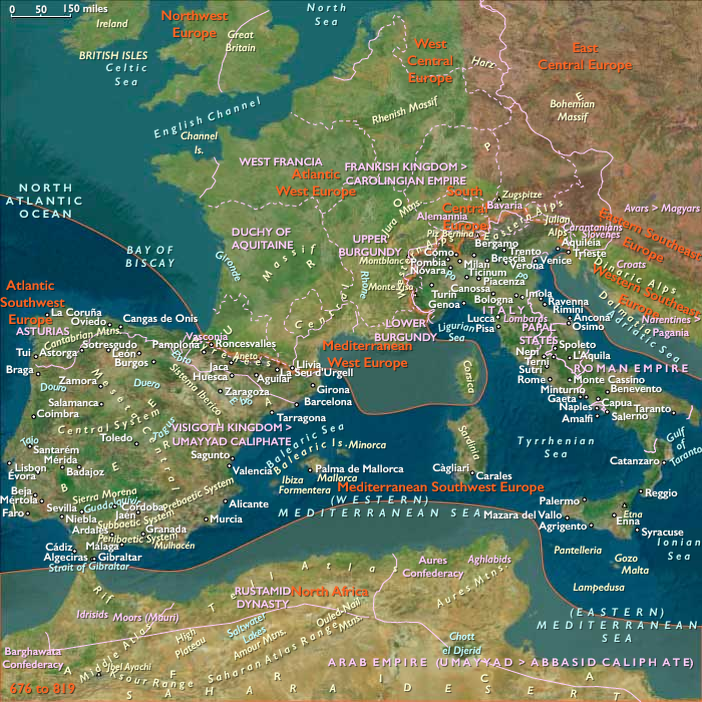
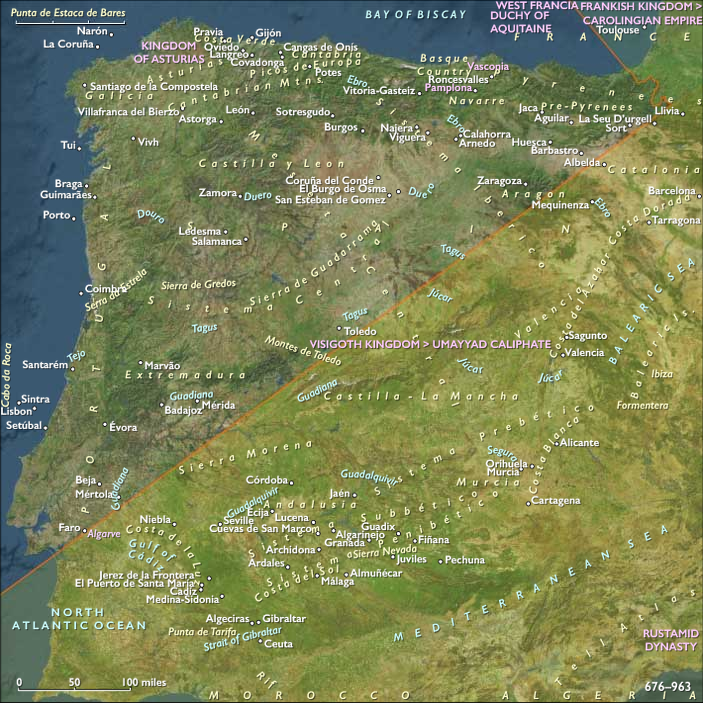
Between 676 and 819 CE, Atlantic Southwest Europe—comprising Galicia, northern and central Portugal, Asturias, Cantabria, and northern Spain south of the Franco-Spanish border (43.05548° N, 1.22924° W)—experienced a profound transformation. The period witnessed the final collapse of Visigothic rule, the dramatic impact of the Islamic conquest of Iberia, and the subsequent rise and consolidation of the Christian Kingdom of Asturias. The region emerged as the resilient heartland of Iberian Christian resistance, characterized by robust local governance, economic stability, distinctive cultural traditions, and strengthened ecclesiastical institutions.
Political and Military Developments
Visigothic Decline and Fragmentation (676–711 CE)
Initially, the region was under weakening Visigothic rule, with increasing internal divisions, aristocratic rivalry, and diminishing royal authority from Toledo. Local aristocrats, especially in Galicia, Asturias, and northern Lusitania, expanded their autonomous power, laying foundations for regional identities independent of central Visigothic governance.
Islamic Conquest and Christian Resistance (711–723 CE)
In 711 CE, Islamic forces decisively defeated the Visigoths at the Battle of Guadalete, rapidly conquering most of Iberia. Atlantic Southwest Europe initially felt significant disruption as Islamic armies occupied southern and central regions, including Emerita Augusta (Mérida) and Olissipo (Lisbon). In the mountainous northwest, resistance swiftly emerged, led by local Visigothic nobles, notably Pelagius (Pelayo). The pivotal Battle of Covadonga (c. 722 CE) symbolically marked the inception of the Asturian kingdom and initiated the centuries-long Reconquista.
Asturian Kingdom Establishment and Consolidation (724–771 CE)
From 724 CE, under Kings Pelagius, Favila, and especially Alfonso I (739–757 CE), Asturias stabilized and expanded territorially. Alfonso I strategically created the "Desert of the Duero," a defensive buffer zone limiting Islamic incursions. Under Fruela I (757–768 CE) and Aurelius (768–774 CE), central authority strengthened, diplomatic alliances were solidified, and regional stability enhanced despite brief internal tensions.
Dynastic Stability and Centralization under Alfonso II (772–819 CE)
After temporary instability following King Silo’s death (783 CE), Alfonso II ("the Chaste," 791–842 CE) decisively restored stability. His long reign firmly centralized royal authority, solidified regional alliances, and reinforced defensive borders against Islamic incursions. Asturias emerged as the undisputed center of Christian resistance, unifying regional aristocrats and ecclesiastical leaders under stable royal governance.
Economic Developments
Resilient and Prosperous Regional Economies
Despite political upheavals, regional economies demonstrated remarkable resilience. Villa-based agriculture (grain, olives, vineyards), livestock farming, artisanal crafts (pottery, textiles, metalwork), and mining—especially gold and silver extraction in Galicia and Asturias—consistently provided economic stability and moderate growth throughout the period.
Steady Maritime and Regional Trade
Coastal settlements, particularly Bracara Augusta (Braga) and smaller ports across Galicia and northern Portugal, maintained consistent maritime trade connections with Atlantic and Mediterranean networks. Although limited, these trade relations were crucial for regional economic continuity.
Cultural and Religious Developments
Increasing Ecclesiastical Influence and Monastic Expansion
Influential bishoprics—Braga, Lugo, Iria Flavia, Asturica Augusta—reinforced civic leadership roles, deeply integrating orthodox Christianity into community governance. Monastic communities expanded significantly, becoming crucial centers of education, cultural preservation, manuscript production, agricultural innovation, and social welfare, strongly shaping regional cultural identity and historical continuity.
Cultural Syncretism and Regional Identity
The persistent fusion of orthodox Christianity with indigenous Celtic and Iberian traditions, particularly in rural Galicia, Asturias, and northern Portugal, profoundly reinforced local identity and unity, providing significant cultural continuity amidst broader political transitions.
Rise of Santiago de Compostela (c. 813 CE)
The reputed discovery of the Apostle Saint James’s tomb dramatically reshaped regional religious and cultural identity. Under Alfonso II, Santiago de Compostela rapidly became a major pilgrimage destination, significantly enhancing regional cohesion, religious unity, and cultural prestige.
Civic Identity and Governance
From Local Autonomy to Asturian Centralization
Initially characterized by decentralized local autonomy amid Visigothic decline, the region transitioned to centralized governance under the Asturian monarchy. Kings Alfonso I, Fruela I, Aurelius, Silo, and especially Alfonso II successfully balanced royal authority with regional autonomy, solidifying a unified Asturian civic identity grounded in shared Christian resistance and ecclesiastical leadership.
Notable Tribal Groups and Settlements
-
Astures and Cantabri: Provided core political and military strength, decisively shaping the emerging Asturian kingdom’s identity and defensive strategies.
-
Galicians and Lusitanians: Maintained pragmatic local governance, economic resilience, and cultural autonomy, cooperating with the emerging Asturian kingdom.
-
Vascones: Retained longstanding political neutrality, cultural distinctiveness, and territorial independence, diplomatically engaging with Asturias but remaining largely insulated from broader regional conflicts.
Long-Term Significance and Legacy
Between 676 and 819 CE, Atlantic Southwest Europe:
-
Witnessed profound political transformations, transitioning from fragmented Visigothic rule through Islamic conquest to stable Asturian governance, firmly establishing a central Iberian Christian kingdom.
-
Maintained resilient regional economies, vibrant cultural traditions, and robust ecclesiastical structures, profoundly influencing the medieval character and trajectory of the region.
-
Initiated the enduring legacy of Santiago de Compostela as a pilgrimage center, decisively shaping religious, cultural, and social dynamics throughout medieval Iberia.
This pivotal era established enduring political, economic, and cultural foundations, significantly shaping Atlantic Southwest Europe’s medieval history and regional identity.

Atlantic Southwest Europe (with civilization) ©2024-26 Electric Prism, Inc. All rights reserved.
People
- Alfonso I of Asturias
- Alfonso II of Asturias
- Aurelius of Asturias
- Fruela I of Asturias
- Pelagius of Asturius
- Silo of Asturias
Groups
- Arab people
- Vascones
- Berber people (also called Amazigh people or Imazighen, "free men", singular Amazigh)
- Lusitanians, or Lusitani
- Jews
- Cantabri (Celtic tribe)
- Astures (Celtic tribe)
- Gallaeci
- Christianity, Chalcedonian
- Tarraconensis (Visigothic province)
- Baetica (Visigothic province)
- Lusitania (Visigothic province)
- Carthaginensis (Visigothic province)
- Visigothic Kingdom of Spain
- Islam
- Umayyad Caliphate (Damascus)
- al-Andalus (Andalusia), Muslim-ruled
- Mozarabs
- Asturias, Kingdom of
- Umayyad Caliphate (Harran)
- Córdoba, Umayyad Emirate of
- Asturias, Kingdom of
Topics
Commodoties
- Weapons
- Domestic animals
- Oils, gums, resins, and waxes
- Grains and produce
- Fibers
- Textiles
- Ceramics
- Strategic metals
- Salt
- Lumber
Subjects
Regions
Subregions
Related Events
Showing 10 events out of 56205 total
Years: 676 - 819
Atlantic Southwest Europe (with civilization) ©2024-26 Electric Prism, Inc. All rights reserved.
People
- Alfonso I of Asturias
- Alfonso II of Asturias
- Aurelius of Asturias
- Fruela I of Asturias
- Pelagius of Asturius
- Silo of Asturias
Groups
- Arab people
- Vascones
- Berber people (also called Amazigh people or Imazighen, "free men", singular Amazigh)
- Lusitanians, or Lusitani
- Jews
- Cantabri (Celtic tribe)
- Astures (Celtic tribe)
- Gallaeci
- Christianity, Chalcedonian
- Tarraconensis (Visigothic province)
- Baetica (Visigothic province)
- Lusitania (Visigothic province)
- Carthaginensis (Visigothic province)
- Visigothic Kingdom of Spain
- Islam
- Umayyad Caliphate (Damascus)
- al-Andalus (Andalusia), Muslim-ruled
- Mozarabs
- Asturias, Kingdom of
- Umayyad Caliphate (Harran)
- Córdoba, Umayyad Emirate of
- Asturias, Kingdom of
Topics
Commodoties
- Weapons
- Domestic animals
- Oils, gums, resins, and waxes
- Grains and produce
- Fibers
- Textiles
- Ceramics
- Strategic metals
- Salt
- Lumber
Subjects
Regions
Subregions